

Friday night offered no shortage of compelling matchups across Northern Virginia. But Woodson against West Potomac drew particular attention—not only for the quality on the field, but for what both programs represent.
Some games are about standings.
Others are about memory.
Woodson is one of those places where history feels close. The field once hosted Pelé, who scored there for the New York Cosmos in a 1976 match against the Washington Diplomats. But Woodson’s deeper story lies in its sustained athletic culture—built over decades by figures such as Red Jenkins, and supported by a community that has long treated sport as something worth doing well.
West Potomac carries a different, but equally rich, inheritance. The school sits on the site of Groveton, which became one of the first in the area to integrate. From that ground came figures like Jimmy Lewis—a pioneering Black athlete and coach whose career would extend from West Virginia to Duke to George Mason, and eventually to the Washington Mystics. When Fort Hunt closed and its students joined Groveton, West Potomac was formed—a school that, over time, has come to reflect the breadth of Northern Virginia itself: large, diverse, and competitive across sports.
That shared sense of lineage gives this matchup weight.
It is reinforced by the men on the touchline. Woodson’s Sean Patrick Burke remains a rarity—a coach who has won state championships on both the boys’ and girls’ sides. Across from him, West Potomac’s CJ Taylor represents a newer model: a younger coach deeply embedded in the modern game, including time with the local professional side Dream FC, recent giant-killers in the U.S. Open Cup. These are not caretakers. They are practitioners.
West Potomac entered as the favorite, having navigated the Patriot District with consistency. Woodson, by contrast, presents differently—physical, athletic, and capable of scoring from a variety of sources. The tension was evident even in warmups.
Woodson began the sharper side. The opening minutes were played largely in West Potomac’s half, the Cavaliers pressing with intent.
Matches, however, are decided by moments, not territory.
West Potomac struck first. Jefferson Martinez broke free down the right, and as the goalkeeper advanced, he lifted a delicate chip over him—an exquisite finish that shifted the tone immediately. Attention had been focused on Josue Diaz, the returning all-region midfielder with international ties to El Salvador. By the end of the night, Martinez had made his own case for prominence.
From there, West Potomac became ruthless—but not without resistance.
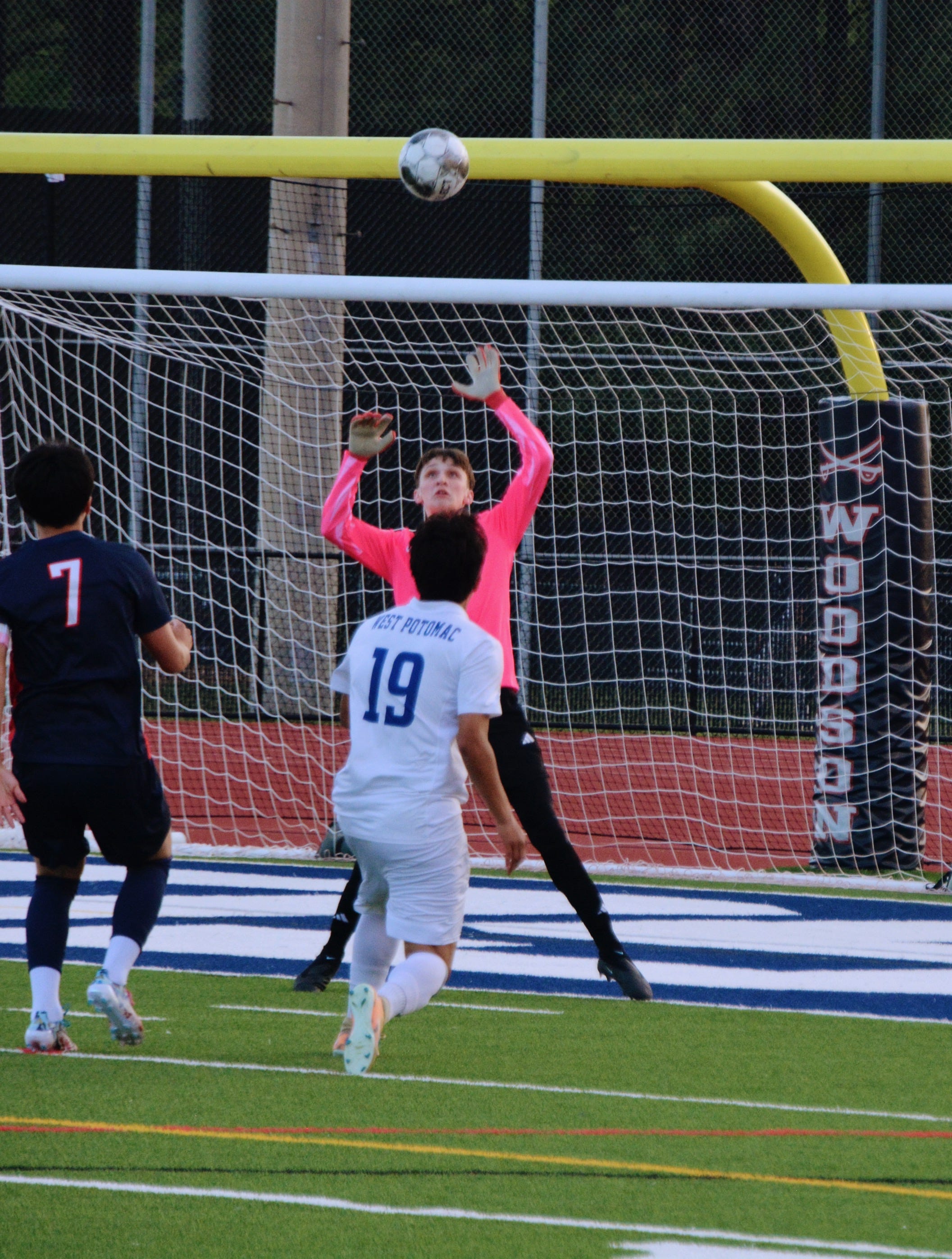
At 1–0, Woodson created a point-blank chance that seemed certain to level the match. Instead, West Potomac goalkeeper Nathaniel Herrmann reacted sharply, parrying the shot to his left to preserve the lead. It was a moment that might otherwise have altered the course of the game. Instead, it steadied the Wolverines.
They surged.
Jack Coulter, commanding at the back and dangerous on set pieces, converted from Jefferson Martinez corner service. After left wing Cameron Bellamy found striker Kai Maxwell-Bundy with a cross on the counterattack, the game had tilted to 3–0—and with it, the margin for error disappeared.
Woodson responded before halftime. Caleb Lee struck from distance, pulling one back and offering a foothold.
The second half brought urgency.
Liyu Samuel combined sharply with Porter Tate, whose finish across goal—high and precise—reduced the margin to 3–2. For a moment, the match reopened.
But West Potomac answered again, and decisively.
Martinez, again the catalyst, reached the right touchline and drove a low ball across goal for a simple Maxwell-Bundy finish. Later, breaking from the opposite side, he cut inside brilliantly and struck the crossbar with force—a reminder that his influence had extended well beyond the opening goal and two assists.
The final score—4–2—felt fair.
West Potomac justified its reputation: balanced, composed, and capable of scoring in multiple ways. Woodson, having lost standout Alex Garrison to William & Mary, still showed the athleticism and attacking variety of a side capable of a postseason run.
At this stage of the season, high school teams are still becoming themselves. Unlike club sides, they are assembled less by design than by circumstance. What matters is how quickly those pieces begin to cohere.
With coaches like Burke and Taylor, that process tends to accelerate.
And on nights like this—under lights, with history close at hand—you can begin to see not just what these teams are, but what they might become.