

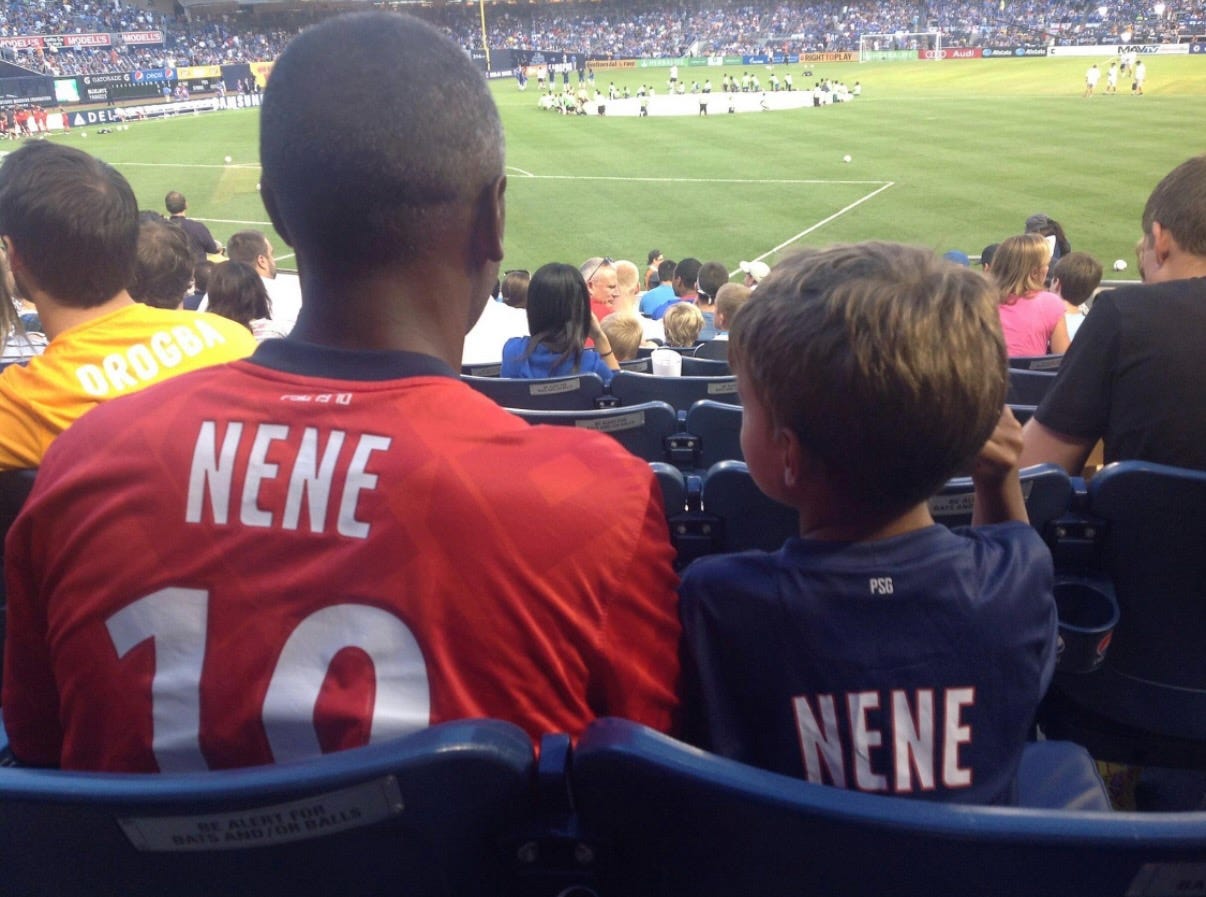
I knew almost nothing about European soccer when my son began playing the game. But as I immersed myself in it, I developed an affection for Paris Saint-Germain, and particularly for a Brazilian winger named Nenê.
Nenê was enjoying a remarkable run of form in the early 2010s, playing soccer with extraordinary flair and imagination. He was inventive, unpredictable, and seemed to regard the game as an opportunity for artistic expression. PSG had other wonderfully interesting players, including the tall, technically gifted midfielder Mathieu Bodmer and the brilliant playmaker Stéphane Sessègnon. They were a quirky, entertaining collection, and I became a supporter. Even the club’s name, joining Paris with the smaller town of Saint-Germain-en-Laye, added to its mystique.
Then came the money.
PSG acquired wealthy Middle Eastern ownership, and with it arrived Zlatan Ibrahimović and an assortment of international stars. Nenê, Bodmer, and Sessègnon soon departed. The club became considerably more successful, but also less interesting to me.
Even the supporters stopped fighting one another at the Parc des Princes.
I stopped following PSG.
My relationship with the Pittsburgh Steelers is considerably older. I became a fan in 1972, watching Franco Harris sprint through opposing defenses with a combination of power and grace. That season ended with the Immaculate Reception, and things only improved. Over the following decade, the Steelers won four Super Bowls and assembled one of the most celebrated collections of players in NFL history.
It was an extraordinarily fortunate time to become a fan.
Before this season, the Steelers have had only three head coaches during my lifetime as a supporter, and I’ve liked all three. I’ve also admired the Rooney family, whose stewardship has given the franchise an unusual sense of continuity.
Mike Tomlin won a Super Bowl early in his tenure and has remained a successful coach. But as the years passed, Steelers fans became increasingly impatient. Winning seasons and consistent playoff appearances were no longer enough. The team was good, but seldom good enough to threaten for a championship.
I understand the frustration. I would enjoy another Super Bowl myself.
But I liked Tomlin. I liked that he cared about his players, his team, and the institution he represents. I liked the continuity. I was fine "struggling" with my guys.
My affection for Arsenal developed for similar reasons.
I was immediately drawn to Arsène Wenger, the club’s dignified, innovative French manager. Wenger assembled wonderfully diverse teams and encouraged a style of soccer that was imaginative, fluid, and beautiful to watch.
Arsenal did not always win championships, but it played soccer that made me want to watch.
Eventually, that was no longer sufficient for many supporters. Second or third place became a source of dissatisfaction rather than evidence of sustained excellence. Wenger, who had done so much to define the club’s modern identity, eventually departed.
Under the talented young manager Mikel Arteta, Arsenal has again become a formidable force, winning the Premier League. But its soccer has sometimes seemed more calculated, more physical, and less enchanting than the game that first attracted me to the club.
I want Arsenal to win, of course. But I would prefer that it win playing the kind of soccer that made me an Arsenal supporter in the first place.
Which brings me to a question that may sound peculiar coming from someone who has spent much of his life watching competitive sports.
Why must we win?
Fans want to win. They buy tickets, purchase merchandise, and invest considerable time and emotion in their teams. Owners need fans, and winning is generally the surest way to keep them happy.
But sometimes, in the pursuit of winning, we lose the very things that made us supporters in the first place.
I loved PSG for Nenê, Arsenal for Wenger, and the Steelers for Franco Harris and the Rooneys. Championships were wonderful, but they weren’t why I signed up.
I want my teams to win. I just want to recognize them when they do.