

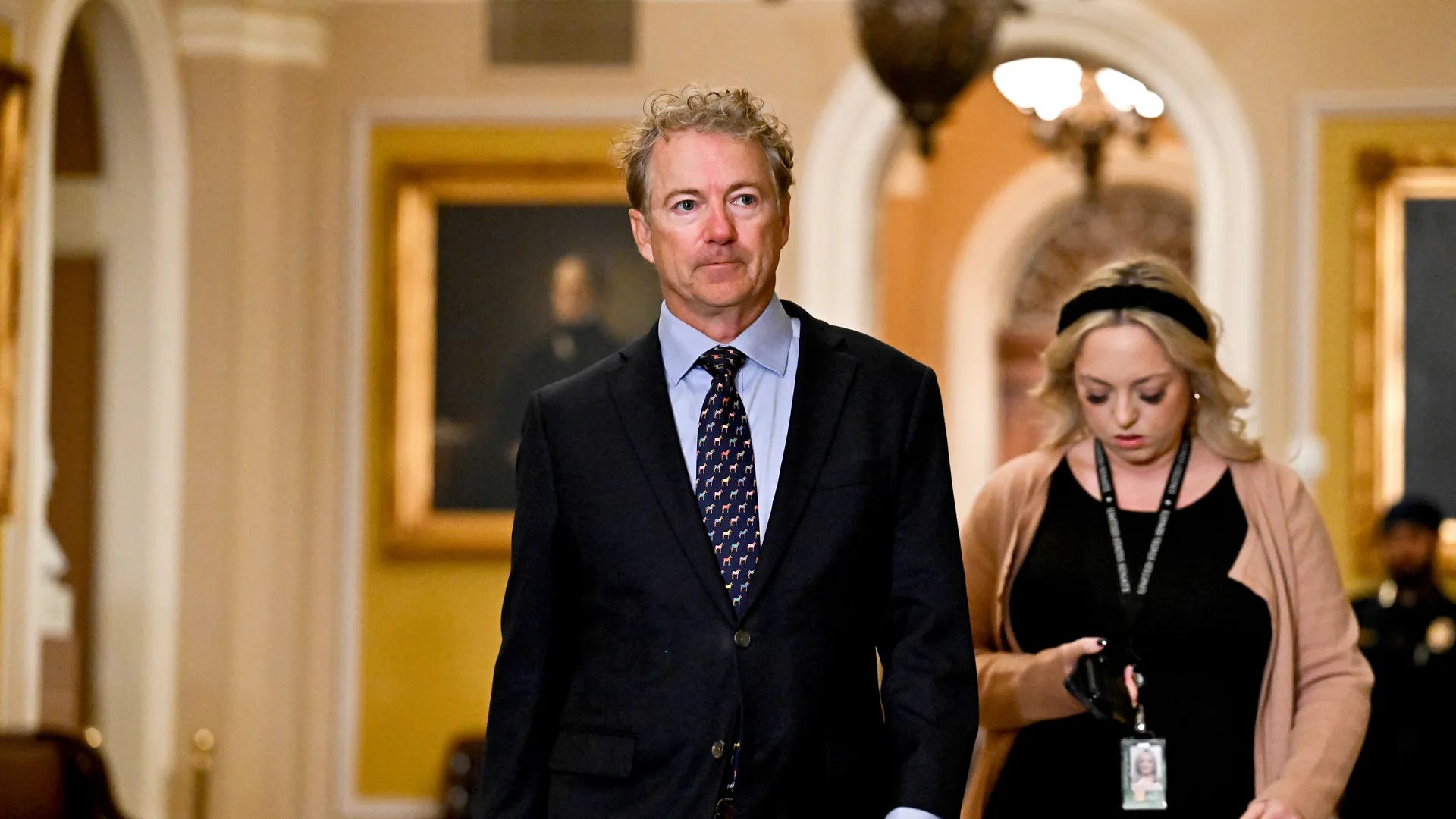
Several years ago, Rand Paul was attacked by a neighbor after what was apparently an epic dispute over landscaping. The assault was indefensible and left the senator seriously injured. Still, the sheer absurdity of a neighbor becoming so exasperated with Rand Paul that the dispute ended up in federal court seemed somehow consistent with the public figure we had come to know.
Rand has always been a complicated figure.
His father, Ron Paul, served for many years in the House and became one of the most recognizable voices in the libertarian movement. He frustrated nearly everyone, but he was consistent to the point of asceticism: the federal government should act only in rare circumstances, and almost never beyond them. If Ron Paul had a defining trait, it was that he never trimmed his sails.
Could Rand be Ron? In theory, yes. In practice, no. Ron’s most faithful political heir may have been Thomas Massie, whose almost pathological consistency recently cost him his seat. Trump targeted him for defeat, and Republican voters obliged. Bravery and principle are admirable. They can also cost you your job.
Rand picks his spots.
He kicks the tires on nearly every military intervention. He may not lead the opposition to masked federal agents, but he will grill administration officials, demand information, hold up a nominee, and make it unmistakably clear when he thinks government power has gone too far. He remains a reliable anti–big government vote, though he is not his father.
Or perhaps he is his father — but one who intends to remain in the Senate.
He may want Ron Paul’s philosophy while keeping Rand Paul’s career.
It is easy to admire Ron’s purity. It is harder to determine how much that purity accomplished. He spent decades as a lonely House member whose vote was often symbolic. A vote cast alone may be principled, but it is still a vote cast alone.
Rand seems to want the libertarian impulse without the libertarian isolation. His compromises keep him in the room — questioning nominees, exercising committee power, and occasionally possessing enough leverage that an administration has to listen.
Perhaps that is accommodation.
Perhaps it is politics.
And Thomas Massie provides an uncomfortable comparison. He demonstrated what political independence looks like when carried nearly to its logical conclusion. He repeatedly defied his own party and president, even when doing so threatened his career. Eventually, it did.
Rand watched all of this from the Senate.
So who is Rand Paul?
Do we even like him? Does it matter? Even if we find libertarianism eccentric, are some of its instincts — skepticism of war, concentrated federal power, surveillance, debt — particularly useful at a moment when government power itself deserves more scrutiny?
Ron Paul offered purity. Thomas Massie demonstrated its price. Rand Paul has chosen something messier: principle tempered by self-preservation.
Maybe that makes him less courageous.
Maybe it makes him more useful.
These are complicated times, and Rand is a complicated person.