

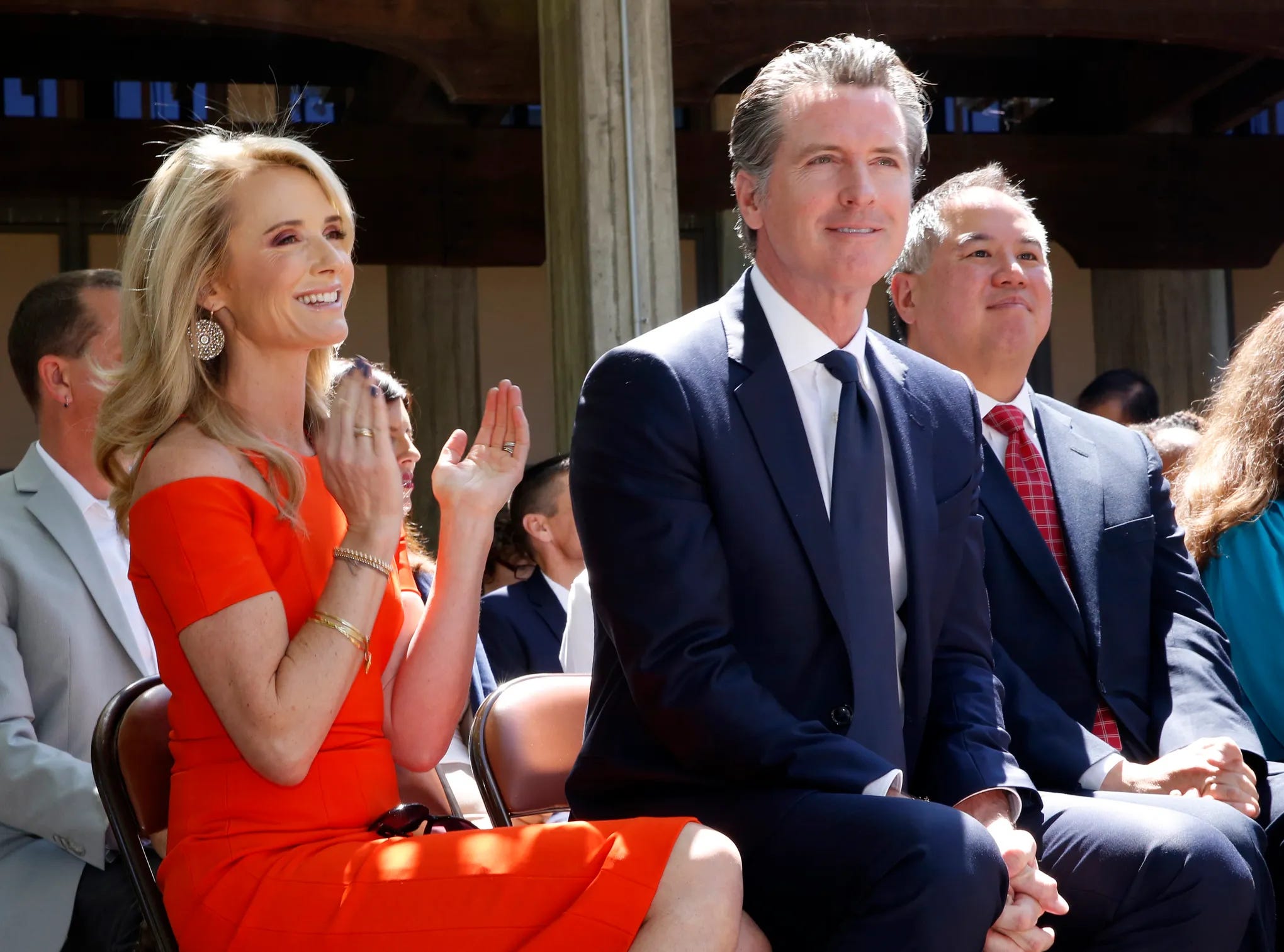
At a moment when courts are weighing a $1.7‑billion fund tied to alleged political weaponization, the news arrives that the wife of California governor Gavin Newsom is under federal investigation for tax fraud. It has become almost cliché to say we are living through a dangerous moment, but structurally — constitutionally — the description fits. Newsom is widely viewed as a leading contender for the Democratic nomination in 2028. An investigation of this sort, if misused, becomes less a matter of law and more a lever of political advantage for the incumbent administration or its allies.
Politics has always had its share of “dirty tricks.” The era of Kennedy and Nixon debating the future of the country on a stage now feels almost quaint. Opposition research and aggressive media scrutiny are part of the modern campaign ecosystem, and one can argue that some of it serves a public purpose: voters deserve to know whether a candidate’s personal conduct reflects the judgment required for office.
But when the Department of Justice is involved, the stakes change. An incumbent president commands vast investigative resources. If those tools are used — or merely perceived as used — to weaken or eliminate political opponents, the system begins to tilt. Whatever the allegations, an investigation of this nature requires clarity and transparency, not to shield Mrs. Newsom from embarrassment, but to protect the legitimacy of the political process itself.
We once assumed that constitutional design would restrain excess. Checks and balances. Independent courts. A Justice Department insulated from political pressure. Yet recent years have shown how much depends on norms rather than rules, and how easily norms can be bent by a determined executive.
If we ever return to something resembling institutional “normalcy,” the question will be whether we have the will to reinforce the guardrails. Will we create clearer statutory limits on presidential influence over federal investigations? Will we define more explicitly what constitutes a conflict of interest? Will we insist on structural reforms that prevent the appearance — let alone the reality — of political prosecutions?
These are not partisan questions. They are constitutional ones. And they go to the heart of whether the system can function when the executive branch commands both the megaphone and the machinery of enforcement.
One hopes it is not too late to insist on clarity — not for the sake of any one politician, but for the sake of the republic that must endure long after them.