

There are moments when Republicans seem to speak with genuine dignity and conviction about reducing government spending.
Ronald Reagan warned of the bloat and overreach of Washington. Newt Gingrich and the Contract with America promised a dramatic rollback of federal excess. The Tea Party movement rose on a wave of anger over deficits and debt. And in the second Trump administration, the creation of DOGE — the Department of Government Efficiency — was presented as the long-awaited instrument that would finally bring the axe to bureaucracy and restore fiscal discipline.
The rhetoric was familiar. The resolve sounded unmistakable.
But history suggests a recurring pattern: the determination to reduce spending often fades once the party making the promise holds power.
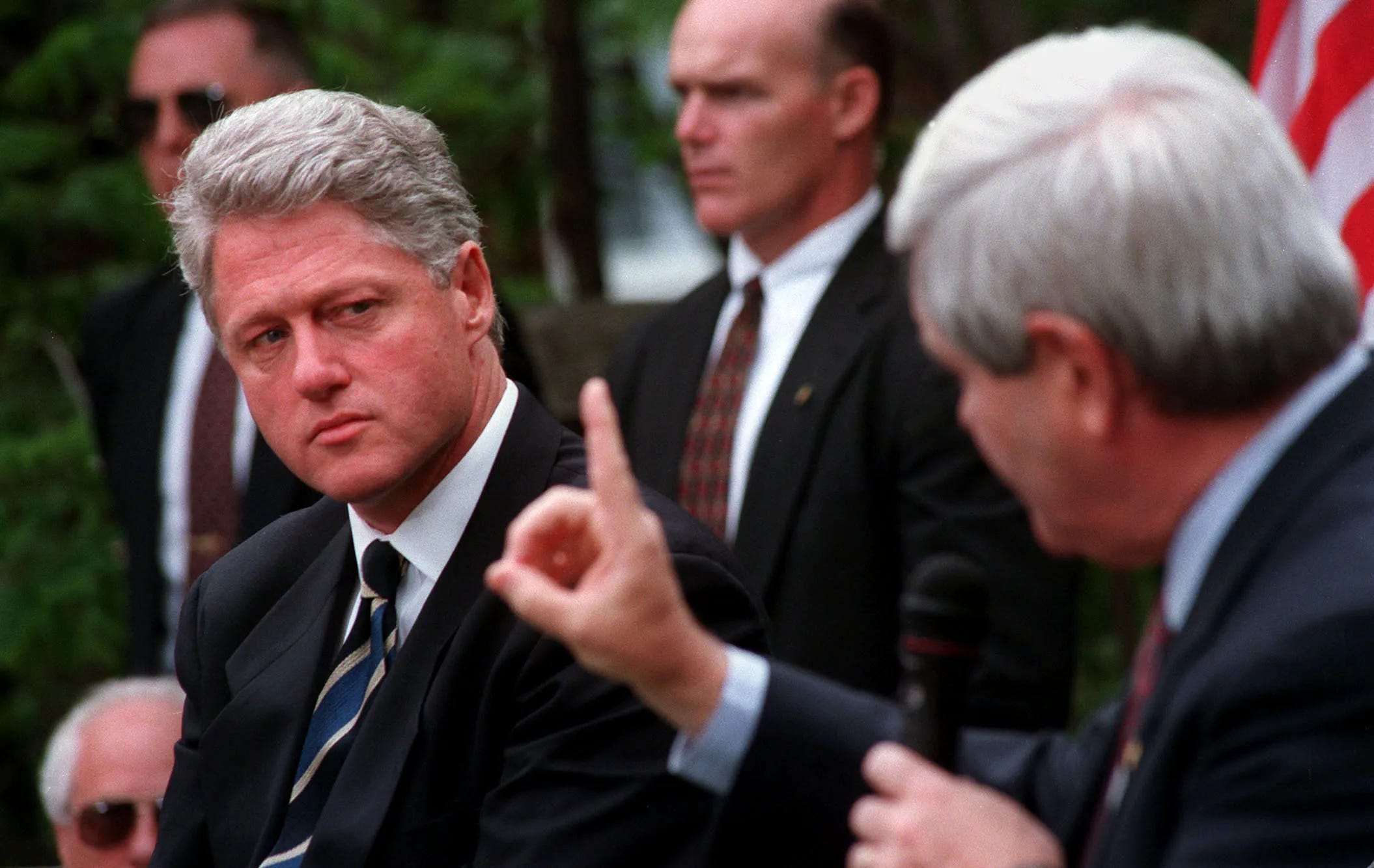
Reagan presided over a dramatic expansion of federal deficits during the 1980s. After the Clinton–Gingrich budget agreements briefly brought deficits under control in the late 1990s, Vice President Dick Cheney famously remarked that “Reagan proved deficits don’t matter.” The comment was less an economic theory than a political observation: deficits rarely punish those who run them.
And after years of Tea Party criticism directed at the spending of the Obama and Biden administrations, the current administration’s own fiscal choices have been striking.
DOGE made headlines early by firing thousands of federal employees and canceling contracts in the name of efficiency. The effort was presented as a crusade against government waste, and for a moment it appeared the administration was serious about austerity.
But the broader fiscal picture tells a different story.
The United States now finds itself engaged in a costly military confrontation with Iran — a conflict that is consuming vast resources while the administration has yet to clearly articulate the objective of the war, the strategy for achieving it, or the conditions under which victory would be declared.
At the same time, the government is offering signing bonuses reportedly approaching $50,000 to recruit new ICE officers as part of an expanded enforcement effort.
And federal funds are being directed toward high-profile construction and ceremonial projects, including a large ballroom addition to the White House complex tied to the nation’s upcoming 250th anniversary celebrations.
Each of these decisions may have defenders on its own terms. But taken together they do not resemble a government seized by austerity.
One does not need to oppose government in principle to recognize the contradiction.
Reducing deficits is not merely an ideological exercise. It has practical consequences: a more manageable national debt, lower borrowing costs, and a government that can operate with greater efficiency and public trust.
For decades, Republican leaders have argued that these goals justify difficult choices. That argument deserves to be taken seriously.
But seriousness requires consistency.
Fiscal restraint cannot be a campaign language and a governing afterthought. If the party that most passionately warns of runaway spending does not demonstrate discipline when it governs, then the axe becomes less a tool of reform than a prop in a familiar political performance.
And when the nation’s debt continues to climb while the speeches about austerity grow ever more eloquent, one begins to suspect that the axe was never meant to swing — only to be admired from a safe political distance.