

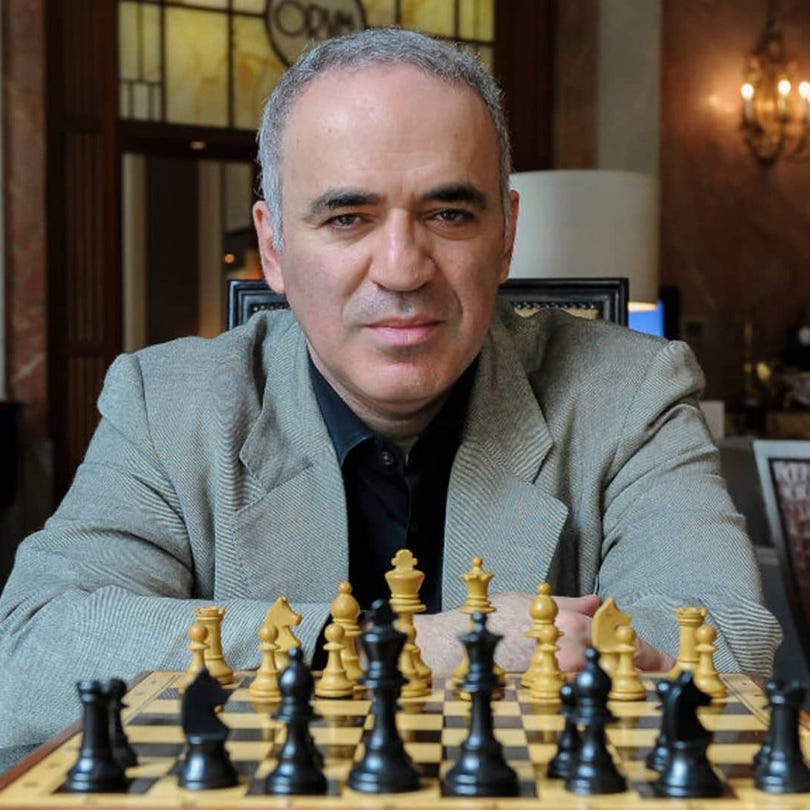
The great chess champion Garry Kasparov appeared this weekend with Charlie Rose to discuss the geopolitics surrounding Iran.
Kasparov has become one of the world’s most articulate defenders of liberal democracy. Few public figures speak more forcefully about the dangers of authoritarianism. And beyond his politics, he remains one of the most formidable strategic thinkers alive.
Which is why one moment in the conversation stopped me cold.
Kasparov told Rose that he knows people inside Iran and that the current conflict could ultimately produce a positive result.
It was a striking claim.
Chess champions are trained to see several moves ahead. Their craft requires imagining consequences invisible to the rest of us — the third move, the fourth move, the quiet repositioning that determines the endgame long before it appears on the board.
But the suggestion that an American-Israeli victory in Iran would naturally produce a healthy democratic outcome raises obvious questions.
Suppose the Iranian regime collapses or surrenders.
What happens next?
Democracy is difficult even under favorable conditions. The United States itself is showing signs of strain. Donald Trump boasts about bending media institutions to his will while Congress hesitates, corporations adapt, and courts move cautiously. Masked federal agents operated in Minneapolis for weeks, in an environment marked by fear, disruption, and deadly encounters with civilians.
If the oldest modern democracy can appear this fragile, the challenge facing a country with little democratic tradition is obvious.
Transitions rarely proceed neatly.
Venezuela offers a recent example. The United States captured President Nicolás Maduro in a dramatic operation two months ago, yet the Venezuelan state itself remained largely intact. Vice President Delcy Rodríguez assumed leadership while much of the governing structure — including the security apparatus — endured.
Removing a leader, it turns out, is not the same thing as building a democracy.
That distinction matters more than it first appears.
More troubling still is the question of whether outside powers would actually permit genuine independence to emerge. In Gaza, military victory has not produced a clear path toward Palestinian self-government. Instead there has been open discussion of externally shaped arrangements and population displacement proposals — raising the obvious question of what “liberation” would mean if it arrives only under foreign management.
If Iran’s government were to collapse, would the outcome truly be Iranian self-government?
Or something more carefully managed from abroad?
For all the Iranian regime’s faults — and they are considerable — it also serves as a regional counterweight to the ambitions of leaders like Benjamin Netanyahu and Donald Trump. Remove that counterweight and the regional balance shifts in ways that are difficult to predict.
Is it optimal to have a Middle East composed entirely of governments aligned with Washington and Jerusalem?
Some of those governments are not democracies at all. Strategic alignments often ignore such contradictions.
Still, the question remains.
When someone as intelligent and principled as Kasparov reaches a conclusion that feels off, the response is not immediate dismissal. It is doubt — about one’s own judgment as much as his.
Perhaps he sees moves on the board that others cannot yet see.
Or perhaps this is simply one of those moments in world politics when even the smartest observers struggle to impose order on events that refuse to behave logically.
Chess rewards foresight. Politics punishes certainty.
The uncomfortable truth is that international politics often produces exactly that kind of puzzle.
And unlike chess, the pieces on this board are human lives.