

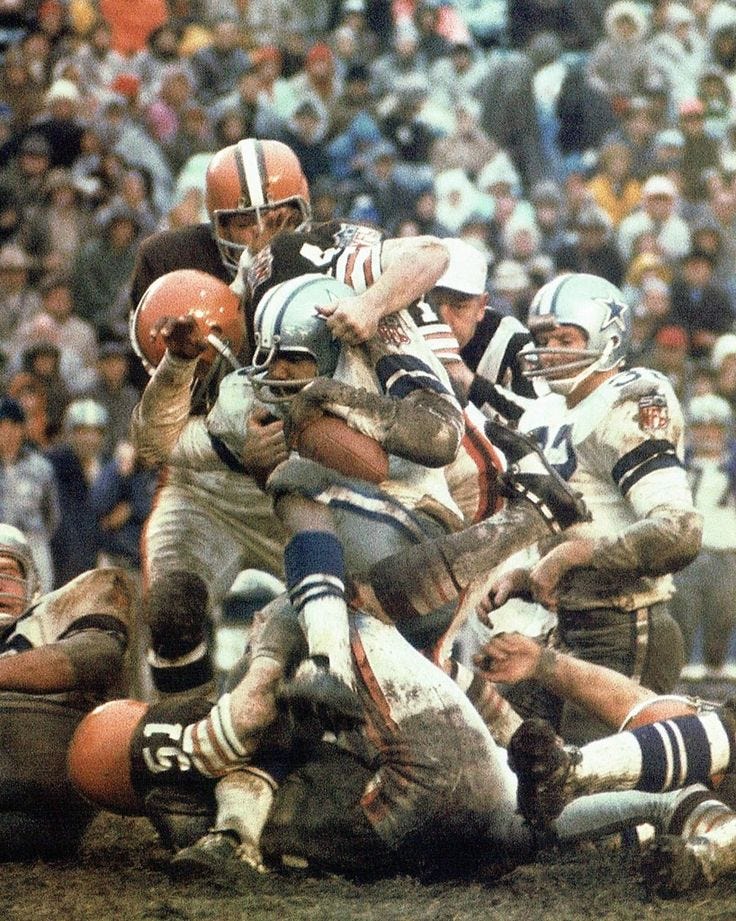
There was a time when Sunday afternoons were sacred.
Between 1:00 and 7:00 Eastern, we watched NFL football. It was an appointment, not an option. Fourteen games, no scheduled bye weeks, the whole league moving in sync. If your team lived in your time zone, you knew your kickoff. If it was a marquee matchup or a trip west, you might earn the rare 4:00 slot — the kind of game you simply didn’t miss.
And if your team wasn’t playing Sunday, it was playing in front of Howard, Giff and Dandy on Monday Night Football. My bedtime was halftime.
Thanksgiving felt like a national indulgence: turkey, family, and the Detroit–Dallas doubleheader. The holiday mattered, but the football mattered too. Two games in one day felt almost extravagant.
Sundays themselves had a rhythm. Church — preferably early. Then the long glide toward kickoff: The McLaughlin Group, Meet the Press, and especially the replay of Notre Dame’s Saturday game with Lindsay Nelson’s unmistakable narration. By 12:30, NFL Today or NFL ’78 carried you the rest of the way.
Scarcity created anticipation.
You didn’t need to consume football continuously because you knew exactly when it was coming. The pregame shows mattered because there wasn’t another game waiting on another screen. Monday Night Football mattered because it was the only game in America. Thanksgiving mattered because abundance was unusual.
We can’t go back, and in many ways we shouldn’t want to.
Now we have Sunday night football, Thursday night football, an 18‑week regular season, expanded playoffs, international games, season passes, tickers, sports bars, and a business model that demands more content, more revenue, more everything.
The accessibility is extraordinary.
No more blackouts. No more hoping your out‑of‑market team sneaks onto the broadcast. Living in Washington, a Falcons fan can watch every snap. Fifty years ago, that would have seemed miraculous.
But what we gained in access, we lost in scarcity.
Last Sunday, the Cowboys and Ravens played in Rio. The game was still on television here, of course — which almost makes the point. Two of the league’s most recognizable franchises could move a regular‑season game thousands of miles away, and the great NFL machine barely noticed. Sunday simply rolled along.
Fifty years ago, taking a Cowboys home game out of Dallas would have seemed unimaginable. Today, there is always another game. Another window. Another night. Another platform. Another week.
Nothing has disappeared. There is simply so much of everything that almost nothing has to be missed.
And perhaps that is what has changed most.
We gained access. We gained choice. We gained the ability to watch almost any team, almost anywhere, almost anytime.
What we lost was the feeling that we had to be there.