

McFarland, USA is frequently described as a Latino version of Hoosiers. But the differences are more revealing than the similarities. Instead of 1950s Indiana farmland and basketball, we are in 1970s California, near Bakersfield, where the sport is cross country. In Hoosiers, the players largely come from stable, middle-class families. In McFarland, they are the children of poor Mexican immigrant farmworkers.
And yet, in both films, a state title run binds a community together.
Hoosiers is often remembered as a portrait of a certain postwar American ideal—small towns, modest prosperity, citizen farmers, and local businesses. It is, in its way, a vision of America at ease with itself—at least on the surface.
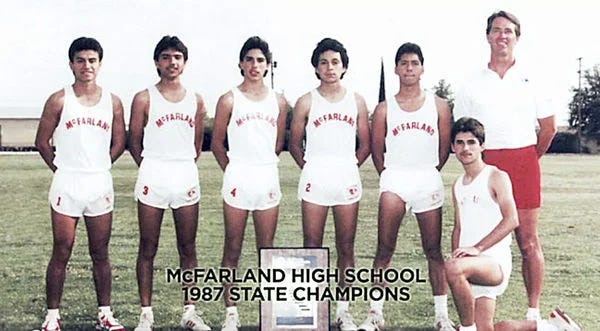
McFarland, by contrast, presents a harder landscape. These are families in which every member must work, often in the fields, simply to make ends meet. The idea of participating in a high school sport is not merely impractical—it is, at first glance, indulgent. And yet, through the vision of coach Jim White, these boys—who run everywhere out of necessity—become runners by design. The result is not only a championship, but something more enduring: every one of them finishes high school, and every one goes on to college.
There is also a telling difference in what lies beyond the final whistle.
Hoosiers, though inspired by the real Milan team, carries an undercurrent of departure. Characters speak, sometimes quietly and sometimes plainly, of leaving Hickory. Barbara Hershey’s character resists Jimmy Chitwood’s return to basketball in part because it threatens his chance to “get out.” In a deleted scene—cut, perhaps for pacing rather than truth—she tells Gene Hackman’s coach that she intends to leave for Chicago to pursue her own future. We celebrate Hickory, but the characters, more often than not, look beyond it.
That instinct is not unfamiliar. My own mother grew up some 140 miles east of Milan, near a town much like it, and most eventually left—save those anchored by land or family enterprise.
McFarland offers a different ending. In its epilogue, we meet the real runners. All but one have returned home. They are teachers, counselors, police officers, veterans—men who, by any reasonable measure, have succeeded. They still run with the current team. They have not remained for lack of opportunity, but by choice.
They did not long for something better elsewhere.
They went home.
And in that choice—quiet, unadorned, and deeply rooted—there is another, quieter vision of what it means for America to be great.