

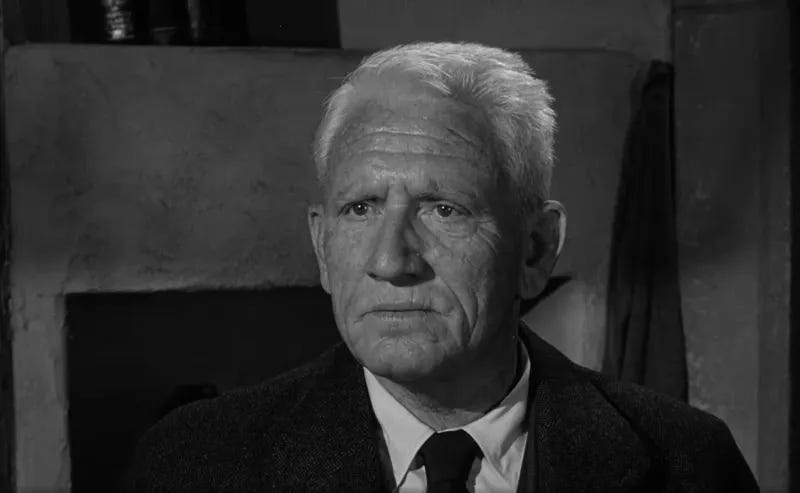
In Judgment at Nuremberg, Spencer Tracy’s judge asks the servants in the house he rents what they knew about the treatment of Jews and the collapse of German democracy.
“Of course we didn’t know,” one replies. “But even if we did, what could we have done?”
She sounds sincere. Even convincing. And yet the weight of the question lingers.
It is probably fair to say that Germans carried this guilt for generations—not only those directly involved militarily, politically, or economically, but those who were not. This was not because they were uniquely cruel, but because they were ordinary. Could they have done more? Why didn’t they?
Historical analogies are always imperfect, and often abused. Americans are often warned not to compare ourselves to 1930s Germany, the analogy said to be inflammatory, unfair, or historically reckless. Perhaps the better comparison is Italy, or Hungary, or something altogether new. But that objection relies heavily on hindsight. Germans in the early 1930s did not know where things would end. Even with Mein Kampf in print, few imagined the scale, efficiency, or horror that followed. They knew bad things were happening. They did not know how bad.
That is usually how it works.
Which brings us to the present.
Buried beneath louder headlines are plans to build hundreds of facilities around the country to house people taken in immigration raids—some on military bases, others in repurposed commercial buildings near highways and airports. There is little public discussion of conditions. Of healthcare. Of education for children. Of access to lawyers. Of who is responsible for ensuring these places are humane, accountable, and temporary.
That these questions are not being asked should trouble us.
History rarely asks people to predict outcomes. It asks only whether they recognized the direction of travel.
If I am driving a truckload of human beings to a warehouse without windows, am I supposed to ask questions?
If I work inside that warehouse and the treatment is harsh, do I keep my job?
If I am told to check accents in a parking lot and ask for papers, do I know what comes next?
No one in those positions will know the full extent of what follows. But no one ever does.
America has long believed—sometimes rightly, sometimes not—that for all its failures it is a force for good. We point to winning world wars, to civil rights, to the long, uneven expansion of freedom. That belief has sustained us through darker chapters. But it also carries an obligation.
If we are authorizing this—through silence, indifference, or bureaucratic obedience—then responsibility does not rest only at the top. It begins lower down, where ordinary decisions are made and justified as temporary, necessary, or not our concern.
The most enduring question is not whether people knew everything. It is whether they knew enough.
And whether, when the moment arrived, they asked themselves what was being done in their name—and what they were prepared to live with afterward.