

World War I was a conflict in which many of the men fighting had more in common with the soldier across the trench than with the leaders who sent them there.
The old European order still lingered. Nations were governed largely by elites, and royal families were joined by extraordinary webs of blood and marriage. The British king, the German kaiser and the Russian tsar were relatives. The men fighting beneath them were more likely to come from farms, factories and mines.
As the war dragged on, moments of fraternization emerged — most famously during the Christmas Truce of 1914. British and German soldiers climbed from their trenches, exchanged cigarettes and small gifts, sang songs and, in some places, met in the no‑man’s‑land they had spent months trying to cross with rifles.
Military authorities understood the danger.
The enemy needed to remain the enemy. It becomes considerably more difficult to shoot a man once you have discovered that he has a wife, worries about money, misses his children and would rather be home too.
The trenches presented an uncomfortable question.
What did these men actually have in common with the people directing the war?
And what did they have in common with the men on the other side?
Nearly a century later, John McCain offered an answer I have always admired.
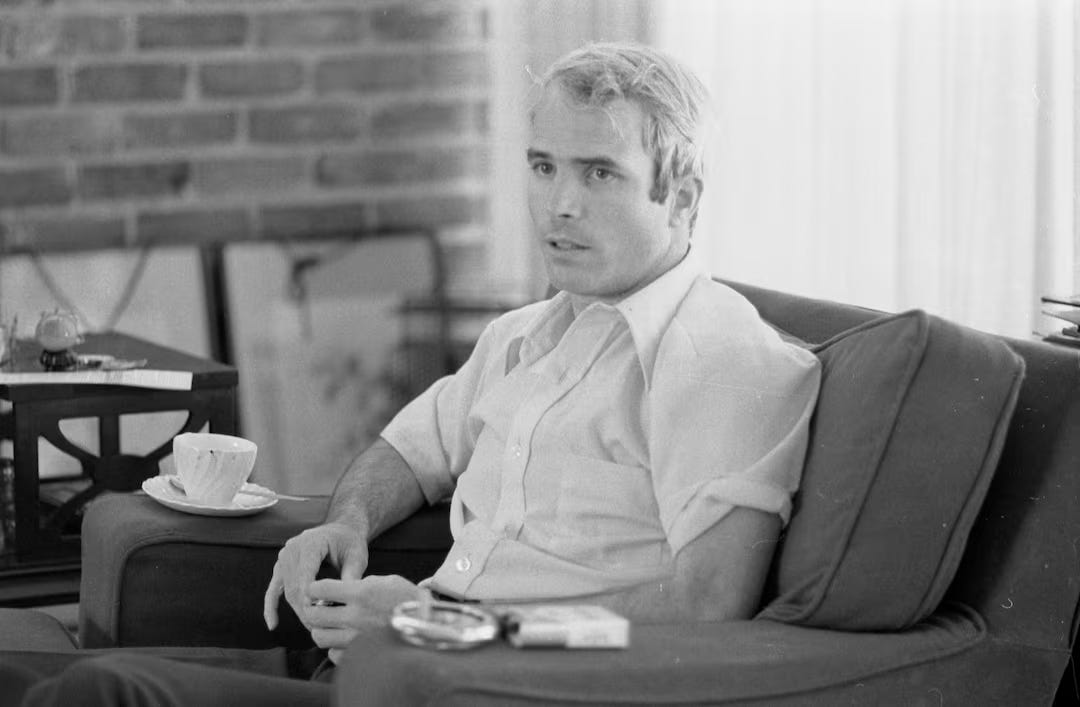
After losing the 2008 presidential election to Barack Obama, McCain stood before his supporters and reminded them that the election had settled something. Obama had won. He would be their president too.
“Whatever our differences, we are fellow Americans,” McCain said. “And please believe me when I say no association has ever meant more to me than that.”
McCain had earned the right to say it. As a prisoner in North Vietnam, he was offered early release after his captors learned that his father was a senior American admiral. He refused to leave ahead of prisoners captured before him. He remained imprisoned and endured years more of brutality.
His loyalty to other Americans was not abstract.
It was lived.
I have always wanted to believe in McCain’s conception of country.
Lately I have begun to wonder whether I still do.
The difficulty is not simply Donald Trump.
The United States has now elected him president twice. He may be the cause of some of what has happened to American political culture. He may be the result of it. Almost certainly, the relationship runs in both directions.
But that distinction can also become a way of avoiding an uncomfortable fact.
Trump did not elect himself.
Americans did.
And elections reveal something about us.
Trump has hardly concealed his conception of power. He has spoken of the Western Hemisphere as an area in which the United States may use its military strength to secure what he considers its interests. He has threatened Iran with annihilation. He has attacked international institutions that might constrain American action. His administration has embraced tariffs, aggressive immigration enforcement and a conception of presidential authority that places enormous weight upon the judgment of the president himself.
These are not stray remarks from a candidate trying to get elected.
They are ideas being put into practice by a government that was elected.
Perhaps Trump persuaded Americans to accept them.
Perhaps Americans who already believed them made Trump possible.
Perhaps both are true.
But eventually the distinction matters less than we would like it to.
Millions of Americans support him.
And that forces me to confront something I would rather not admit.
On some of the questions I consider most fundamental — democracy, constitutional restraint, alliances, the treatment of immigrants, the sovereignty of other nations, the usefulness of international institutions, the obligations government owes people who lack power — I sometimes find that I have more in common politically with people living thousands of miles away than with millions of my fellow Americans.
That is a strange thing to say.
Perhaps even an uncomfortable one.
Citizenship is supposed to provide an answer to the question of who “we” are.
But what happens when it doesn’t?
An American who believes strongly in international alliances, pluralistic democracy and restraints upon governmental power may recognize much of his political worldview in Canada or Europe. Another American may make precisely the opposite discovery. Someone who favors nationalism, tighter immigration restrictions, greater executive authority and fewer international constraints may find considerable political kinship with movements abroad while feeling alienated from millions of Americans at home.
The point is not that one of these Americans is more American than the other.
The point is that both are American.
And increasingly they may disagree not merely about policy, but about the political principles through which policy should be made.
Americans have always argued about taxes, wars, immigration, race, regulation and the proper size of government. Those disagreements can be fierce.
But there is another kind of disagreement.
Who gets to exercise power?
What restrains that power?
Do rules still apply when they frustrate our objectives?
Do other countries possess the same right of self‑determination that we claim for ourselves?
Does losing an election mean accepting the government chosen by people with whom we disagree?
These are not simply disagreements over what government should do.
They are disagreements over what government is.
And perhaps that is why McCain’s words affect me differently today.
His concession speech assumed something beneath the election itself. McCain and Obama had profound disagreements. Their supporters had profound disagreements. But when the votes were counted, McCain could say that Obama would be his president and ask his own supporters to help him succeed.
Whatever their differences, they remained fellow Americans.
No association meant more.
There was a political “we” beneath the political argument.
I still want McCain to be right.
A democracy probably requires him to be right, at least to some degree. It cannot survive if every election causes half the country to conclude that the other half no longer belongs to the same civic community.
But a common nationality cannot mean merely that we occupy the same territory.
A political “we” requires some agreement about the rules by which we govern ourselves, the restraints we accept when we possess power, the legitimacy of those who defeat us, and the obligations we recognize toward people with whom we disagree.
And this is where the soldiers of 1914 return to the story.
For a few hours at Christmas, some of them climbed from their trenches and discovered something their governments would rather they had not discovered.
The man on the other side was not as foreign as they had been told.
Our discovery may be the reverse.
Modern communications allow us to look across an ocean and recognize something familiar in people who speak differently, live under different flags and carry different passports. Democracy simultaneously requires us to look at the people around us and confront what their choices reveal.
The unsettling possibility is not simply that Donald Trump has taken America somewhere millions of Americans do not want to go.
It is that millions of Americans may want to go there with him.
John McCain believed that no association mattered more than being American.
I still want him to be right.
But perhaps citizenship answers only the easier question.
It tells us where we belong.
It does not necessarily tell us what we have in common.