

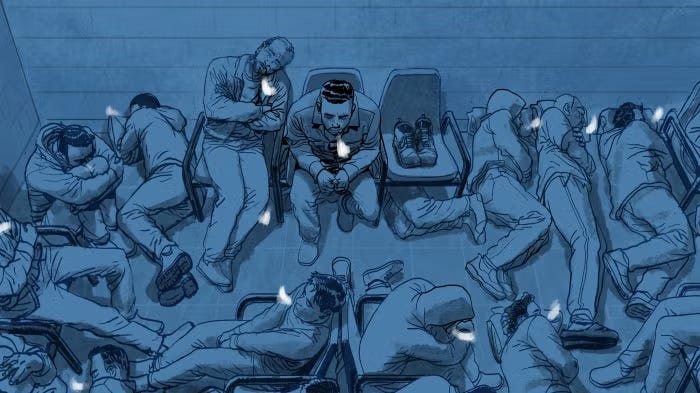
A recent report suggested that roughly seventy percent of the people held in ICE and DHS custody had no criminal record. Many are being detained not because they are dangerous, but because of uncertainty surrounding their immigration status. There may be lawful reasons to deport such people. But deportation, after a fair process, is one thing. Confining human beings in detention facilities with inadequate oversight is another.
Many of these facilities lack the protections we should expect from any institution empowered to detain people. Oversight is limited or unclear. Building standards are opaque. And personnel rapidly elevated to “guard” duties often appear to have little of the training such a difficult responsibility requires.
The questions follow naturally.
Are appeals processes adequate for cases that are often complicated?
Do detainees have meaningful access to counsel?
Can they communicate with loved ones?
Can journalists or elected officials see what is happening inside?
Who inspects the facilities? Who investigates mistreatment? Who has the independent authority to say the government has gone too far?
Increasingly, the answer is: we do not know.
Arrests are carried out in broad daylight by masked agents, sometimes on the authority of administrative warrants issued within the executive branch rather than warrants approved by independent judges. People who pose no apparent threat are taken into custody. Whatever one’s position on immigration enforcement, the distinction matters. A government may have the legal authority to remove someone from the country. That does not give it unlimited moral authority over that person while he or she is in its custody.
The Administration has begun using the word “bad” with unsettling frequency — bad people, bad governments, bad actors — as though moral categories could substitute for legal ones. We will do “bad things” to “bad people.” Cuba is “next” because its government is “bad.”
But governments do not become good merely by calling their adversaries bad.
Every government is operated by human beings, and human beings bring their prejudices, ambitions, fears, loyalties, moods, and errors of judgment with them. That is why free societies construct restraints around power. Courts exist for a reason. Lawyers exist for a reason. Inspectors, journalists, legislators, and appeals exist for a reason. Their purpose is not to make government efficient — often they make it maddeningly inefficient. Their purpose is to prevent the government from becoming the sole judge of whether its own conduct is justified.
That principle matters most when the people affected are unpopular.
If Americans are willing to watch people who pose no threat be arrested in public by masked agents; if voters are willing to elect officials who implement such policies; if we build harsh facilities in which vulnerable people disappear from public view; if we deny independent observers meaningful access to those facilities; and if we know enough to ask what is happening but decide that not knowing absolves us, then we cannot exempt ourselves from the moral vocabulary we apply so casually to others.
History will not be particularly interested in whether every person detained had completed the correct immigration paperwork. Some may have had no legal right to remain in the United States. History may instead ask what we did with people once we had nearly complete power over them.
Did they have lawyers? Could their families find them? Were they treated humanely? Could independent officials inspect the places where they were held? When mistakes were made, could they be corrected? When abuses occurred, did anyone have the power to stop them?
Those are not questions about immigration.
They are questions about us.
Bill Parcells liked to say that we are what our record says we are.
Nations are no different.
We are what our conduct says about us.