

Some rivalries are inherited through generations. Others are created by maps, zoning lines, and the swift rearrangement of communities. West Springfield and South County belong to the second category, though by now the emotions are no less real.
For years, the sharper edge of this rivalry has been felt most strongly in football, where tense postseason meetings and occasional flare-ups have added texture to an already combustible relationship. Geography has done the rest.
West Springfield opened in 1966, when nearby Lorton’s large correctional complex still shaped land use and slowed surrounding residential development. When the facility closed in 2001, the area changed quickly. Growth accelerated. New neighborhoods followed. With them came the need for a new high school. South County opened in 2005, drawing students largely from West Springfield and Hayfield.
The result was fertile ground for rivalry. West Springfield has often carried a more established suburban profile, while South County reflects the speed, variety, and unevenness of newer growth alongside older working-class pockets. Yet the divide is never complete. Many students have grown up together through youth sports. In soccer circles especially, nearly everyone knows everyone else.
That combination—shared history, new boundaries, overlapping friendships, and contested identity—is ideal material for sport.
Tuesday Night’s Meeting
Both teams entered with four points from three district matches, well placed but hardly secure in the notoriously difficult Patriot District. A win would lift either side. A loss would tighten the pressure with the postseason approaching.
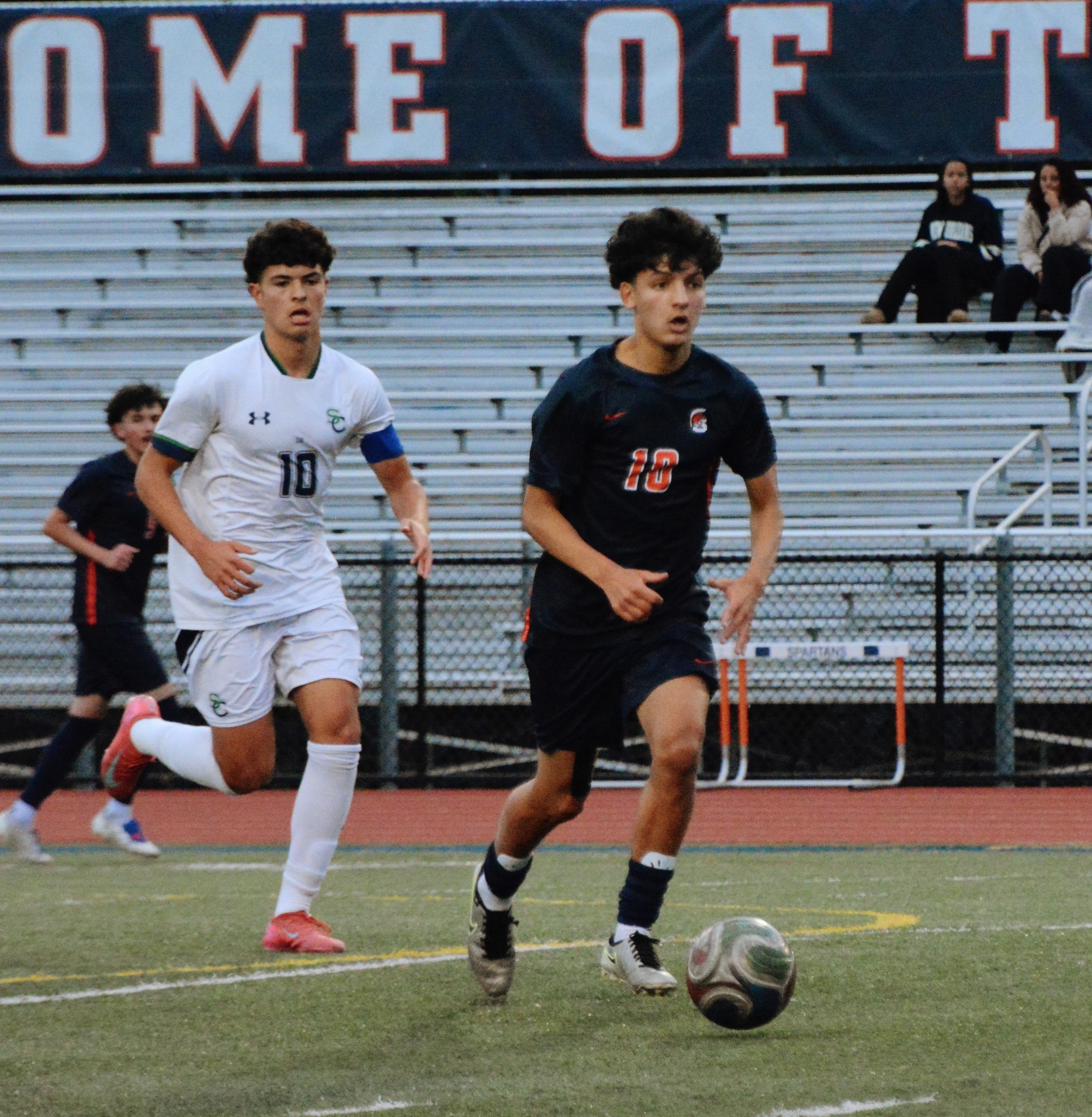
Even before kickoff, the contrast was visible. West Springfield looked the more physically imposing side—taller, broader, more mature. South County appeared younger, lighter, quicker, a team whose confidence would need to come through movement rather than force.
The opening quarter-hour belonged to the Stallions.
South County circulated possession sharply through midfield, using angles and short combinations to move West Springfield from side to side. Their control was driven by Diego Ramos, who set the tempo with energy and authority, repeatedly receiving under pressure and moving play forward. What they lacked was the final connection in the attacking third.
Territory was theirs; chances were not.
The Match Turns
With roughly twenty minutes remaining in the half, West Springfield struck against the run of play. Elijah Soriano combined neatly with right winger Michael Garcia. With South County stretched and retreating, Soriano received the return pass outside the area and bent a measured finish into the far-left corner.
It was a goal of intelligence more than power: the right choice, perfectly executed.
And it changed the emotional balance of the match.
West Springfield grew immediately in confidence. The Spartans began to win more second balls, contest midfield more forcefully, and play with the authority of a side newly convinced of itself. Much of that shift came through captains Daniel Minnar and Christian Sadek, whose presence gave the team structure and edge.
South County, however, responded before halftime.
A handball in the area brought a penalty, calmly converted by Diego Ramos, restoring parity and rewarding the Stallions for their persistence.
The equalizer opened the match further.
West Springfield continued to press and soon found reward. After a corner was not fully cleared, Joaquin Irazabal reacted first, driving a one-touch finish powerfully through traffic and into the net. It was the sort of goal rivalries often produce—not elegant, but sharp, forceful, and born of alertness.
Closing Stages
From there, the contest became stretched and urgent.
South County’s midfielders Ramos and Kevin Ponce searched persistently for the elusive Azarya Mikel, dangerous on the ball and capable of unsettling defenders anywhere near the box. But West Springfield’s back line, organized and disciplined, protected the 2-1 lead through the closing stages.
The final margin was narrow, as these matches often are. Two talented sides, two strong midfields, and a handful of moments separated them.
Both now move on in a district where little is given easily. The regular-season title remains in play, but so too does the equally valuable matter of postseason seeding, with the tournament less than three weeks away.
The Larger Story
Some rivalries are born of old grudges.
Others emerge from changing suburbs, new schools, and former teammates now wearing different colors.
Those can be just as fierce.