

In the summer of 1983, going into my senior year, the Robinson boys’ varsity attended team camp at UVA in Charlottesville. It was an opportunity to play against tough competition and train together for a week. The experience had a profound effect on me, eventually leading me to attend UVA for both undergraduate and law school.
We played against teams from schools of very different classifications and levels of quality. If I didn’t already know it going in, I learned that while the size of a school can influence the strength of a basketball team, the story is always more complicated. The game is still won on the court.
There was no three-point shot in 1983, but it was the early days of delivery pizza. Charlottesville had a Domino’s, so pizza was no longer limited to Friday nights at Pizza Hut, Victor’s, or Angie’s. Run-DMC had just released its transformational sound, and it seemed to be playing on every boom box. We didn’t have smartphones, computers, or the internet, but we could always find a pay phone to let our moms know we were fine.
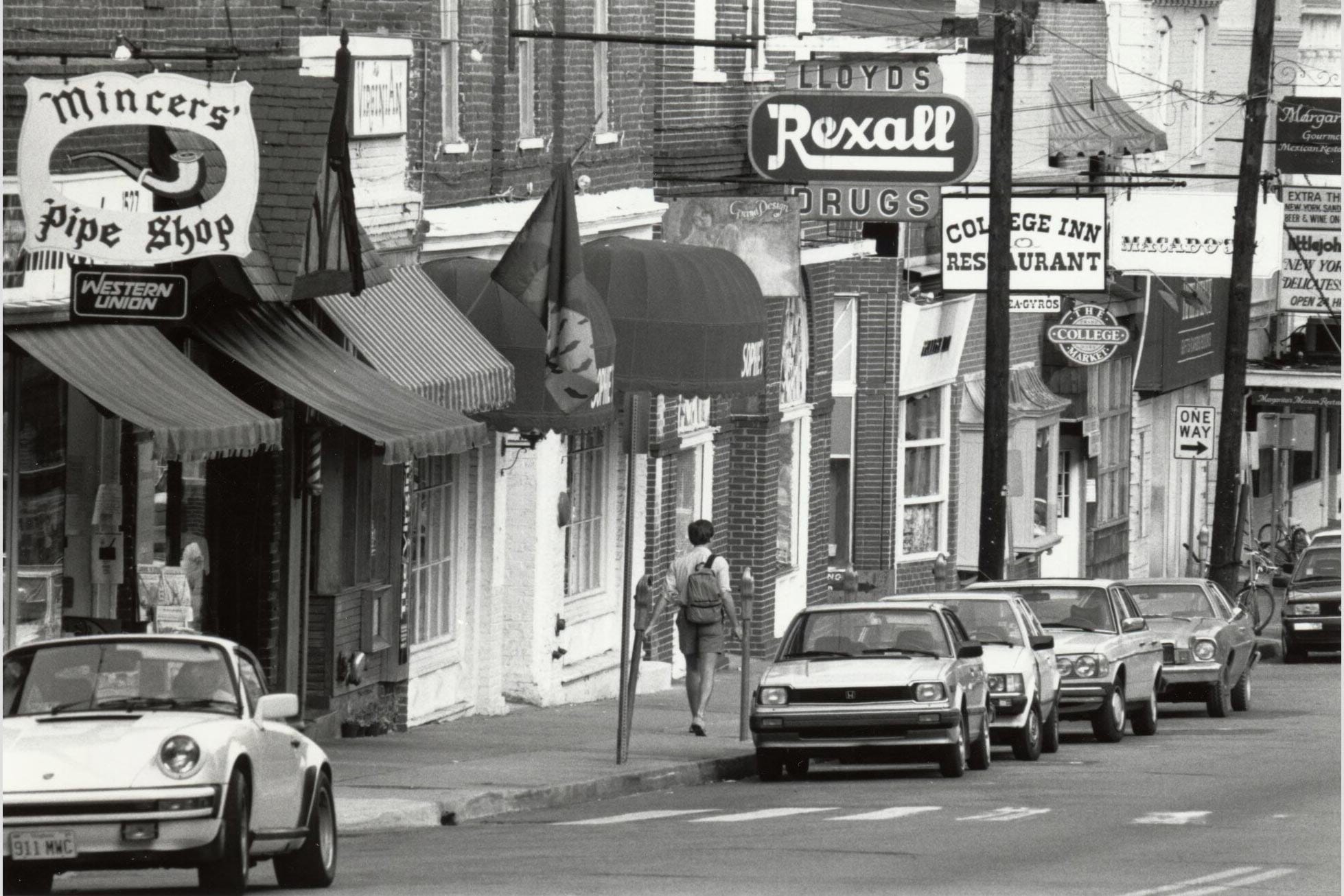
The week was filled with pickup basketball and the usual provincial trash talk, but also card games and philosophical late-night discussions about life. There were drills and practices, and finally the games themselves. Charlottesville was still a small southern college town in those days, without the retail and restaurant franchises that now line the streets. One highlight of the week was bumping into Ralph Sampson and watching him climb into his custom-made Ferrari in front of University Hall. For a group of high school players, it might as well have been a celebrity sighting.
Robinson had just completed a 12-9 season in the notoriously tough Northern District in new coach Bob McKeag’s first year. Coach McKeag had played at UVA and coached at nearby Western Albemarle before relocating to Robinson. That year we had upset regional champion and eventual state finalist T.C. Williams in the “Garden,” making some noise in a league that had no easy nights. Woodson featured Amaker and Whitting, Lake Braddock was a year away from reaching the regional final, and West Springfield was always strong and well-coached.
Unfortunately, only one starter from the ’82–83 team would be attending the camp. Rising junior Jeff Bowling was a dynamic 5’11” guard who would later attend Air Force and eventually set a Western Athletic Conference assist record that stood for many years.
At 5’4”, I would be the point guard in a 1-4 offense that would eventually morph into a flex/baseline attack. John Gould, a tough 5’9” defender from the JV team, backed up the position. Niels Mohler, a 6’2” transfer from Pittsburgh, was an effective wing who could shoot from outside or slash through the lane. The real difference-maker was Brian Smith, a 6’4” forward with the wingspan of a 6’9” player and a deadly outside shot in an era without the three-point line.
We were also missing several players because football season was approaching, but we brought along 6’7” Mike Noble from the JV team. After recovering from injuries early in the week, Noble replaced Mohler during tournament play. We lacked size, depth, and experience compared to many teams at the camp, but the five of us played well together. We understood our roles and stayed in our lanes.
The camp featured an impressive collection of talent.
AAA Woodbridge arrived with a full squad after a strong finish in the Commonwealth District. Their wings, 6’3” Billy James and 6’1” Tommy Bennett, were confident, organized, and happy to talk about how good they were. Their suite was close to ours, so we heard about it all week.
Future UVA guard Richard Morgan led a talented AA Salem team that presented constant problems for opposing defenses.
Future UNC star JR Reid and a Kempsville teammate anchored a stacked pickup squad from the UVA individual basketball camp.
But the most interesting team in Charlottesville that week came from much farther away.
Single-A Mullens High School arrived from the mountains of West Virginia. Charlottesville must have felt enormous to kids from Wyoming County, a place without a traffic light and with very little flat land. They were coal miners’ sons—among the politest boys I had ever met—but they also drank whiskey and played the most brutal practical jokes I had ever seen.
Their star was 6’2” Herbie Brooks, a future West Virginia University player who had scored a record 50 points in the state tournament earlier that year during Mullens’ championship run. The team was coached by the legendary Don Nuckols, finishing his 16-year run at the school. During that time tiny Mullens had somehow produced NBA player and coach Mike D’Antoni and Boston Celtic Jerome Anderson.
Their trademark was a devastating fast break. Even with a graduating class of barely fifty students, Mullens would be difficult to beat.
Virginia’s Single-A dynasty Cumberland also arrived with a strong team. Between 1978 and 1985, Cumberland would win four state championships. Their run was interrupted only by Drewry Mason—featuring future UVA players Tim Martin and Ronnie Price—and Fort Defiance, led by Dell Curry.
Cumberland was coached by Will Robinson, who had worked Robinson’s summer camp and would later become Coach McKeag’s assistant. Robinson would go on to build a perennial powerhouse at Woodbridge High. Cumberland ran Louisville’s famous high-post offense with discipline and precision, feeding their inside presence and spacing the floor perfectly.
With Mullens and Cumberland both present, the small schools were anything but small problems.
Robinson, meanwhile, was the largest school represented at the camp but arrived with a team few people took seriously. Fortunately, we were coached that week by Albemarle High coach Rich Lyons, a proven winner who had built a strong program at Luray before moving to AAA Albemarle.
With Jeff Bowling and Brian Smith stretching the floor, our flex offense produced layup after layup. We played with discipline and confidence, losing only to Woodbridge during the week and finishing second in the regular-season standings.
In the tournament semifinals we faced JR Reid’s pickup squad while top-seeded Cumberland met Mullens in the other bracket. Reid was outstanding, but his team couldn’t stop our steady parade of cuts and layups. We advanced comfortably to the championship game.
Cumberland edged Mullens in their semifinal, setting up the final: the largest high school in the region against a tiny school from rural Virginia.
It wasn’t quite “Hoosiers,” but the contrast was unmistakable.
Though we had beaten Cumberland earlier in pool play, they came into the championship ready. Their guards Gary Austin and Kevin Brown shut down our penetration and switched perfectly on every back cut. The flex offense that had produced easy baskets all week suddenly found no openings.
At the other end, Cumberland ran Louisville’s offense with remarkable discipline, repeatedly feeding their 6’2” low-post star Richard Brooks. It didn’t matter that Robinson had hundreds more students per class. On that afternoon, Cumberland was simply better.
They beat us convincingly.
The Cumberland players celebrated their win enthusiastically, and several of them would later travel to Fairfax the next summer to train with us. Still, I never felt like we got our revenge.
Looking back now, it’s clear that everyone involved carried something away from that week.
Mullens repeated as West Virginia champions in 1984 before the school sadly closed in 1998. Cumberland captured the Virginia Single-A state championship in 1985 with the same core group. Robinson returned to the middle of the Northern District standings but would eventually win the regional title in 1987 and narrowly lose to Alonzo Mourning’s Indian River team in the state final. Woodbridge followed its camp performance with a strong season and a district title.
JR Reid and Richard Morgan would go on to make major impacts in the ACC.
Recently I reconnected on Facebook with Herbie Brooks, who became a starter at West Virginia and still speaks fondly of that week in Charlottesville. He has remained in touch with both Reid and Morgan over the years.
Four decades later, the memory remains vivid.
The lesson we learned that summer still holds: in basketball—as in most things—the size of the school doesn’t decide the outcome.
Only the game does.