

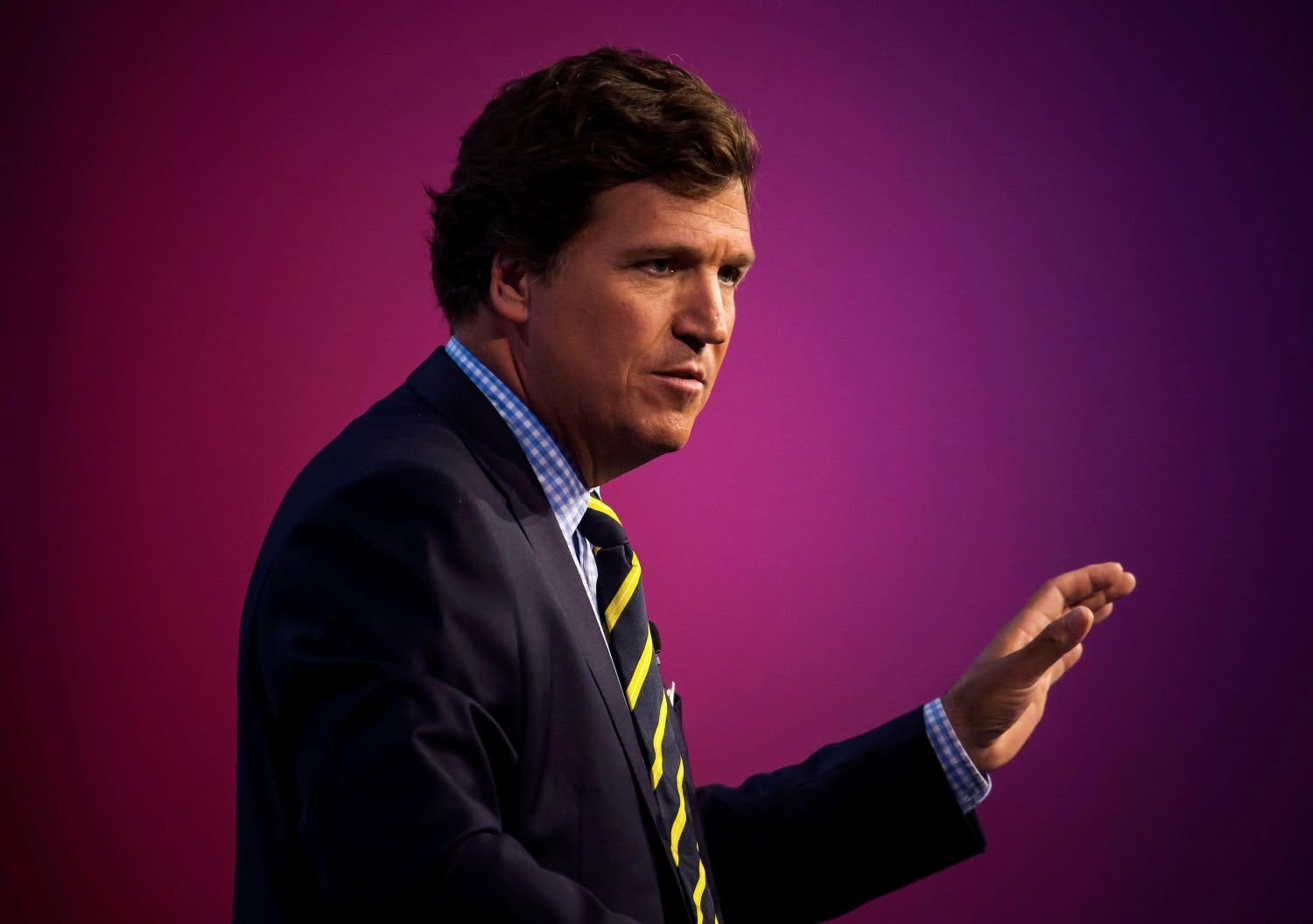
As prominent figures drift away from the MAGA movement—or at least from Donald Trump personally—the same question keeps resurfacing: Is Trump running in 2028? The speculation now extends to figures as different as Tucker Carlson and Marjorie Taylor Greene, each periodically cast as a possible heir to the movement Trump assembled. Among liberals, one hears a familiar warning: Carlson may actually be more dangerous than Trump because he possesses something Trump largely does not—an ideology.
There is some truth to this. Carlson’s worldview is darker, more coherent, and more intellectually rooted than Trump’s. He is openly skeptical of liberal democracy, deeply hostile to immigration in cultural and demographic terms, and increasingly willing to frame political conflict in civilizational language. He is suspicious of liberal internationalism and modern interventionism. Unlike Trump, he reads. He thinks in historical terms. He can construct an argument.
And yet, I would still take Tucker Carlson over Donald Trump without much hesitation.
The reason is simple: Trumpism introduces a form of instability and personalization of power that modern democracies are not especially well designed to absorb.
With Carlson, one can at least imagine a governing philosophy, however objectionable. Ideology—even illiberal ideology—tends to follow internal rules. It has a logic, a structure, a set of constraints. With Trump, one encounters appetite masquerading as doctrine. The ideological content shifts constantly; the instincts do not. Loyalty replaces coherence. Power becomes personal. Government begins to function less as an institution than as an extension of grievance, impulse, branding, and self‑interest.
Trump’s rhetoric on race and immigration has often crossed into the ugly or outright indefensible. But unlike Carlson’s worldview—which emerges from a discernible, if troubling, intellectual tradition—Trump’s statements frequently feel improvisational, shaped for effect rather than belief, calibrated to applause, dominance, or advantage in the moment.
That distinction matters.
Ideologues can be dangerous; history provides no shortage of evidence. But ideological actors are at least constrained by the internal logic of the systems they claim to believe in. That logic does not guarantee moderation or decency, but it does impose a degree of structure and predictability. Trump, by contrast, often appears constrained only by impulse, opportunity, and whether something can be made to serve him personally.
Hence the peculiar features of Trumpism that would likely not emerge under a President Carlson: meme coins orbiting political identity; family members conducting quasi‑official diplomacy; proposals to purchase Greenland floated on apparent whim; personal feuds elevated into matters of state; tariff policy deployed less as economic philosophy than as leverage; and the persistent fusion of governance with branding culture.
Even many of the ambitions associated with Project 2025 would likely require more discipline, continuity, and administrative consistency than Trumpism naturally sustains. Trumpism tends to substitute spectacle for execution.
This is not an argument in Carlson’s favor. His posture toward Russia is deeply troubling. His flirtations with ethnonationalist rhetoric are worse. His hostility to liberal norms is overt and sincere. I disagree with him on nearly everything.
But there remains a meaningful distinction between authoritarian ideology and authoritarian temperament. The former can be debated, resisted, and politically isolated. The latter corrodes institutions more diffusely because it treats institutions themselves as subordinate to personality. Modern democracies are built to withstand ideological disagreement; they are far less equipped to withstand the erosion of impersonal norms.
That is the deeper danger of Trumpism. Not that it is conservative, nationalist, or populist—democracies have survived all three before—but that it dissolves the boundary between state, movement, family enterprise, entertainment, and personal will.
And once politics becomes entirely personal, it becomes exceedingly difficult for institutions to remain impersonal at all.