

I have never quite understood how Donald Trump, or the administration he has assembled, regards women.
Trump’s personal history hardly offers a reassuring starting point. There was the infamous recording in which he boasted about grabbing women, the civil judgment finding him liable for sexually abusing E. Jean Carroll, and his acknowledged habit of entering backstage areas at beauty pageants. He married a former model whose early career included nude photography. None of this is particularly new, and much of it has been discussed so often that it scarcely attracts attention anymore. The news arrives with the force of a fire hose, each new revelation washing away the last.
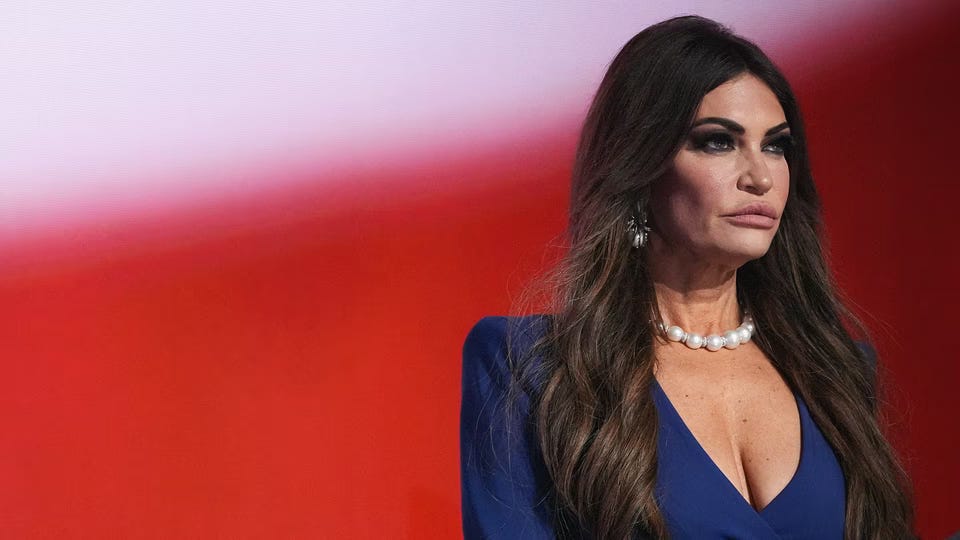
Yet the women surrounding Trump present a curious picture. Some are glamorous, most often blonde, conspicuously attentive to their appearance, and seemingly comfortable with the president’s appetite for admiration. There is even something approaching a recognizable MAGA aesthetic: elaborate makeup, sculpted faces, prominent lips, and considerable cosmetic intervention.
Some may say there is nothing inherently objectionable about any of this. Women are entitled to look however they please. But should we celebrate a political culture in which adopting a particular appearance seems to offer a path to power and success? What interests me is the extraordinary uniformity of the presentation, particularly in an administration that professes such contempt for conformity imposed by others.
It sometimes seems that Trump has a rather traditional conception of women: attractive, loyal, admiring, and preferably not too troublesome.
Women have occupied important positions in his administration. Susie Wiles became the first woman to serve as White House chief of staff. Pam Bondi was attorney general, Kristi Noem secretary of homeland security, and several others held Cabinet positions. Yet how much independence and judgment these women were permitted to exercise remains an interesting question. Holding a powerful office and exercising independent power are not necessarily the same thing.
And the pattern of departures has become difficult to ignore.
Noem was removed. Bondi followed. Labor Secretary Lori Chavez-DeRemer departed amid controversy. And now Kimberly Guilfoyle, the ambassador to Greece and once a prominent figure in the Trump family orbit, has been asked to resign following allegations of misconduct, which she denies.
There were legitimate questions surrounding these women and their performance. But that only makes the comparison with the men more interesting. Pete Hegseth survived the Signal messaging scandal and other controversies. Other prominent men have weathered considerable criticism without suffering comparable consequences.
One begins to wonder whether loyalty is a more durable currency for the men than for the women.
The administration’s preoccupation with diversity, equity, and inclusion adds another dimension. DEI is regularly denounced as an affront to merit, an elaborate system by which supposedly unqualified people are elevated over their betters.
Consider, then, the administration’s own devotion to merit.
A secretary of defense whose military career peaked at major in the National Guard, whose subsequent public prominence came largely from Fox News, and who now exercises authority over generals and admirals with decades of command experience. Some of those officers have since been removed from their positions by a man whose own military career never approached theirs in rank or responsibility.
A secretary of education whose principal executive experience was running a professional wrestling enterprise.
A secretary of health and human services whose background includes environmental litigation and vaccine skepticism rather than the administration of a major public-health institution.
Personal loyalty, television presence, ideological enthusiasm, and a willingness to flatter the president seem to count for rather a lot. Apparently, qualifications are indispensable when someone else is making the appointment.
Then there is the SAVE America Act, promoted as a measure to protect the integrity of elections. Its documentary citizenship requirements could create particular difficulties for married women whose names no longer match their birth certificates. A woman who has voted for decades might find herself required to produce additional documentation merely because she took her husband’s surname. The legislation offers procedures for resolving discrepancies, but that does not eliminate the burden.
One might have imagined that imposing such obstacles on married women would be politically unthinkable. Evidently not.
And yet the electoral picture is more complicated than any of these observations might suggest.
Trump actually improved his performance among women in 2024 against Kamala Harris compared with his showing against Joe Biden four years earlier. Women continued to favor the Democratic candidate, but by a narrower margin.
Women, of course, are not a political monolith. They differ by race, education, religion, class, age, and ideology. Some undoubtedly admire Trump’s style of leadership. Others may dislike his personal conduct but consider economic conditions, immigration, or other issues more important. Still others may regard the very qualities his critics find objectionable as evidence of strength.
The contradiction remains fascinating.
Here is a president whose public and private conduct toward women has repeatedly invited scrutiny, whose administration displays a striking preference for a particular feminine image, whose female officials have proved conspicuously expendable, and whose party advances voting requirements that could impose special burdens on married women.
And yet millions of women continue to support him.
Perhaps the mistake is expecting women’s political judgments to be determined principally by how a president treats women. Voters rarely organize their priorities so neatly.
Still, it is difficult to escape the impression that Trump is more comfortable with women who admire power than with women who exercise it independently.
That may tell us something about his conception of women. It certainly tells us something about his conception of power.