

This week, the Supreme Court refused to allow the Postal Service to impose new requirements on election mail shortly before the 2026 midterms. The rule would have required states to redesign ballot envelopes, add specialized barcodes and transmit certain voter information to the Postal Service.
Justice Brett Kavanaugh agreed that the Postal Service might possess the statutory authority to adopt such a rule. But imposing it this close to an election, he concluded, would be arbitrary and capricious because state and local officials lacked sufficient time to comply.
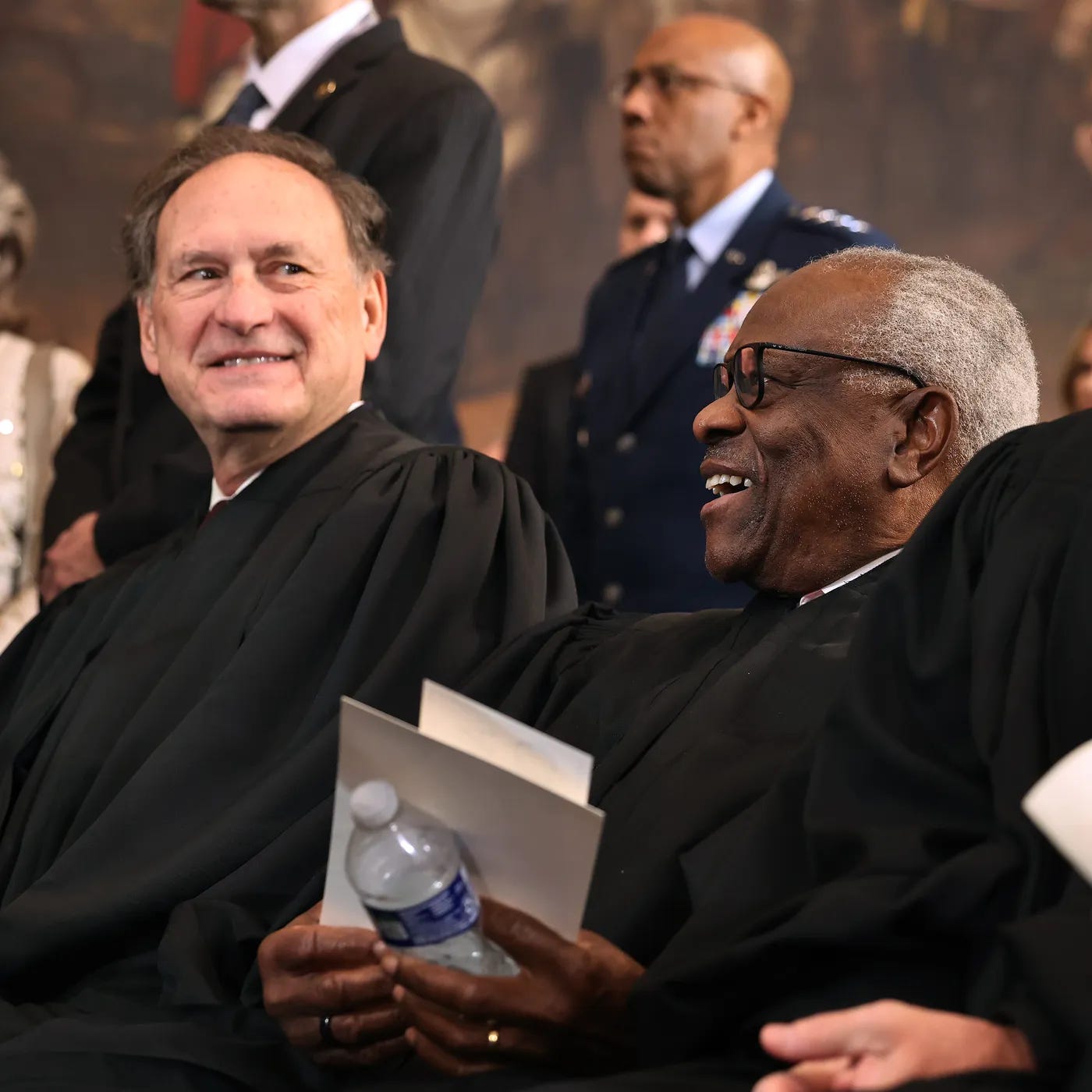
The Court denied the government’s request by a vote of 7–2. Justice Samuel Alito dissented, joined by Justice Clarence Thomas. Alito acknowledged the practical difficulties created by the rule’s timing but did not believe they justified blocking it.
The alignment felt familiar: seven justices on one side, Thomas and Alito on the other. It made me wonder how often the two had stood alone together.
The answer is considerably more often than I expected. Since Alito joined the Court in 2006, Thomas and Alito have been the two dissenters in at least twenty-seven 7–2 merits dispositions. No other pairing has approached that number during the same period. Even on a Court with six Republican appointees, they repeatedly find themselves standing alone.
It is tempting to explain the pattern entirely through politics. Thomas and Alito are the two members of the Court most consistently found at its rightward edge. When Chief Justice John Roberts and Justices Kavanaugh, Amy Coney Barrett and Neil Gorsuch join the three liberal justices, the conclusion seems obvious: Thomas and Alito simply occupy a position farther to the right.
Whether that makes them the Court’s “most conservative” justices depends upon what conservatism is understood to conserve.
Conservatism can mean adherence to original constitutional meaning. But it can also mean respect for precedent, institutional continuity, judicial restraint and caution toward sweeping change. Thomas, in particular, is willing to discard substantial bodies of precedent and reconstruct constitutional law from first principles. That may place him to the right, but it is not conservative in every recognizable sense of the word.
Their dissents usually begin with a legitimate judicial concern. Sometimes it is the language of a statute. Sometimes it is history, federalism, finality or the limits of judicial power. In cases involving the presidency, it may be the danger that courts or Congress will interfere with the executive branch. These are not invented principles, nor are they concerns that liberals should dismiss merely because Thomas and Alito invoke them.
The more revealing question is what happens next.
Again and again, Thomas and Alito identify one legitimate constitutional value and allow it to overwhelm every competing consideration. Text displaces purpose. History displaces precedent. Finality displaces fairness. Executive authority displaces oversight. What begins as a sound judicial concern becomes an absolute rule.
The postal case captured the distinction unusually well. Kavanaugh did not dismiss the government’s legal argument. He separated the existence of power from the manner of its exercise. The Postal Service might possess the authority, he reasoned, while still acting unlawfully by imposing its rule too close to an election.
Alito and Thomas placed greater weight on statutory authority, standing and the limits of judicial review. Those concerns were real. But they were not the only concerns before the Court. Election administration, reasonable notice and the danger of disrupting voting procedures also mattered. The dispute was not between law and politics. It was between one conception of law and a broader exercise of judicial judgment.
The other conservative justices often stop where Thomas and Alito continue.
Gorsuch is capable of joining them in sweeping constitutional cases, but his textualism sometimes takes him elsewhere. In criminal cases, he may insist that the government prove exactly what Congress required it to prove. He has also joined the liberal justices in cases involving tribal sovereignty and limits on governmental power. His conservatism is real, but it does not always dictate his destination.
Barrett’s departure is different. She frequently shares Thomas and Alito’s originalist premises but appears less willing to make history carry more weight than the evidence will bear. She pays close attention to standing, procedure and the precise question before the Court. Her disagreement is often not over philosophy but over whether the necessary analytical bridge has actually been built.
Kavanaugh is more attentive to precedent, institutional stability and practical consequences. He often prefers a narrow decision to a broad declaration. Thomas may regard disruption as the necessary price of constitutional fidelity. Kavanaugh is more likely to ask whether the Court can correct one problem without unsettling everything around it.
Kavanaugh, Barrett and Gorsuch—and, in a different fashion, Roberts—remain considerably more conservative than the justices with whom I generally agree. Recognizing their independence in these cases does not require agreement with their broader jurisprudence. It requires only the fairness to notice when they have declined to follow their ideological allies beyond the point their own judgment permits.
Their departure also requires something from them.
If Thomas and Alito joined the majority in these cases, the Court could often speak 9–0. Roberts, Kavanaugh, Barrett and Gorsuch could disappear within institutional unanimity, their individual choices largely unnoticed.
A Thomas–Alito dissent removes that shelter.
It strands the remaining conservatives alongside the Court’s three liberals and makes their independence visible. They must publicly decline the invitation to follow the Court’s most consistently rightward bloc. In politically charged cases, that can require a form of judicial courage. The dissent draws a line, and the other conservative justices must decide on which side of it they are prepared to place their names.
The cost is real. A unanimous Supreme Court possesses special authority, particularly when it limits presidential power, protects basic procedure or settles a question on which the country is badly divided. A 9–0 decision tells the public that the rule does not depend upon ideology. A 7–2 decision inevitably leaves room for political actors to portray even a broad consensus as merely another contested judicial judgment.
Thomas and Alito are entitled to dissent. Judicial unity purchased by suppressing genuine disagreement would have little value. But their coupling means that the Court speaks with one voice less often than it otherwise might.
At the same time, their dissent can make the agreement among the other seven more meaningful. Roberts, Kavanaugh, Barrett and Gorsuch are not merely carried along by unanimity. They have been forced to choose.
The isolated dissents themselves are not all alike. Some involve close questions of statutory construction on which reasonable judges can disagree. A few may ultimately prove persuasive. Others rest on serious principles carried farther than the law or circumstances justify.
The most troubling arise when the dispute concerns concentrated governmental power.
Thomas and Alito have expressed legitimate concern about harassment of presidents, interference with executive responsibilities and judicial intrusion into matters assigned to the political branches. But rules created to protect a president do not disappear when another president takes office. Every grant of immunity, every restriction on judicial review and every presumption of executive authority becomes available to the next officeholder—including one whose judgment, motives and restraint we may have far less reason to trust.
That is the test judicial doctrine must survive.
Would the same principle be applied when it protects an immigrant rather than the government seeking to remove him? A criminal defendant rather than the prosecutor? A tribal nation rather than a state? Congress rather than the president? A Democratic administration rather than a Republican one?
Consistency does not require identical outcomes. Cases differ, and law necessarily involves judgment. But when a principle repeatedly strengthens one kind of power and repeatedly weakens those who might restrain it, the pattern deserves examination.
The history of the Court contains other enduring dissenting partnerships. William Brennan and Thurgood Marshall stood alone together far more often than Thomas and Alito have. Hugo Black and William Douglas formed another powerful pairing, as did Antonin Scalia and Thomas. Such partnerships can serve an important purpose. Today’s isolated dissent may identify the principle that a later generation recognizes as correct.
But isolation can produce another effect. Two justices who repeatedly validate one another may become less responsive to the doubts that persuade everyone else. Agreement supplies confidence, and confidence can harden into certainty.
That may be the most important feature of the Thomas–Alito partnership. They are rarely without a respectable legal argument. Their weakness is not the absence of principle. It is the tendency to treat their chosen principle as though it has resolved the act of judgment itself.
It has not.
Constitutional law is filled with competing values because democratic government is filled with competing dangers. Government can become too weak to act, but also too powerful to restrain. Courts can exceed their authority, but they can also abandon it. Precedent can preserve error, but disregard for precedent can turn constitutional law into an expression of will.
The judicial task is not merely to identify one of those dangers. It is to recognize all of them.
When Thomas and Alito stand alone, we should therefore do something more demanding than celebrate or condemn them. We should ask what principle they have identified, what competing value they have discounted, and whether they would apply the same rule if political power changed hands.
Sometimes their answer may deserve respect. Occasionally it may deserve acceptance.
But when seven other justices—including four fellow conservatives—conclude that the law requires something else, the disagreement often reveals more than ideological distance. It reveals the difference between possessing a judicial principle and exercising judicial judgment.