

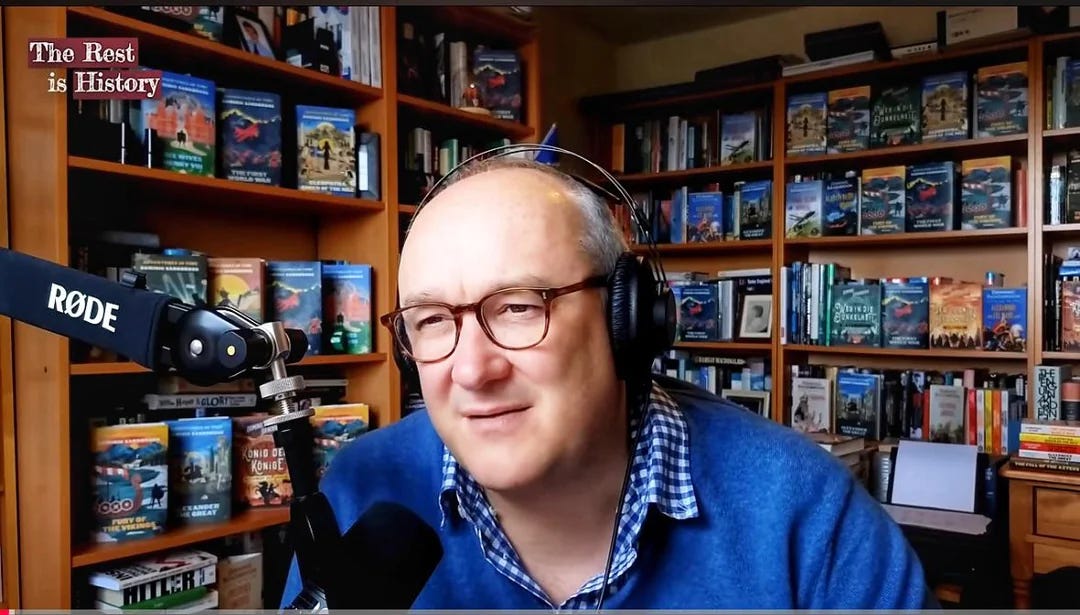
In a recent episode of The Rest Is History, Dominic Sandbrook delivered a line so quick and so dry that many listeners may have missed it. Discussing the late‑1930s German military, he noted that the Nazi Army and Air Force often failed to communicate—not merely because of bureaucratic dysfunction, but because they despised one another. Then came the aside, tossed off with perfect Sandbrook timing: “Of course they hated each other. They were all terrible people.”
It was funny, but it was also true. We sometimes imagine the Nazi regime as a model of grim efficiency, a machine of perfect coordination. In reality, it was a nest of rivalries, jealousies, and personal vendettas. Their early victories owed less to strategic brilliance than to luck, miscalculation by their enemies, and a willingness to gamble recklessly. Their decision to attack the Soviet Union—like their dash through the Ardennes—was not the product of genius but of astonishing hubris. They were always going to blow it.
And Sandbrook’s quip contains a deeper insight: we often assume that people who share bad intentions will naturally cooperate, but history shows the opposite. Terrible people rarely like one another, and they make even worse colleagues. It is one of the great misunderstandings of authoritarianism—the belief that shared ruthlessness produces unity. More often, it produces chaos.
Some observers today describe the Trump administration as a movement toward a more authoritarian style of leadership—a belief among supporters that unity behind a strong leader is a virtue in itself. Even policies that break sharply with traditional conservative orthodoxy, such as sweeping tariffs or expanded federal policing, have been met with surprising compliance across the board. The assumption seems to be that any future leader will seamlessly inherit this perch, that the media, corporations, and courts will permanently fall in line, and that the movement will remain a well-oiled machine. It is the familiar belief that a strongman guarantees order.
But perhaps not.
Authoritarian movements often fracture not because their opponents defeat them, but because the people inside them cannot stand one another. Many of the figures who rise in such systems do so not through public service but through notoriety—people with long records of unpaid bills, domestic scandals, dubious associations, or public statements that would disqualify them in any normal political culture. These are not the ingredients of durable unity. They are the ingredients of a circular firing squad.
Authoritarianism promises discipline. What it often delivers is chaos.
The people inside such movements may cooperate when it benefits them, or when the leader demands it, but the alliances are brittle. They are transactional, not principled. And when the center weakens—when the leader falters, or the polls shift, or the courts intervene—the factions turn inward. They do not trust one another any more than their critics trust them.
History suggests that leadership built on fear, grievance, or personal loyalty eventually collapses under the weight of its own internal toxicity. But a circular firing squad still fires live ammunition. Long before these movements implode from within, their chaotic power struggles rip through the institutions of the state, leaving lasting wreckage in their wake.
The question is not whether such leadership will ultimately fail. The real question is how much of the country it will take down with it before it does, and whether we can recover afterward.