

There is a certain stickiness in how we view other countries — perhaps in how we view anything. Foreign policy is supposed to rest on national interest, international law, and the principles of self-determination and freedom. Yet our judgments are inevitably colored by long-held impressions of other nations. Cuba, Israel, Germany, the United Kingdom, Canada, China, Russia, Japan — our views of these countries rarely shift quickly. They are shaped by decades of history, memory, and myth. That Donald Trump has managed to alter how many of his supporters perceive Russia or even North Korea is remarkable because such transformations are usually glacial.
When Trump walks among the G7 leaders, they are not merely assessing him; they are trying to understand the United States. For generations, America was known — especially in the postwar era — as an engine of business, a home of imagination, great universities, and yes, a certain cowboy swagger. Imperfect, certainly, but generally trusted, or feared enough that others followed its lead. Trump’s first term strained that image, but many assumed Biden’s presidency restored it. Trump’s return to the White House signals something different: this was not a one-off. This is a choice the United States is capable of making again.
Foreign leaders see the domestic tumult and they see the conduct of diplomacy. They see detention centers, masked agents, tariffs, and disputes with longtime allies. They do not view these as aberrations. They view them as expressions of who America is at this moment. When Trump wanders through the G7 or delivers uneven press conferences, they accept that this is the leadership Americans have selected. And even if it changes, it can be selected again.
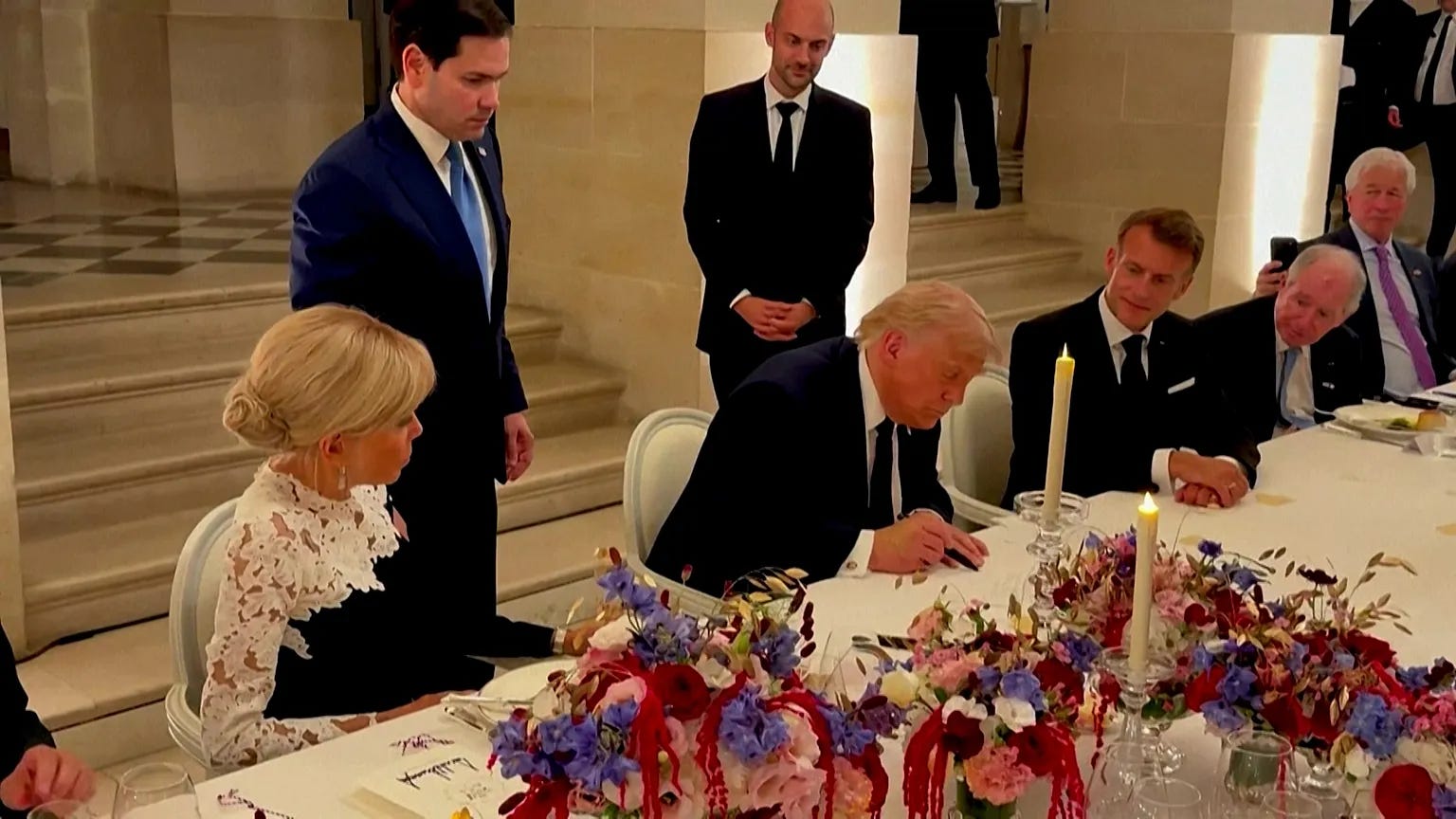
None of this means America cannot be respected or that business cannot be done with it. The United States remains the most powerful country on earth, economically and militarily. But the old stickiness — the reflexive assumption that America is fundamentally well-intentioned — is wearing off. Other nations see Trump without the friendly confines of American media, and they see him against their own histories. They remember Macron having Trump sign a commemorative document at Versailles, and the symbolism lost on him but not on them.
Soft power is not sentimental; it is strategic. When America’s good deeds and good will fade from memory, Americans lose something real. Perhaps the idealism was always imperfect, but it mattered. It made others willing to trust us, to follow us, to believe that our power was tied to purpose.
The world now sees us as we present ourselves. And whatever remains of that older notion is slipping away.