

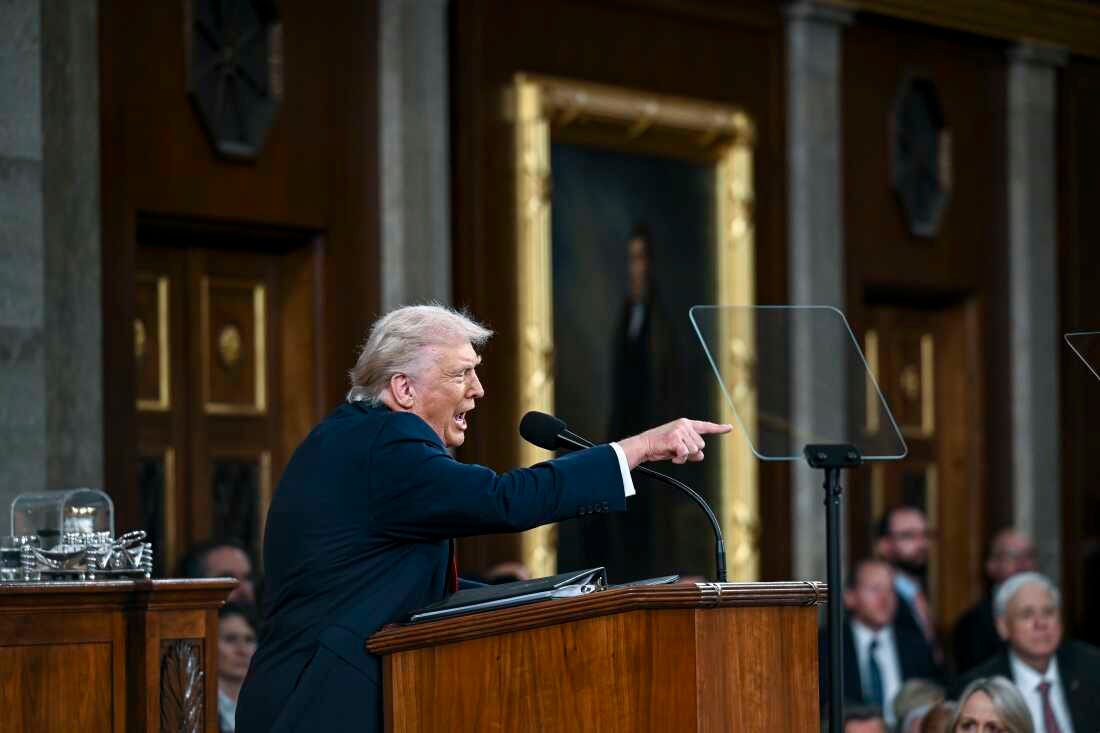
We often oscillate between two interpretations of Donald Trump. Supporters describe him as instinctive; opponents as impulsive. Others insist everything is deliberate — a kind of political chess in which every move conceals a deeper plan. After Tuesday’s State of the Union address — the longest in modern American history — a simpler question emerges: why hold the country’s attention for so long?
If there is strategy, it may lie less in the specific words than in the act of speaking itself.
In stable democracies, institutions normally explain public life. Courts issue opinions, legislatures debate bills, agencies publish rules, and journalists interpret events. Citizens may disagree with decisions, but they generally understand where authority resides. When confidence in those institutions weakens, however, communication shifts from structure to personality. The leader increasingly becomes the interpreter of reality.
A very long address serves purposes beyond persuasion. It functions at once as policy announcement, economic report, ideological instruction, national narrative, and — perhaps most importantly — a test of alignment. The speech does not merely describe government; it becomes a form of governing. The implicit message is not only what the rules are, but who determines them.
There is also power in duration. Holding public attention for hours requires the entire political community to adjust to a single voice and cadence. Networks rearrange schedules. Commentary pauses. Families leave televisions on even while moving in and out of the room. The state, briefly, moves at the pace of one individual. Supporters feel directly addressed rather than indirectly represented.
The next day reveals the effect. Supporters quote passages as explanation; opponents respond to tone as much as substance. Conversations revolve less around legislative details than around what the president “meant.” The speech becomes a reference point for understanding events themselves rather than simply a statement about them.
In robust democracies, speeches compete with other interpreters — legislators who respond, journalists who question, courts that review, and voters who judge. Precision matters because the audience possesses independent authority. Under those conditions rhetoric tends to be concise. Length invites scrutiny.
Where the speech becomes the principal channel of explanation, however, length carries little penalty. It substitutes narration for mediation. For some listeners this produces reassurance, even intimacy; for others fatigue or unease. Yet both reactions acknowledge the same fact: a single voice has become the central source of political meaning.
It is often difficult to separate strategy from temperament. Political behavior can be both calculated and instinctive at once. Tuesday’s address appeared to change few minds outside the president’s supporters, but persuasion may not have been its primary purpose. The audience was not the undecided voter so much as the already convinced citizen whose sense of connection is reinforced by proximity to the speaker.
Modern politics increasingly rewards spectacle, but spectacle contains a paradox. The more public life depends on personalities to explain reality, the less stable shared reality becomes. Institutions exist precisely so that law does not require a narrator.
When citizens must rely on a single voice to understand how their government functions, politics becomes less a system and more a story. Stories bind communities powerfully — but they also make them fragile. A free society ultimately depends not on the endurance of a speaker, but on the endurance of rules that do not need to be spoken aloud in order to be obeyed.