

This weekend, with the NCAA Tournament humming in the background from noon to midnight, I found a quiet window for something smaller, and in its way, just as large.
I watched McFarland, USA—the story of a California cross country team built from the sons of farm workers. It is, in essence, a Latino Hoosiers: a place where the town and the team are indistinguishable, where the finish line belongs to everyone. In Hoosiers, Dennis Hopper listens from a hospital bed, but when Hickory wins, he might as well own the world. In McFarland, the same truth holds.
Hollywood didn’t invent that feeling. It just recognized it.
You see it every year, in gyms and on fields across the country. High school sports are not just about competition—they are about gathering. Each game adds a few more voices, a few more familiar faces in the stands. By the postseason, those scattered threads have become something like a community fabric. You can feel it thicken as the stakes rise.
That, as much as the championships, is the point.
This past basketball season delivered its share of endings. Westfield fulfilled the weight of expectation and won a state title. Heritage’s boys and girls both made deep runs, and their doubleheaders became something close to civic events—gyms alive in a way that doesn’t quite translate unless you’re there. Osbourn Park’s girls repeated. South County returned to the state stage on both sides, both built on a defensive identity that carried them through.
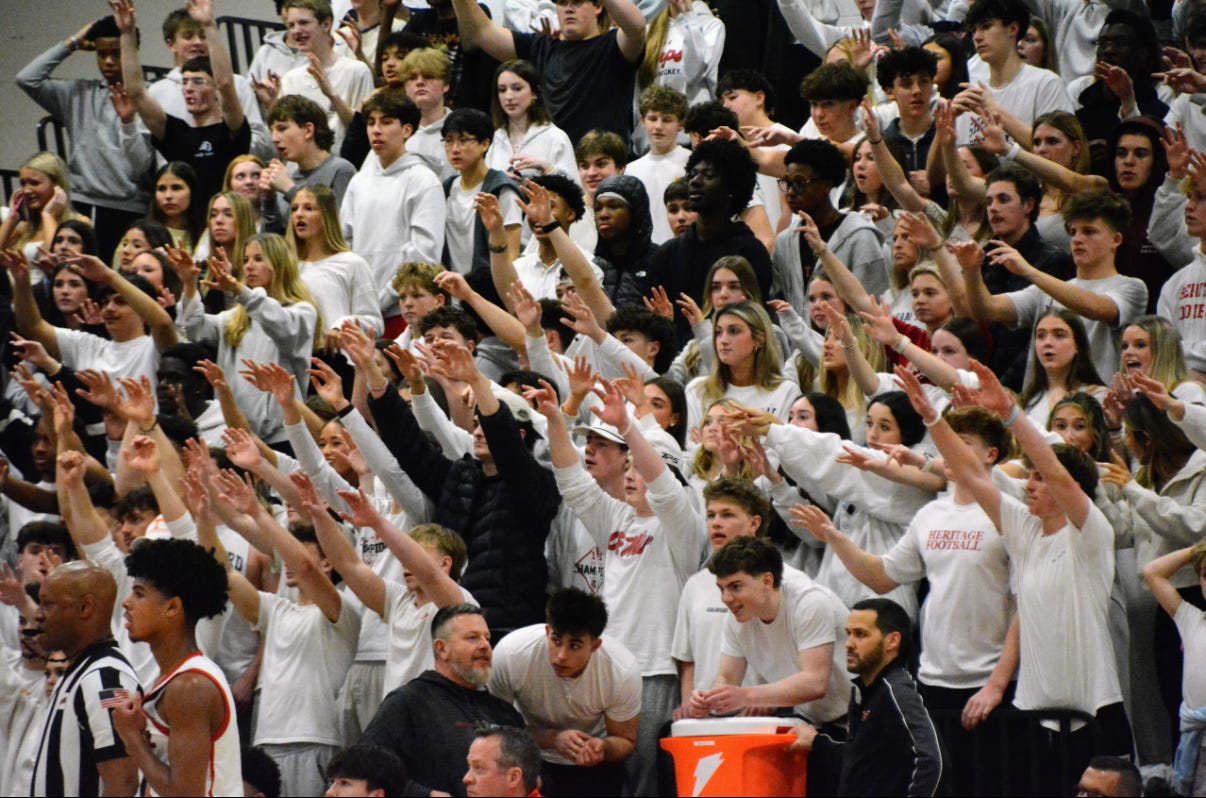
The banners will hang. The results will be recorded. But what lingers is the atmosphere—the noise, the anticipation, the sense that something is being built together, night after night.
Now the calendar turns.
Soccer begins again, and with it, the long, quieter stretch before the crescendo. The regular season doesn’t announce itself the way March does. It teaches. It experiments. It gathers.
Last year’s run was a reminder of how unpredictable these arcs can be. Wakefield, uneven and injured, found its way through three penalty shootouts and all the way to a state final. Herndon, loaded with promise, endured its own narrow escapes and ultimately delivered. Those are not outcomes you forecast in April. They emerge.
That’s the nature of it.
The question each spring is not whether this season will match the last—it almost never does in the same way—but whether it will produce its own version of that shared experience. The same slow build. The same gathering of people and meaning. The same sense, by the end, that something larger than the games themselves has taken place.
It will.
You can see it already, in small clusters along the sidelines, in early-season matches that matter only a little—until they don’t. The fields will fill. The voices will grow. And somewhere along the way, without much notice, a season will become a story.
And for a few weeks, it will belong to everyone.