

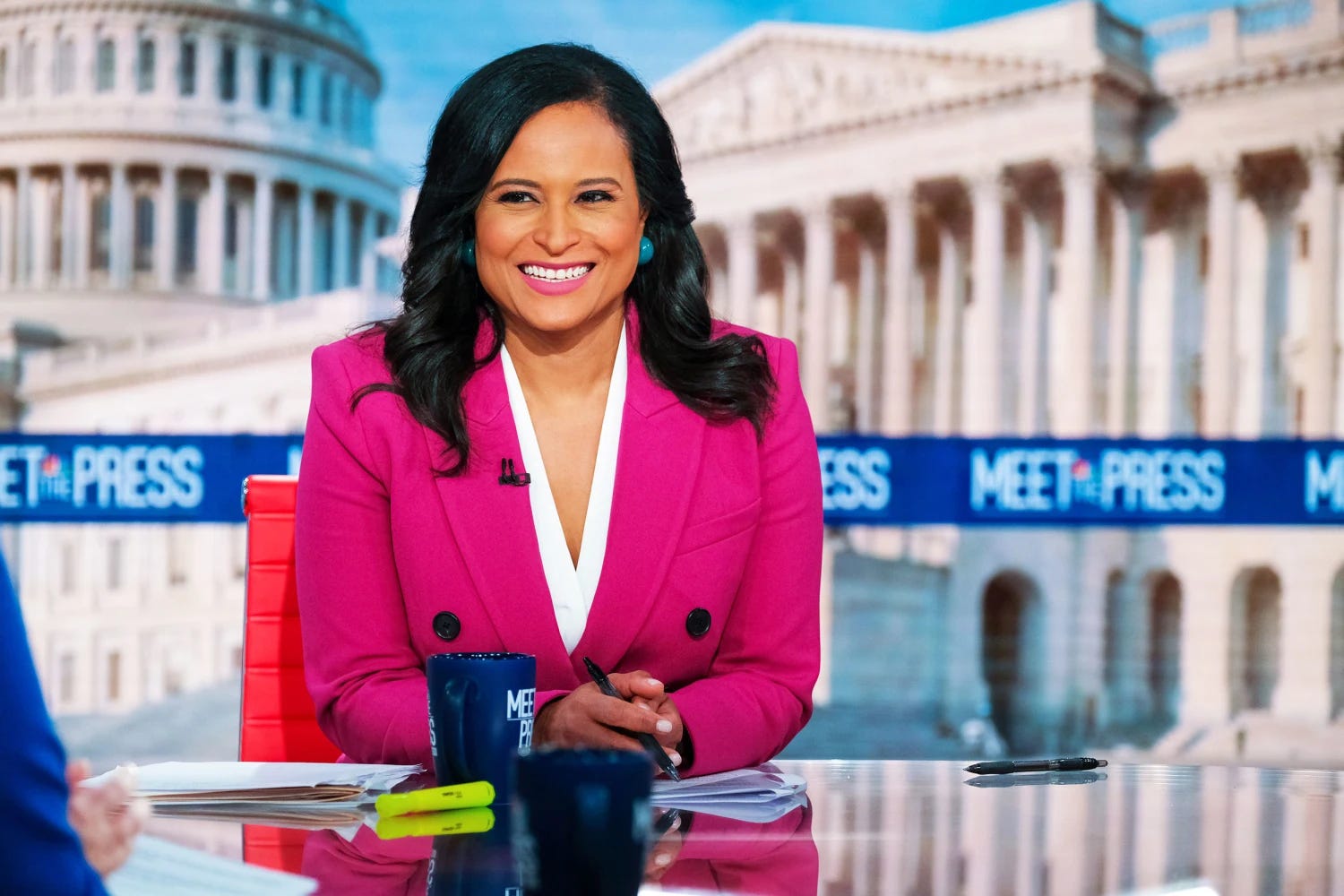
Kristen Welker is receiving plaudits this week for the rarest of journalistic feats: asking a question so straightforward that it caused the president to walk off the set. And what was this devastating inquiry? Not whether he had been unfaithful to his wife. Not whether his bankruptcies should give voters pause about his stewardship of the economy. Not whether his posture toward Iran is influenced by the interests of any lobbying group.
No — her offense was far simpler.
“Sir, there is no evidence for that.”
That such a sentence now requires courage tells you everything about the state of American media.
We are watching venerable institutions wobble. 60 Minutes is being hollowed out. Late‑night comedians are being trimmed back. Reporters like Jim Acosta and Terry Moran — hardly radicals — are attacked for the crime of doing journalism. These are people with long résumés and reputations for seriousness, yet they are treated as if they have wandered into public life by accident.
Welker, for her part, has generally managed to navigate the Trump era with the caution of a tightrope walker — visible, competent, and just far enough from the line of fire to avoid becoming a character in the drama. John Dickerson perfected this art until he was terminated, a reminder that even the most careful journalists can be removed when the winds shift.
But there comes a moment when even the most cautious reporter must step forward. And Welker’s moment came when she asked for something that used to be the price of admission in public life: evidence.
This, apparently, is unforgivable.
A California election is fraudulent because it takes too long to count. Welker herself is corrupt because she asked a follow‑up. The media, in this telling, is not a constitutional safeguard but an inconvenience — the sort of thing one walks away from when it becomes irritating.
It is, of course, the media figure who should remain on the stage.
The deeper problem is that journalists are being isolated one by one. A host here, a correspondent there, each singled out as biased, corrupt, or disloyal. And when the profession does not stand together — across networks, across ideologies — the result is predictable: they are picked off individually, and the presidency is left to operate without scrutiny.
Is it getting harder because so much media is now owned or influenced by people friendly to the president? Possibly. But the alternative is worse: a press corps too intimidated to ask the most basic question in the civic vocabulary.
Is there evidence for that?
If that becomes a firing offense, then the country has a larger problem than a walk‑off interview.
Excellent and powerful summation. And yet, until the "offense," the interview struck me as being somewhere between "happy talk" and pablum, with Welker barely pushing back at all on piles of "presidential" nonsense and outright lies.