

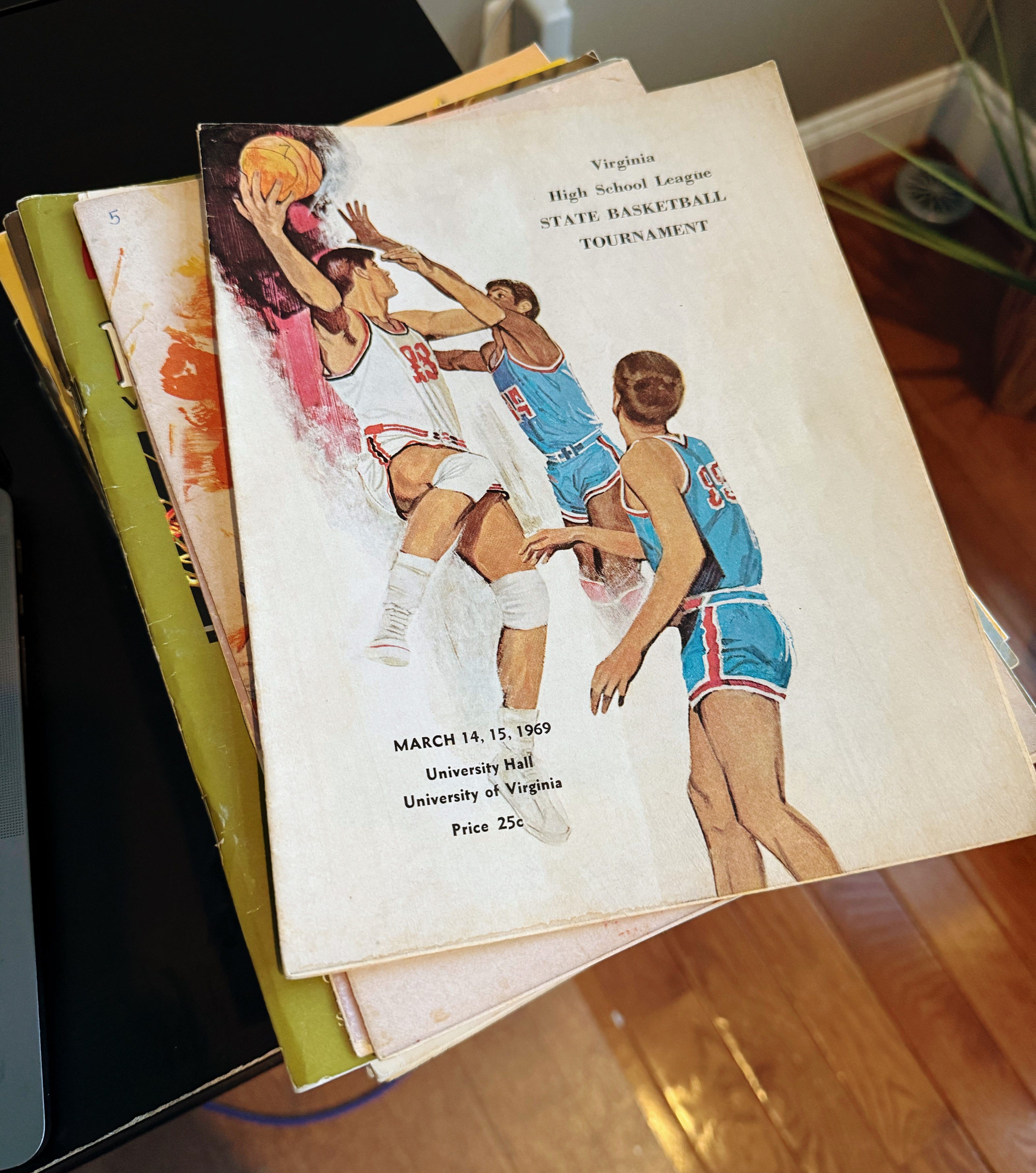
One of the great rituals of the state basketball tournament used to happen before the ball was even tipped. You walked into the gym, bought the program, and suddenly the whole tournament was in your hands.
To some of us, that program might as well have been scripture.
I would buy one at the first game and spend much of the opening half studying it as seriously as any coach studying film. Each team had its own page. I’d go through them slowly, one at a time — the roster, the heights, the season results, the team picture all on the same page.
In the days before the three-point shot stretched the floor, size meant everything. If a team had three players listed at 6’5” or taller, that was practically a prophecy.
Then came the results. Every game, every score. Who they beat. Who they lost to. Sometimes that raised troubling questions. How could a team good enough to make the state tournament possibly have lost to someone else along the way?
The team photo was always my favorite. The players stared back from the page with the unmistakable look of young men who knew they had arrived. We’re at states. We’re in the program. And you paid to get in.
Never mind that the photograph had probably been taken in November, when the season was still young and nobody knew how the story would end.
And the program didn’t stop with the teams. There were brackets, stories about the tournament, advertisements from local businesses, and the results from the previous year’s state championship games. It felt less like a pamphlet and more like a guidebook to the entire event.
These days the mystery is gone. Before the tournament even begins, we already know the teams. Social media has introduced them. Video clips circulate. Rankings update weekly. By the time the state tournament arrives, very few teams are strangers.
In some ways, that is progress.
In other ways it makes the program feel like something from a different era. Virginia hasn’t produced a printed one for years. For a while there was an online version, but even that has disappeared. A modern printed program would be unwieldy anyway. With today’s classifications and brackets, it would weigh as much as a college textbook.
But once, we treated those programs with reverence.
You didn’t just toss one on the bleachers. And if a friend asked to see it, the request carried a certain gravity. Handing over the program felt a little like letting someone take your sister to the dance. Possible, certainly — but not without supervision. I would watch the game with one eye and keep the other trained carefully on the program.
A few years ago I was reminded how much those things meant.
Legendary TJ coach Dick Wickline invited me to breakfast. We didn’t know each other especially well, but he had been watching my small crusade to revive stories about Virginia high school basketball — the players, the games, the legends.
Over coffee he handed me a box.
Inside were his state tournament programs. Every one of them, from 1960 through 2012. More than fifty years of basketball history, each program marked with his own handwritten notes — leading scorers, defensive schemes, observations only a coach would bother recording.
He had kept them for decades. Now, in his eighties, he believed the history needed a new caretaker.
It was an astonishing gift.
I spent weeks going through them. Some years I already owned, which only made it better — two copies meant one could be handled a little more freely. But opening the 1966 program, from a tournament played just a month after I was born in Petersburg, carried a particular thrill. The names, the teams, the small details of a season long finished — yet somehow still alive between those pages.
People like Coach Wickline understand something that’s easy to forget.
History doesn’t always live in museums.
Sometimes it waits quietly inside an old tournament program, until someone curious enough opens it and the whole tournament begins again.