

The Trump administration often speaks as though any nation that disagrees with American policy is not merely mistaken but evil — a word deployed so casually that it becomes a kind of moral solvent. Once an adversary is labeled evil, almost anything done to them begins to feel justified. We speak casually about annihilation, targeted killings, and the destruction of civilian infrastructure as though such language were routine. Even the public discussion surrounding possible strikes on Iranian leadership carried, at times, an air of open bravado. And beneath it all lies a political truth modern democracies rarely admit: it is far easier to sustain public support for war when the adversary is cast as a moral monstrosity rather than a nation pursuing its own interests.
Some of the finest war films understood this tension. Grand Illusion especially portrayed enemies who remained recognizably human even amid conflict. Even in bitter modern wars, occasional stories emerge of small acts of decency between combatants and prisoners. War is not always Bataan; cruelty is not the only register available to human beings in uniform.
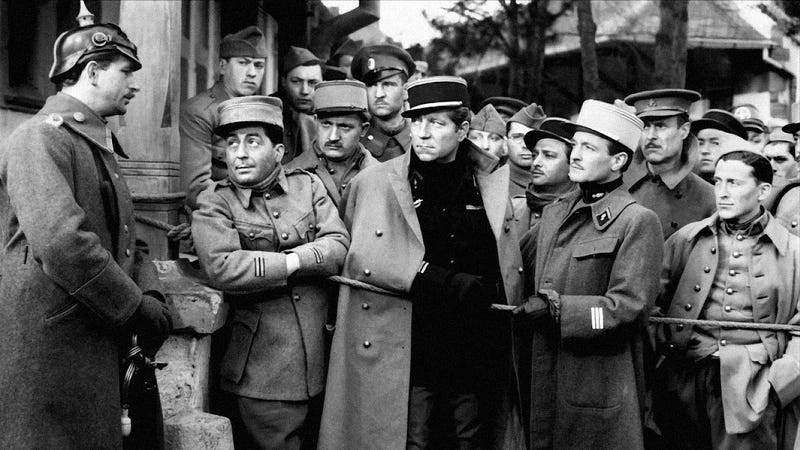
But modern conflict is increasingly framed in absolute moral language. The Cold War was presented as a struggle between freedom and evil empire. The Iraq wars, Afghanistan, and many recent conflicts involving Israel carried similar undertones of civilizational struggle. Strategic disputes become moral crusades. Opponents become embodiments of evil rather than nations pursuing interests, however harshly or cynically.
This is the danger of approaching war through the assumption that the adversary is evil. Our military operates under a Code of Conduct. We submit to the Geneva Conventions and to international norms not because our enemies are always virtuous, but because disciplined nations understand how quickly war drags human beings toward barbarism. The rules exist to keep us from tumbling in. And they work not only because we follow them, but because they create a framework of reciprocity that protects our own soldiers and civilians even when the other side falls short.
The Geneva Conventions are not sentimental. They are practical. They protect our soldiers when captured. They protect civilians when the tables turn. They remind us that the purpose of discipline is not only to win battles but to preserve our own humanity while doing so.
Perhaps, then, the answer is not to take no quarter, but to take a moment — to remember that the line between war and barbarism is thinner than we like to admit, and that the rules we impose on ourselves are often the only things preventing that line from disappearing entirely.