

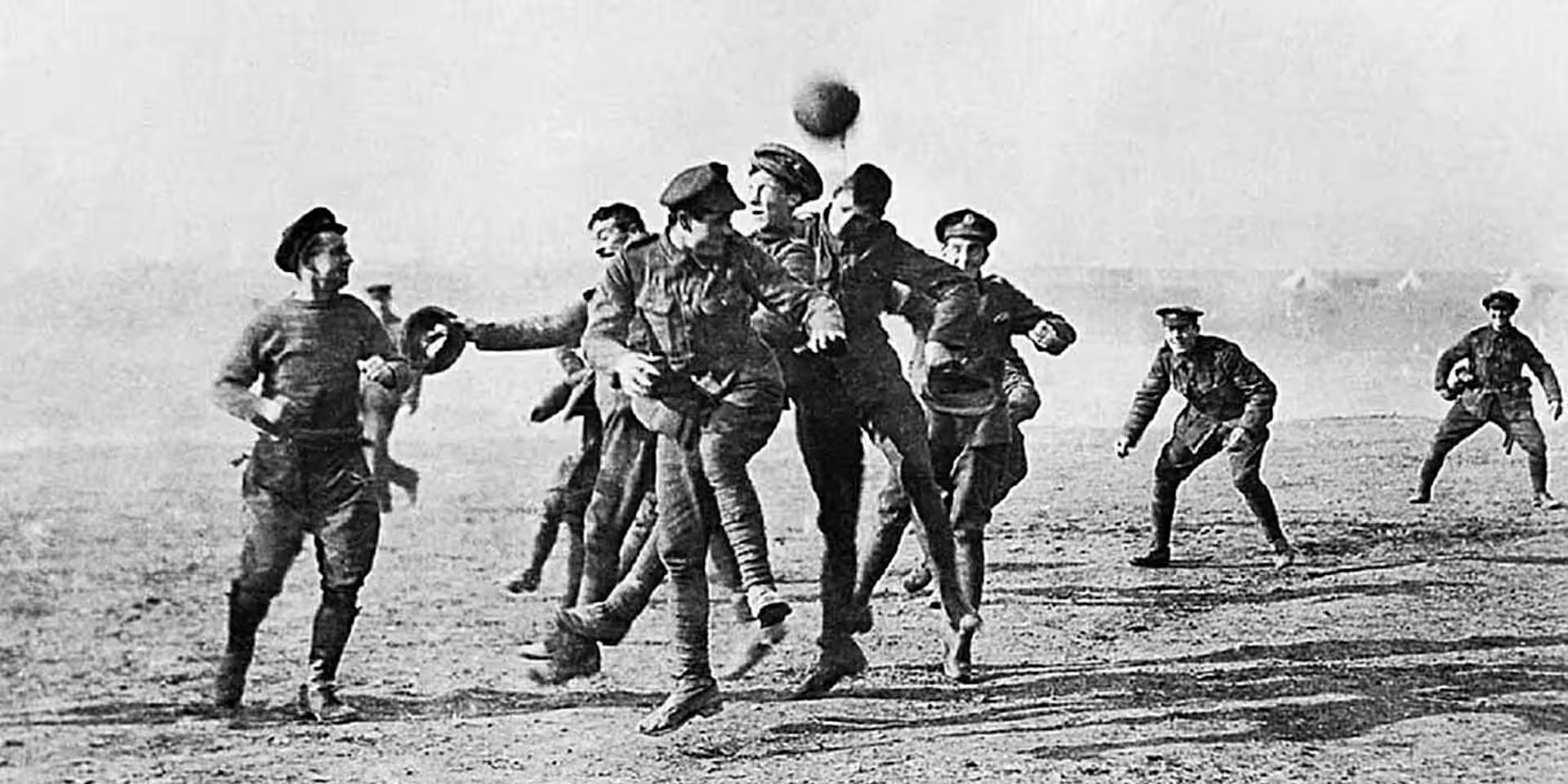
In the early days of the First World War, along the Western Front, there occurred—by now almost legend—a Christmas truce. Soldiers, having spent months in trenches, emerged cautiously to meet one another in the space between. There are accounts of conversation, of shared cigarettes, of small acts of recognition. Some say there was a football match. That detail may be embellished. The truce itself is not.
It did not last.
Military leadership on both sides understood the danger. If men came to see one another not as abstractions, but as individuals—if familiarity replaced distance—the machinery of war would falter. It is difficult, after all, to sustain hatred toward someone whose voice you have heard.
The war resumed, as wars do. But something had shifted. In the years that followed, the old European order—rooted in aristocracy and distance—began to give way. The costs of the conflict made visible a truth that had long been obscured: that the interests of those who fight are not always aligned with those who decide.
It is tempting to think of such moments as confined to history.
But there are suggestions—quiet, uneven—that we may be approaching something not entirely dissimilar.
In recent days, Donald J. Trump has spoken in terms of rendering Iran uninhabitable, even as he expresses admiration for leaders such as Kim Jong-un and signals openness to working with Vladimir Putin. At the same time, alliances that once seemed foundational—NATO among them—are treated less as commitments than as options, contingent and revisable.
This is not, in itself, unprecedented. Nations have always acted in their interest, and leaders have always exercised discretion in defining it.
What is less clear is whether the language and posture of leadership continue to reflect the instincts of the people they represent.
Globalization, for all its contradictions, has altered the terrain. People are more connected than at any point in history—through commerce, certainly, but also through communication, travel, and shared awareness. The distance that once made abstraction easy has narrowed. It is increasingly possible to see, across borders, not only difference, but resemblance.
This does not eliminate conflict. It does, however, complicate it.
It is worth asking, in this context, what exactly is being contested. Iran’s government has repressed its own citizens; this is well documented. But it is also true that power, in various forms, is exercised unevenly across the world. Nuclear weapons are not confined to one region. Standards are not always applied uniformly.
From this perspective, the question becomes less about any single nation, and more about the structure within which nations operate.
Will a world organized primarily around power—asserted, defended, and occasionally imposed—continue to command legitimacy? Or will there emerge, gradually and unevenly, a different expectation: that governance, whether domestic or international, must answer not only to authority, but to the consent and judgment of those who live under it?
Media can amplify nationalism. Leaders can appeal to identity, to grievance, to fear. These have always been effective tools.
But they are not the only forces at work.
There remains the possibility—still tentative, still fragile—that people, given the means to see one another more clearly, may begin to recognize common interests that transcend the categories in which they are often placed.
If that recognition deepens, even slightly, it introduces a subtle but consequential shift. It becomes more difficult to sustain narratives that depend on distance. More difficult to justify actions that appear, upon closer inspection, less necessary than asserted.
History offers no guarantees. The Christmas truce did not end the war. The twentieth century did not resolve the tensions it revealed.
But it did expose something enduring.
That beneath the language of nations, there are individuals.
And that when they encounter one another—even briefly—the terms of conflict can begin, however quietly, to change.
Whether that possibility expands or recedes is not solely a matter for governments to decide.
It may, in time, depend on whether people continue to see one another—not as adversaries to be managed, but as counterparts to be understood.
And whether that recognition, once made, proves difficult to forget.