

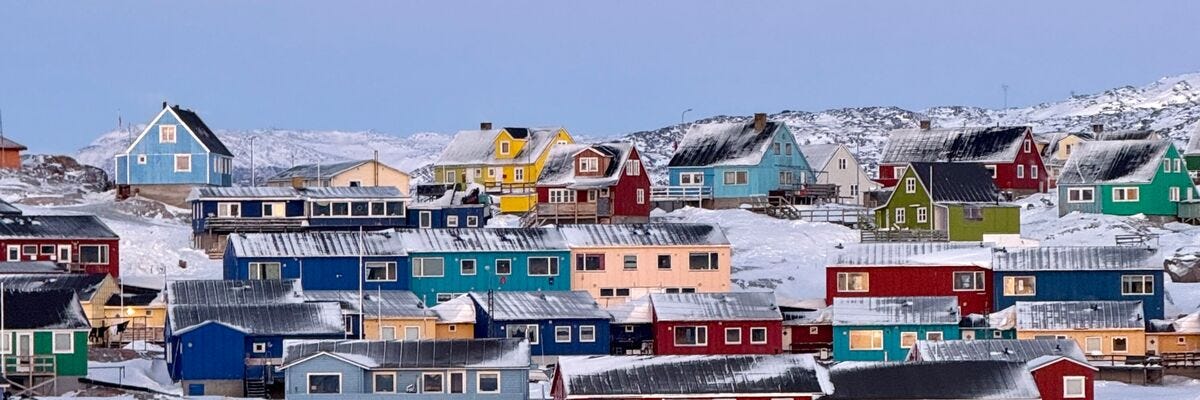
In the early days of Trump II, we heard the occasional trial balloon: we need Greenland. Perhaps as the fifty-second state, perhaps as a territory—details to be sorted out later. The idea briefly vanished amid other enthusiasms: Venezuela, mass deportations, the casual resolution of nine wars. But now Greenland is back in the news, complete with a newly appointed American “special envoy,” and with it a familiar exhibition of American self-regard.
Greenland is not a blank space on a map awaiting sensible ownership. It is a place of extraordinary difficulty and endurance. Its towns and hamlets are scattered across one of the harshest terrains on earth, often connected only by water or air. It has one of the highest suicide rates in the world. Life there is demanding in ways few Americans can easily imagine.
And yet Denmark—patiently, unglamorously—has managed to provide world-class healthcare across this vast and forbidding land, subsidizing daily life while preserving Greenland’s culture and character. Against considerable odds, many Greenlanders thrive.
The United States, of course, already has a presence there. We maintain military bases and have long cooperated with Greenland and Denmark in containing global threats—from Nazi Germany to the Soviet Union to modern Russia. Greenland has been a willing partner. But partnership is not possession, and cooperation is not entitlement.
Yes, Greenland is rich in natural resources. And yes, the temptation to extract them is obvious. But at what cost—and for whose benefit? In an era acutely aware of environmental limits, few trust a Trump administration or a Republican Party that treats planetary stewardship as an inconvenience to be brushed aside when profits beckon.
Nor is the social bargain remotely comparable. It is difficult to imagine a Greenlander surrendering comprehensive healthcare—delivered under Arctic conditions—for an American system that begins with a four-figure deductible and ends in negotiation with an insurance company.
The world also remembers Puerto Rico. When a devastating hurricane left the island desperate for aid, the president appeared irritated by the inconvenience. Paper towels were tossed. Gratitude was expected. The moment entered history as something between farce and insult—an almost perfect modern echo of let them eat cake. One is tempted to borrow Mel Brooks instead: the people are revolting.
What was an acute crisis in Puerto Rico is, in many respects, daily life in Greenland: distance, exposure, logistical fragility. The difference is trust. The world trusts Denmark to meet those challenges. It does not trust the Trump administration.
And that, more than minerals or maps, explains why Greenland is not for sale—and why the very suggestion reveals far more about American drift than Arctic destiny.