

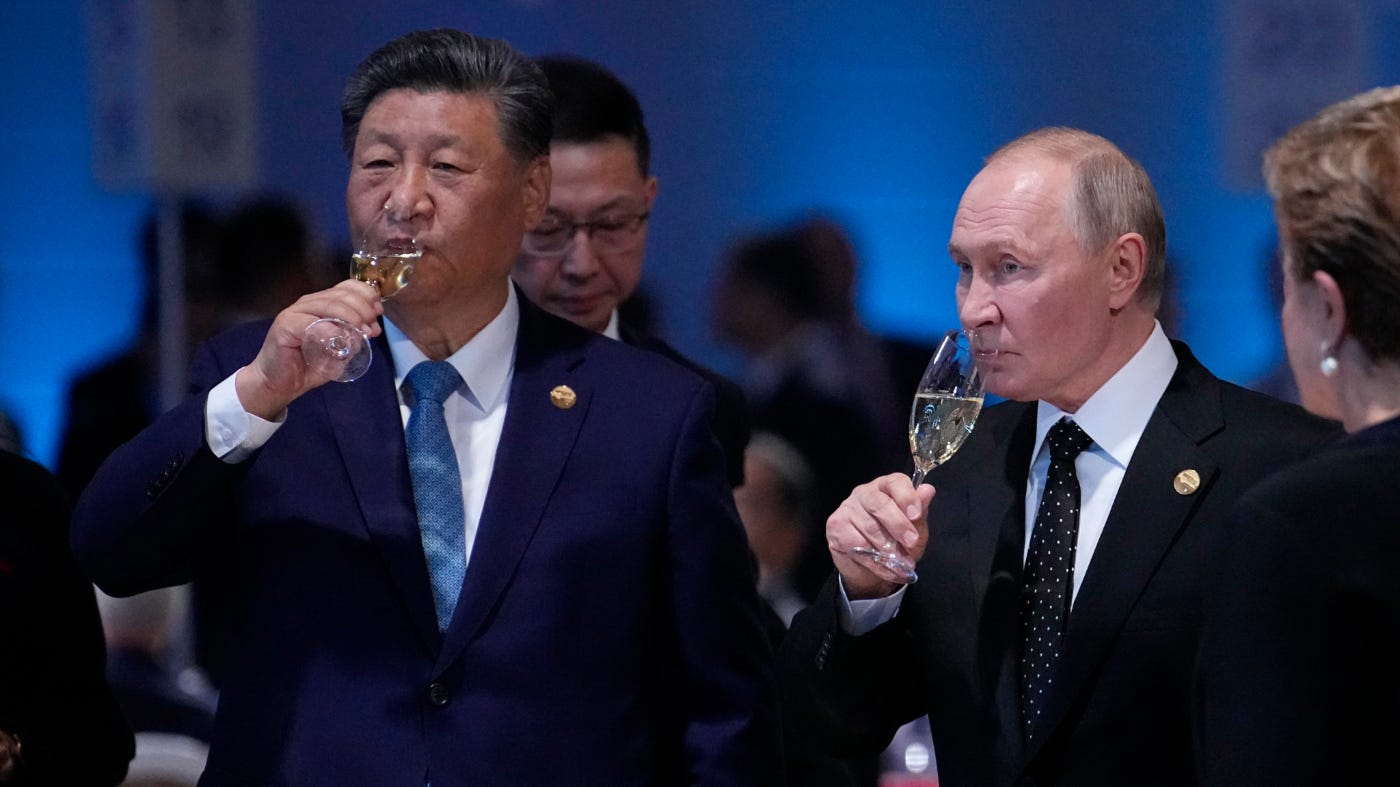
When Vladimir Putin invaded Ukraine, he committed Russia to a war of territorial conquest whose costs have proved vastly greater than he appears to have anticipated. Nearly five years later, the conflict grinds on. Having failed in his early effort to bend Kyiv to his will, Putin finds himself locked in a costly struggle in the Donbas, a campaign marked more by attrition than decisive success. His earlier ventures in Georgia and Crimea produced relatively swift gains; the rest of Ukraine has proved a different matter altogether.
The language of territorial expansion has not been confined to Moscow. Donald Trump has repeatedly raised the prospect of acquiring Greenland, incorporating Canada into the United States, and extending American influence elsewhere in the hemisphere. His rhetoric is not equivalent to Putin’s invasion, but it reflects a similarly old-fashioned conception of national greatness, one in which the expansion of territory or sphere of influence is itself treated as evidence of power.
Such ambitions raise an interesting question: does national greatness still depend upon the size of a country’s territory, or has the relationship between geography and power fundamentally changed?
For most of human history, land was a principal measure of national strength. Territory meant population, resources, agricultural output, strategic depth, and military power. Empires expanded because acquiring land often meant acquiring wealth.
Yet the twenty-first century offers examples that challenge this assumption. Singapore possesses almost no strategic depth and few natural resources, yet it enjoys one of the world’s highest standards of living. Switzerland, similarly, has long demonstrated that financial stability, advanced industry, sound institutions, and global commerce can generate prosperity without territorial expansion.
China provides an important qualification to any claim that geography no longer matters. Its vast territory, enormous population, strategic resources, and access to major maritime routes remain substantial sources of national power. Yet China’s rise has depended at least as much on industrial capacity, technological development, education, infrastructure investment, and integration into global trade. Its territorial ambitions, particularly regarding Taiwan and the South China Sea, demonstrate that Beijing has hardly abandoned traditional conceptions of geographic power. Nevertheless, China’s economic transformation has been achieved primarily by developing its existing resources and capabilities rather than acquiring additional territory. It has sought to combine the traditional advantages of geography with the modern advantages of innovation and economic sophistication.
Neither Singapore’s nor Switzerland’s success, nor China’s example, means geography has ceased to matter. Geography still confers advantages and imposes constraints. But these examples demonstrate something important: a nation need not enlarge its borders to become extraordinarily prosperous or influential.
The economies most likely to lead the future may be those that invest not merely in land and resources but in technology, artificial intelligence, advanced manufacturing, education, and financial sophistication. Natural resources, energy, and strategic geography will remain important. Indeed, technological change can make certain resources and locations more valuable than ever. But territorial accumulation is no longer a reliable measure of a nation’s economic potential. Geography today is often a multiplier of success rather than its primary cause.
None of this diminishes Ukraine’s stake in defending its territory. For Ukrainians, the war concerns not simply land but sovereignty, independence, and national survival. A nation’s right to govern itself does not depend upon the economic value of the territory it occupies. Nor does surrendering land necessarily satisfy an aggressor whose ambitions extend beyond the immediate battlefield.
Russia’s leadership appears animated, at least in part, by a historical vision that reaches beyond contemporary borders and draws upon memories of empire and the former Soviet Union. Yet conquest carries costs of its own. Armies must be sustained, occupied populations controlled, and resources diverted from productive investment. Russia is sacrificing lives, capital, and economic opportunity in pursuit of territory whose acquisition may never compensate for those losses. Even military victory would not necessarily amount to national success.
The broader lesson of our age may be that greatness is increasingly earned rather than acquired. Geography still matters, but it matters differently than it once did. The decisive advantages of the twenty-first century are increasingly found not beneath a nation’s soil but within its institutions, its technologies, and the capabilities of its people.
Putin has spent nearly five years trying to enlarge Russia’s borders. In doing so, he may be weakening the very foundations of Russian power. China, despite its own territorial ambitions, has demonstrated that developing industrial, technological, and economic capabilities can accomplish far more than the acquisition of additional land. The contrast is instructive. The countries most likely to prosper in the decades ahead will not necessarily be those that possess the most territory, but those that make the most effective use of the territory, institutions, and talent they already have.