

In the coming weeks, another class of high school seniors will play their final games. For most, it will be the last time they compete in anything like this. There is plenty to look forward to—prom, graduation, beach week—but for those still playing, the season lingers just a little longer. One more match, one more chance. That, in itself, is enough.
It brings me back to my son’s final season at Yorktown.
They entered the year as defending Northern Region champions and state runners-up, a group that had grown together and understood what was possible. For me, it was a complicated vantage point. I had spent more than a decade as a soccer parent, and I could see the end approaching—not just for him, but for me as well.
He was never the athlete I imagined myself to be at his age. I had been louder, more physical, more inclined to impose myself on a game. He was something else entirely—measured, thoughtful, a player who saw patterns rather than collisions. Early on, even getting there was uncertain. He missed travel teams, found his way through different clubs, and slowly, almost quietly, improved.
What he developed was not flash but awareness: the habit of knowing the next pass before the ball reached him, and of being in the right position so others could do their work.
By the time he reached Yorktown’s varsity, that quality fit. The team was well-coached, organized, and unselfish. Under Carlos Aranda, they played a kind of game that rewarded intelligence: keep the ball moving, avoid unnecessary risk, trust structure over spectacle. It suited him, and it suited them. They won a district title, then a regional final against South Lakes that felt as tense as anything in the high school game, before falling just short in the state final.
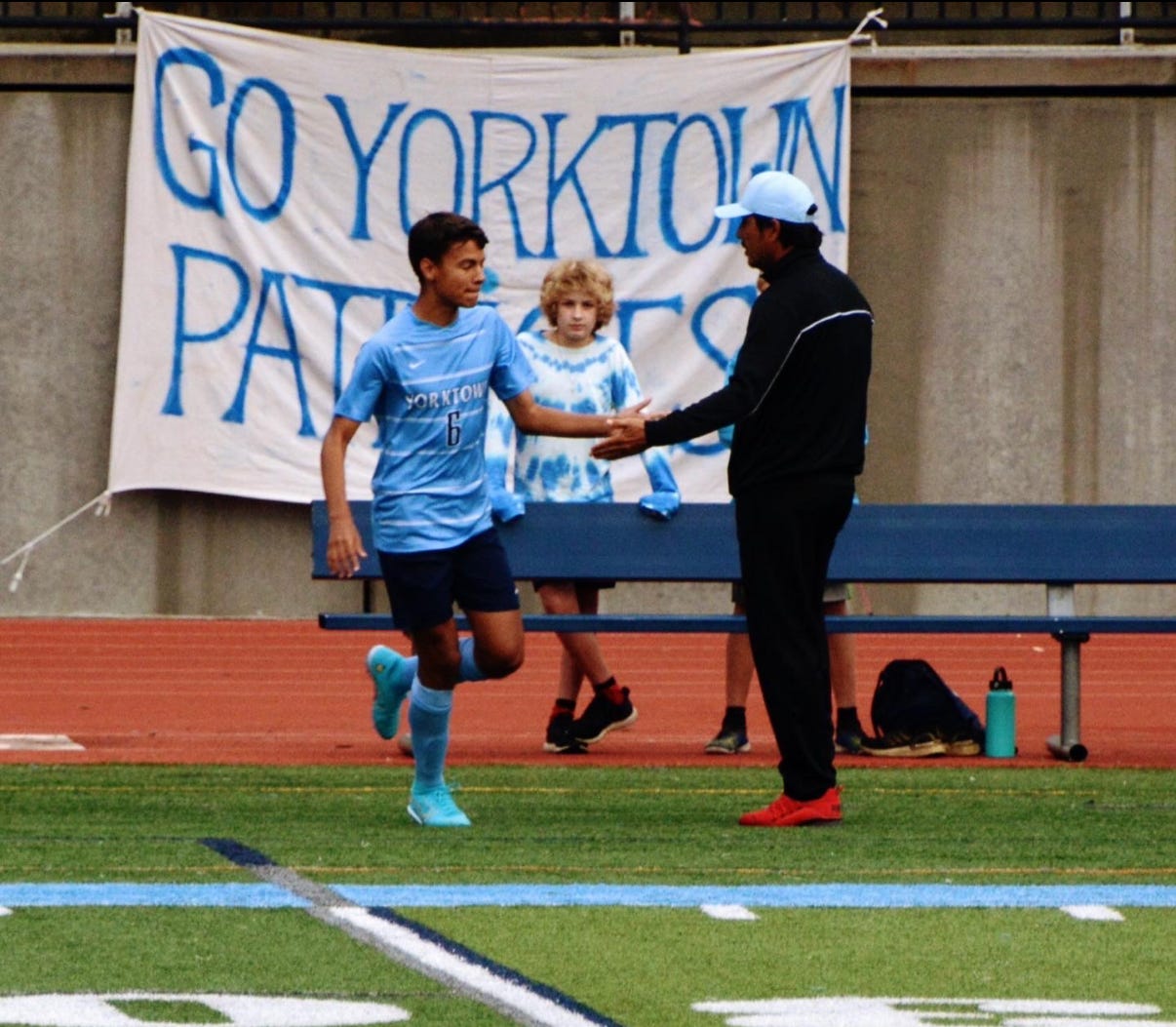
Senior year offered another chance, though it rarely unfolds cleanly. Yorktown began well—undefeated through the early stretch—but injuries accumulated at the worst time. Key players were limited or unavailable as the postseason approached, and the margins narrowed.
The district final came on a brutally hot day at Washington–Liberty. He fought through cramps just to stay on the field, the kind of detail that rarely shows up in a box score but defines how a season feels from the inside. They lost.
A few days later, they faced South Lakes again, this time with everything on the line. He played that night with a clarity that comes only when there is no next game guaranteed—covering ground, closing space, the work that allows others to play.
It was enough to advance, but not beyond.
In the regional semifinal against McLean, missing key pieces, Yorktown created chances but could not convert them. McLean could. The winning goal came from a moment he still carries—a rotation that developed on the play, an attacker moving into space that might have been followed a step earlier, a shot that found its way in. It is rarely one player’s responsibility, and never that simple. But those are the moments players remember.
And then it was over.
It always is.
The rest of senior year moved quickly—graduation, goodbyes, the transition to what comes next. He went on to the University of Virginia, as I once did, and now approaches graduation himself.
Looking back, what stays isn’t any one result, but the arc itself: the way he found his own path in a sport that never came easily, and the way he met its ending. He played his best soccer when it mattered most—not through force, but through understanding. In hindsight, the irony is hard to miss: while I had once measured athletic success narrowly, he was helping take a team to a state final quietly, intelligently, and in ways I never managed as a player.
There are different ways to be an athlete.
For a long time, I thought I understood that. Watching him, I learned otherwise.