

“Speak softly and carry a big stick; you will go far.”
So wrote Theodore Roosevelt—in a phrase he attributed, with characteristic modesty, to a West African proverb. The provenance remains uncertain. The wisdom does not.
Roosevelt expanded on the thought more plainly: bluster, by itself, is no substitute for strength; nor is softness persuasive if it is not backed by it. The balance—between restraint and capacity—was the point.
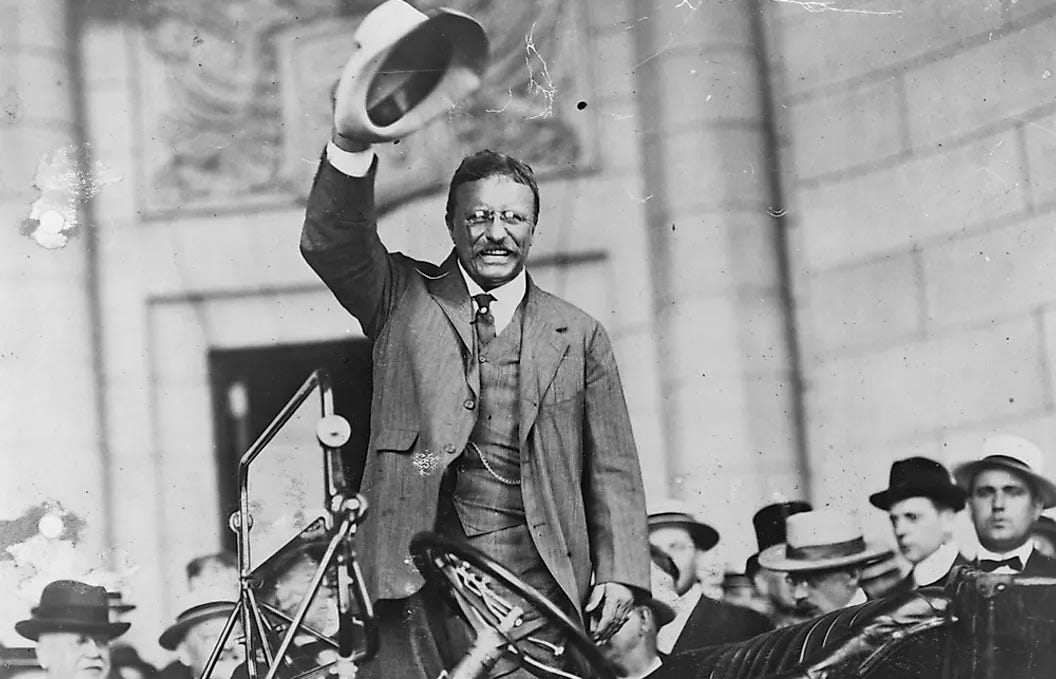
His own life gave the idea a certain authority. His charge up San Juan Hill came when the United States was still emerging from the long shadow of the Civil War—more a regional than a global power. As president, Roosevelt possessed both the inclination and the credibility to use force. One may debate the consequences of American expansion into Cuba and the Philippines; the record invites it. But the principle he articulated—of measured language paired with real capability—was not theoretical. He practiced it.
It is worth asking how that principle translates today.
We live in a moment when American officials—presidential and military alike—speak frequently of strength in its most explicit terms: lethality, dominance, overwhelming force. The language is not subtle. It is meant to signal resolve, and perhaps to deter. But when strength must be constantly described, one begins to wonder whether it is being demonstrated—or compensated for.
Deterrence does not depend on repetition. A country already recognized as the most capable military power in the world does not strengthen its position by announcing the fact with increasing volume. At some point, repetition ceases to signal strength and begins to suggest its absence.
The temptation to reverse that order—to speak first, and rely on strength to follow—is not new. But it is newly visible.
Roosevelt understood something that is easier to admire than to practice: that credibility is not enhanced by constant declaration. It is, in a sense, diminished by it.
He was not a pacifist. Far from it. One suspects that, had he lived to see the architecture of the twentieth century—the emergence of alliances, institutions, and forums for negotiation—he might have made use of them, if only as instruments of order alongside power. Strength, in his conception, was not an alternative to diplomacy, but its foundation.
Which raises the more difficult question.
If force must be used, does it benefit from having been advertised in advance? Does a threat become more effective through repetition, or less so? And does a nation gain leverage by describing, in vivid terms, what it is already understood to possess?
There is, finally, a difference between possessing a big stick and speaking about it. Roosevelt’s insight was not merely that both matter, but that the order—and the proportion—are everything. When the speaking overtakes the substance, the balance is lost.