

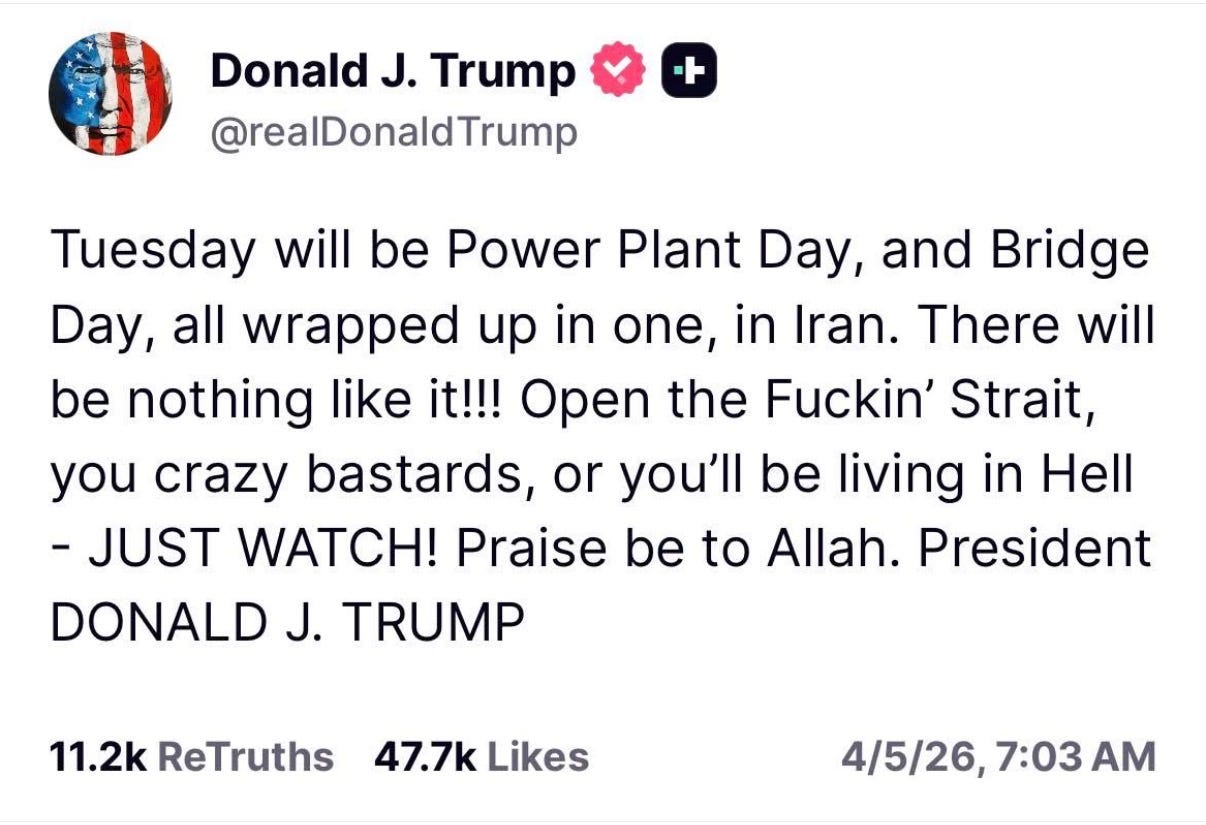
On Easter morning, Donald Trump issued a message that was deeply troubling in both policy and tone. It spoke explicitly of destroying infrastructure—bridges, power facilities—with a tone of theatrical certainty. It is the sort of language that cannot be dismissed as rhetorical excess. In matters of state, tone is never merely ornamental.
There is an older understanding of power, articulated most clearly by George Kennan, that influence rests not only on what a nation can compel, but on what it demonstrates. The United States, for much of the twentieth century, exercised a form of leadership that combined strength with restraint. Its authority did not derive solely from military capacity, but from a broader perception—however imperfect—that it aspired to something beyond it.
That perception mattered. It allowed the United States a degree of latitude in pursuing its interests that few nations have enjoyed. It was not simply feared; it was, in critical moments, trusted.
The present moment is less settled—and less forgiving. Russia, following its invasion of Ukraine, has been met with widespread sanction and isolation. China advances its interests with patience abroad while maintaining firm control at home. Iran continues its long pattern of regional disruption and internal repression. None of these actors offers a model the West would wish to emulate.
And yet, the comparison is no longer theoretical; it is being quietly drawn.
When American leaders adopt a language of unqualified destruction—when they speak in terms that blur the line between deterrence and spectacle—they are altering the very standard by which others are judged. Power, expressed without discipline, begins to resemble the conduct it seeks to oppose.
This is not an argument for passivity. It is an argument for proportion. The credibility of American leadership has always depended on a certain coherence between its means and its manner. When that coherence frays, the effect is not immediate collapse, but gradual erosion.
The world is attentive. It does not merely register actions; it interprets posture. If the United States appears to abandon restraint, others need not improve to gain relative standing. They need only appear steadier.
In such a contest, perception is not secondary. It is decisive.
This is the quiet risk.
That in seeking to demonstrate strength, we diminish the very distinction that has long made American power persuasive.
And that, in time, may matter more than any single act of force.