

Donald Trump arrived at the G7 with the swagger of a man convinced he is the indispensable figure in the room. He is, after all, president of the United States — commander of a military unmatched in scale, steward of an economy that remains the envy of much of the world. But how he is viewed abroad is not how he is viewed within the friendly confines of American media. The other leaders see a different picture.
They see a United States that has struggled in its venture in Iran — a costly undertaking they declined to join, one that now appears to be winding down without meaningful strategic gain, save for Iran’s discovery that it possesses more leverage than Washington assumed, particularly in the Strait of Hormuz. They see a president who has been, at times, an antagonist toward Volodymyr Zelensky, yet Ukraine continues to survive without decisive American leadership. They see tariffs imposed without consultation, lectures delivered without diplomacy, and a United States that seems increasingly uninterested in the collective problems of the world.
In short, they see a superpower that is powerful, yes — but unpredictable, inward‑looking, and difficult to rely upon.
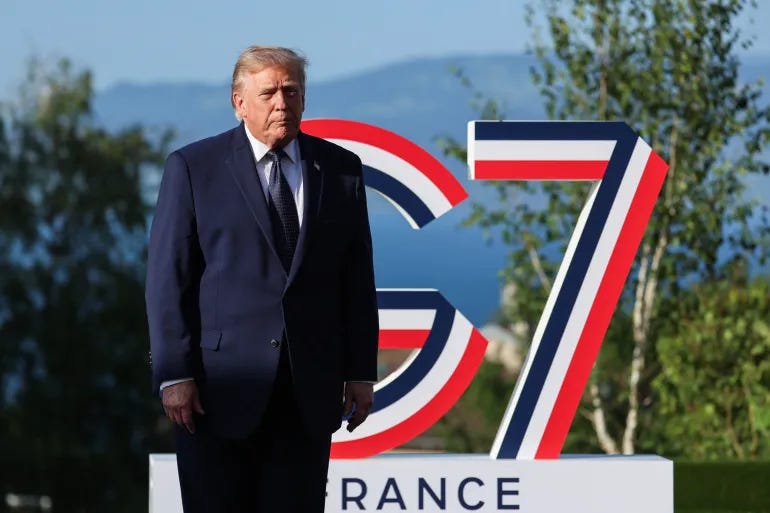
And so these leaders find themselves in an awkward position. They cannot afford to be hostile to the American president; the United States still carries immense weight. But they cannot quite cheer for him either. A stronger America, under this administration, may not align with their own interests. They watched the U.S. emerge from the pandemic downturn more quickly than many expected, yet they see little evidence that Washington is prepared to use its recovery to strengthen alliances, confront China collectively, or rebuild the international architecture that once defined Western strategy.
They are left wondering what exactly the United States stands for — and whether Americans themselves are certain.
The conflict is not personal; it is structural. The world needs an engaged America, but it also needs a predictable one. And as the G7 leaders look across the table, they must ask themselves a question that Americans, too, are quietly asking: are we cheering for the United States, or merely enduring it?