

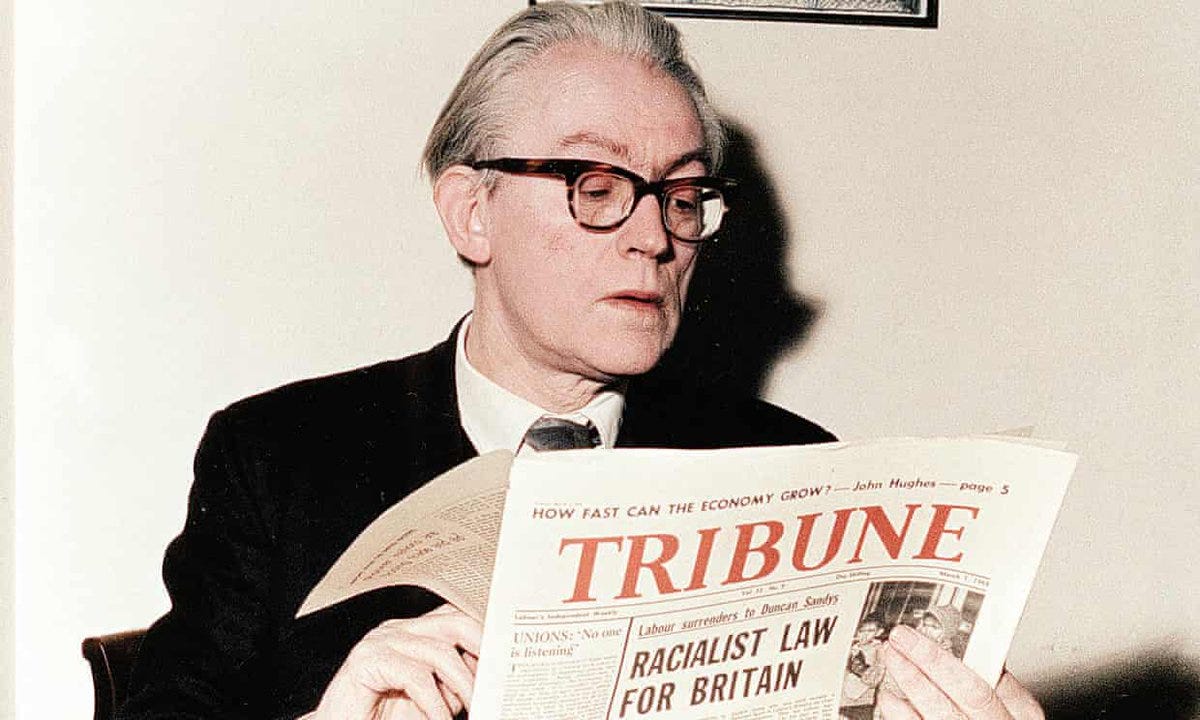
I was recently watching a 1982 BBC interview with Michael Foot — the brilliant British politician and philosopher — in which he explained Labour’s position on unilateral nuclear disarmament. Foot believed Britain should give up its nuclear weapons, not out of naïveté, but in the hope that unilateral action could begin reversing the logic of proliferation itself. Britain could show leadership by stepping back, encouraging other nuclear states to do the same, and pushing the superpowers toward disarmament.
It feels like a world away from 2026.
Less than forty years after Hiroshima, the danger of nuclear war was still vivid. Progress meant moving away from that danger, even if it left one’s own country in a relatively weaker position. And Foot was no fringe figure; he was a major force in Labour politics for generations. His argument was serious, moral, and grounded in a belief that civilization should aspire upward.
Many would say that Foot may have been wrong about the policy. What is striking now is how difficult it has become even to imagine the aspiration.
Today’s world is almost the opposite.
Nuclear weapons have become a symbol of strength. North Korea and Pakistan are treated with more caution — and, in some circles, more respect — because they possess them. Iran, meanwhile, offers the opposite lesson: lacking a nuclear deterrent can leave a country terribly exposed. Nuclear capability has become a kind of geopolitical credential, a badge of seriousness rather than a burden of responsibility.
And Britain kept its arsenal.
That decision looks rather different today than it did in Foot’s time. With doubts about the reliability of the American nuclear guarantee, Britain’s independent deterrent has assumed greater importance within NATO and for allies such as Canada. France possesses its own independent arsenal, but Britain formally assigns its nuclear capability to NATO. A country that Foot believed could lead the world by relinquishing nuclear weapons now finds that those same weapons give it an importance within the Western alliance that few would have imagined disappearing forty years ago.
Foot’s view was not universally shared even in his own era, but it reflected a broad intuition: that the ability to destroy cities and nations was not something to celebrate. It was a danger to be contained. Today, unilateral disarmament is not merely unfashionable; it is nearly unthinkable. The idea that a nation might voluntarily step back from nuclear power now seems almost quaint.
Civilization has not advanced in this respect. It has retreated.
We have moved from a world that feared nuclear weapons to one that increasingly treats them as ordinary instruments of statecraft. Foot would not have been surprised by the persistence of human folly, but he might have been startled by how completely the incentives have reversed. The countries that possess nuclear weapons are treated cautiously. Those seeking them may be attacked to prevent them from succeeding. And every government watching can draw the obvious lesson.
The tragedy is not simply that Michael Foot lost the argument.
It is that forty-four years later, we can barely imagine anyone making it.