

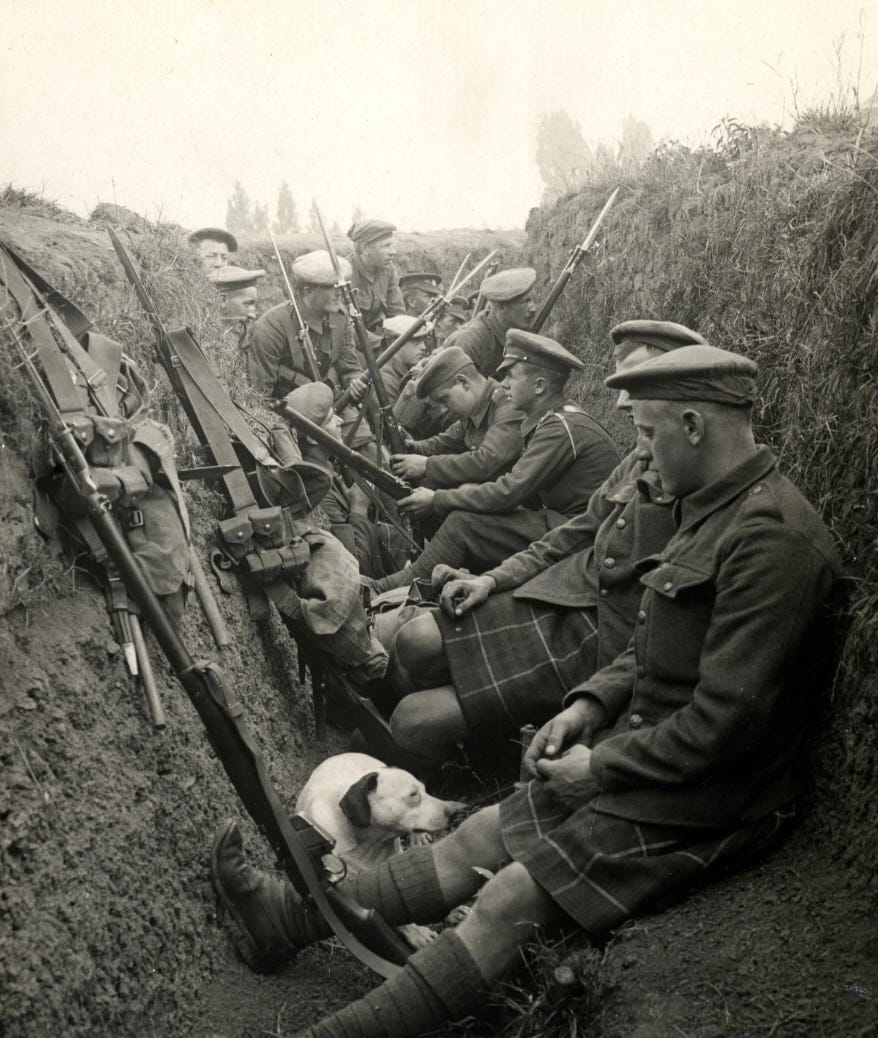
By the end of the first year of the Great War, it was clear Germany faced a grim strategic reality. The initial drive through Belgium and into France had brought German forces within kilometers of Paris, but the defeat at the Marne ended Germany’s hope for a quick victory in the west. The armies dug in. Germany still occupied substantial French territory, but it had fallen far short of its aims. And with its ally Austria-Hungary proving woefully unprepared for war against Serbia and Russia, Germany faced the prospect of a prolonged struggle on two fronts against enemies that collectively possessed greater resources.
Could peace have been possible on at least one front?
France had little reason to negotiate while German troops occupied French territory. But if Germany simply surrendered that territory — its principal bargaining leverage — what would its leaders tell a public that had been promised victory? Hundreds of thousands had already been killed or wounded. Was Germany now to return to something resembling the prewar map and explain that all of it had purchased nothing?
Sometimes a nation must cut its losses.
Selling that politically is another matter entirely.
Jared Kushner recently provided an unusually blunt illustration of the problem. Acting as an American mediator — and presidential son-in-law — he said that Vladimir Putin had identified the territorial line Russia wants and that, if Ukraine withdrew to it, much of the rest of a peace agreement was essentially in place.
It is easy to understand why Ukrainians found the formulation offensive. It is harder to dismiss the problem underneath it.
What settlement can either government actually survive politically?
Can Putin absorb the financial and human cost of more than four years of full-scale war and then tell Russians that territory Moscow claimed as an objective will remain Ukrainian? Conversely, can Ukraine accept a settlement requiring it to surrender territory Russia has failed to conquer?
For Ukraine, the question is not merely cartographic. The country has endured invasion, destroyed cities, enormous casualties and Russia’s deportation and forcible transfer of Ukrainian children — conduct a United Nations commission has concluded constitutes crimes against humanity. Peace requiring Ukraine to relinquish additional territory would therefore carry its own enormous political and moral cost.
And therein lies one of war’s crueler paradoxes.
The longer a war continues, the stronger the argument for ending it becomes.
And the harder ending it can become.
Every additional death increases the cost of continuing. But every additional death can also increase the political and psychological cost of accepting a settlement that appears not to justify the deaths that came before it. Leaders must explain what the sacrifice purchased. Families naturally ask what their sons and daughters died for. Governments that promised victory must explain why something less has become acceptable.
There are many reasons not to go to war. For a time, we even imagined war might become a relic of history, restrained by the logic of mutual destruction and the accumulated horrors of the twentieth century.
It turns out there is another reason.
Wars are extraordinarily difficult to end.
Eventually the mediator arrives with maps.
Give up this territory. Withdraw from that territory. Recognize this border. Accept that one. Each proposal can look perfectly rational on paper.
The dead are not on the map.
That may be one reason wars are so much easier to begin than to end.
Before a war, leaders must persuade people that the objective is worth dying for.
To make peace, they may eventually have to persuade them that it is worth stopping short of it.