

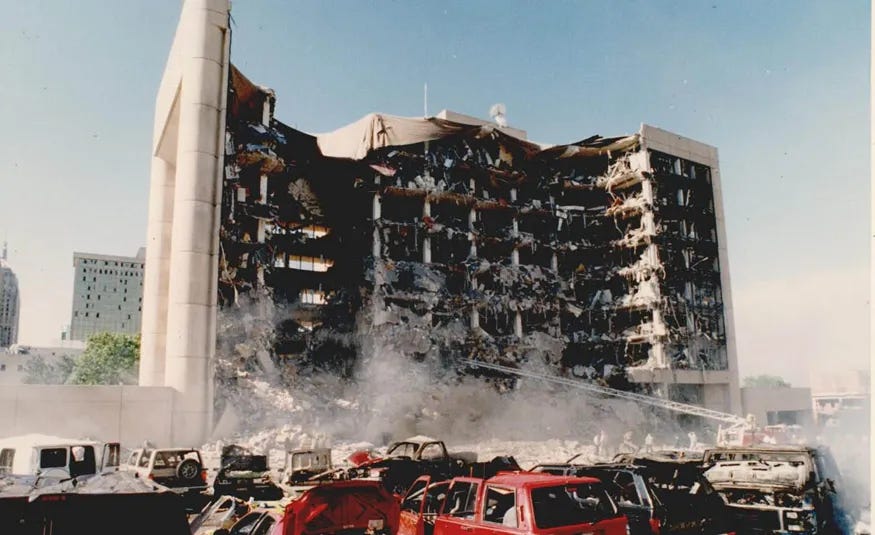
In the 1990s, when Timothy McVeigh parked a truck bomb outside the Murrah Federal Building in Oklahoma City and killed 168 people, I remember being genuinely perplexed by the idea that the federal government was “out to get us.”
Growing up in the sunset of the civil‑rights era, I had been conditioned to see federal power differently. Washington had enforced voting rights, protected minorities when states would not, and expanded individual liberties. It was hardly always benign, but in the history I had witnessed and learned, federal power had often been the instrument that protected ordinary people from abuses closer to home.
Republicans increasingly saw something different.
Waco and Ruby Ridge gave new intensity to an older conservative suspicion of Washington. The gun‑rights movement argued that citizens needed weapons — including semi‑automatic weapons — not merely for hunting or self‑defense, but as protection against an unjust government. Federal agents themselves became objects of suspicion. The logic was stark: if the government ever came to your home, you might need the means to resist it.
Then came Oklahoma City.
McVeigh had absorbed precisely this vision of federal power. He had visited Waco during the siege and later described the government as having declared war on the American people. His target in Oklahoma City was not a military installation. It was a federal office building filled largely with ordinary government employees.
And yet even after 168 people were murdered, including children, prominent Republicans remained deeply wary of giving the federal government additional authority. Newt Gingrich warned that the fear of Washington could not simply be dismissed as extremism and continued defending efforts to repeal the assault‑weapons ban. Other conservatives argued that expanded surveillance of militia groups would itself represent an unacceptable expansion of federal power.
I found the argument extraordinary.
But at least it contained a recognizable principle: government power is dangerous.
Somewhere along the way, that principle changed.
Today federal immigration agents can operate masked, conduct street and traffic stops, and exercise extraordinary authority over people they suspect of being in the country unlawfully. And among many of the same political constituencies once most suspicious of federal agents, the presumption often seems to run in the opposite direction.
When federal immigration officers shot two U.S. citizens in Minneapolis earlier this year, President Trump and senior administration officials publicly characterized the victims as aggressors almost immediately. Subsequent video and other evidence contradicted important parts of the administration’s initial accounts. In other encounters, official descriptions of shootings have likewise been challenged by video evidence.
In another Minneapolis case, an ICE officer is now federally charged with lying to the FBI about a shooting. Prosecutors allege that video contradicted his account of being attacked before he fired. He has pleaded not guilty.
None of that establishes that federal agents are generally wrong or that every person they stop is innocent.
It establishes why scrutiny of government power matters.
And that leaves a question I find difficult to escape.
What changed?
How did government employees — even routine bureaucrats sitting in offices in Oklahoma — once come to symbolize a federal government so threatening that citizens needed military‑style weapons to protect themselves from it, while masked federal agents exercising coercive power on American streets can now receive something approaching automatic deference from many Republicans?
Is it the mission?
Is it the identity of the people being targeted?
Or did we never really disagree about the size of government as much as we disagreed about whom government should protect and whom it should restrain?
The transformation is striking. The Republican suspicion of federal power that once animated arguments over Waco, guns, surveillance, and Washington itself has not simply disappeared. It appears increasingly selective.
Perhaps that is the deeper shift.
The fear of government once centered on the idea that federal power might intrude on “us.”
Today, the comfort with government power can seem to rest on the belief that it will be used on “them.”
That is not necessarily a change in the amount of government power we tolerate.
It may be a change in whom we are willing to tolerate it being used against.