

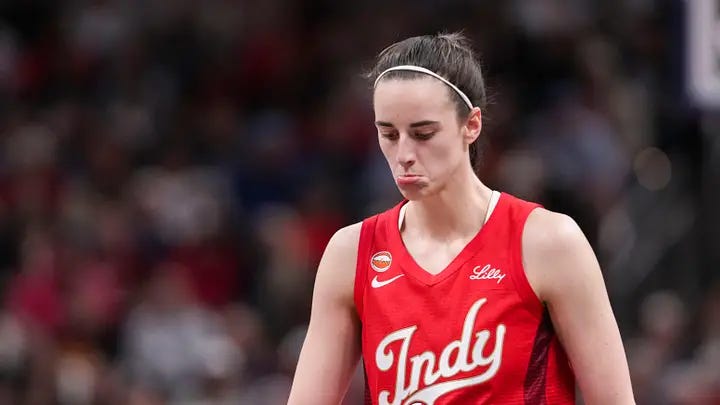
I sometimes hear a faint echo of 1985 when I say something complimentary about Caitlin Clark online. Back then, a Black college student praising Larry Bird risked being accused of apostasy. Not that any of us ever praised him. Bird, of course, is beloved now. Time has a way of sanding down the edges. Caitlin Clark inspires nothing quite like the old Boston‑versus‑everybody animus, but she does provoke a similar instinct in the public: the urge to find something wrong with her.
She turns the ball over too much.
She hasn’t won a major title.
Other players are more decorated.
All true.
And yet she remains one of the most compelling athletes in America.
Part of the fascination is athletic. Part of it is cultural. Clark seems to provoke debates that extend well beyond basketball.
Part of that is her style of play. Clark attempts passes others would never attempt and takes shots others would never dare take. She plays with visible ambition. Success and failure are both magnified because she constantly operates at the edge of what seems possible. That makes her exhilarating to watch and, inevitably, easy to criticize.
She is also singular. She has pulled NCAA women’s basketball and the WNBA into a brighter spotlight — not only through admiration, but through the friction she generates. Love her or resent the attention she receives, she has expanded the stage, the audience, and the revenue for everyone. That, as the economists say, is a rising tide that lifts all boats.
I can say this with some authority: I never watched the WNBA until Caitlin Clark. Because of her — and the attention orbiting her — I tuned in and watched every game of her rookie season. I was hardly alone.
The latest critique concerns her behavior. She barks at officials. She gestures in frustration. She snaps at her coach and occasionally earns a seat on the bench. She reacts sharply to contact. In other words, she behaves like a highly competitive athlete in the heat of competition.
But American sports have long been generous in their interpretation of male competitiveness. We call it intensity. We call it fire. We call it leadership. A quarterback argues with an official, a point guard slams a chair, a baseball manager erupts from the dugout, and commentators often fold the behavior into the mythology of greatness. We have always been quick to canonize the tempers of our sporting heroes, but in Caitlin Clark’s case we convene a committee.
Clark’s frustrations are subjected to a different level of examination. The scrutiny is not always unfair, but it is often disproportionate. The reaction suggests that we are still negotiating what competitiveness is supposed to look like when it is displayed by a woman who occupies the center of the sports conversation. Much of what is treated as evidence against Clark would attract far less attention if displayed by a celebrated male star. We might criticize the behavior. More often, we would shrug and say he hates losing.
Caitlin Clark has altered the landscape of American sports and media. We cannot seem to take our eyes off her, and she has become a kind of cultural mirror. The reactions she provokes — admiration, irritation, resentment, fascination — tell us as much about ourselves as they do about her.
And that, perhaps, is not merely a story about Caitlin Clark. It is a story about how we decide which forms of ambition, competitiveness, and confidence we celebrate, and which we scrutinize.
Clark may ultimately be remembered not only for the shots she made or the records she broke, but for the arguments she forced the country to have. Few athletes become symbols. Fewer still become symbols while they are still playing.
And that, perhaps, is the real story.