

In one of the stranger stories in a time when strange stories are plentiful, Secretary Hegseth announced that military personnel over thirty will have their testosterone levels checked, with the possibility of therapy to “restore” them to normal. As workplace policy, it raises the usual questions about how any employee responds to excessive oversight. As military policy, it suggests a profound misreading of modern war.
It also rests on an assumption for which there is remarkably little evidence: that increasing testosterone in otherwise healthy service members produces better soldiers.
The war in Ukraine offers a vivid demonstration of contemporary conflict. Many assumed after World War II that Europe would never again see a major land war. Yet we have one—bloody, grinding, and technologically complex. One war is a small sample, but it is the best laboratory available, and nothing in Ukraine suggests that testosterone is the decisive variable.
Russian soldiers have suffered staggering losses despite possessing all the traditional attributes once thought to define military power: large numbers of young men, physical strength, and a willingness to endure enormous casualties. The battlefield has instead rewarded adaptation, intelligence, logistics, electronic warfare, precision weapons, and increasingly, software. Modern war is proving remarkably indifferent to brute chemistry.
The confrontation with Iran underscores the same point. Contemporary conflict is shaped by intelligence, cyber capabilities, economics, diplomacy, precision strike systems, and political judgment. The testosterone levels of the participants are not being measured. Nor would they tell us much if they were.
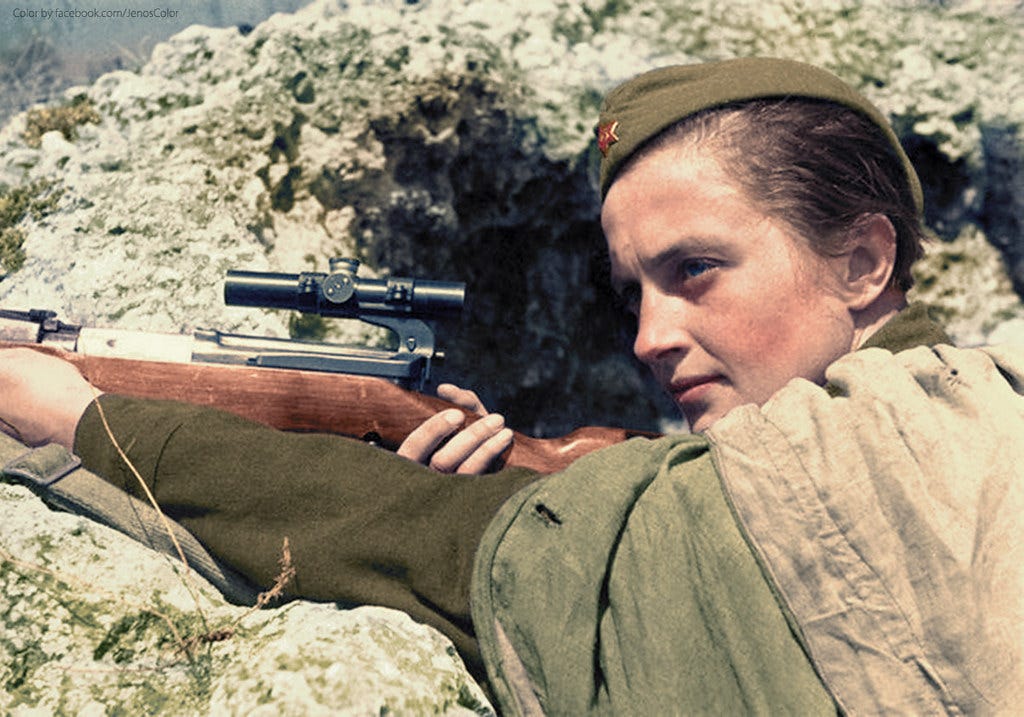
These stereotypes are hardly new. For generations they have distorted how societies think about military effectiveness. One of the most successful soldiers of the Second World War was Lyudmila Pavlichenko, the Ukrainian sniper credited with 309 confirmed kills on the Eastern Front. Whatever her hormone profile, she represented precisely what every military seeks: extraordinary effectiveness in combat. Today, Ukrainian women continue to play critical roles in drone operations, one of the most consequential innovations of the war.
So is this merely another curious story in an administration that seems to produce them daily? Perhaps. But symbols matter. If it alienates talented men and women in uniform, it matters. If it encourages commanders to mistake physiology for combat effectiveness, it matters. And if it distracts us from thinking seriously about how wars are actually fought, it matters a great deal.
One of the central lessons of Ukraine is that modern war has not become less deadly. It has become less intuitive. Success belongs less to the strongest army than to the army that learns fastest. Ukraine has repeatedly demonstrated the possibilities of adaptation. Russia has repeatedly demonstrated the cost of failing to evolve.
There are better ways to measure and prepare a fighting force than its testosterone levels.