

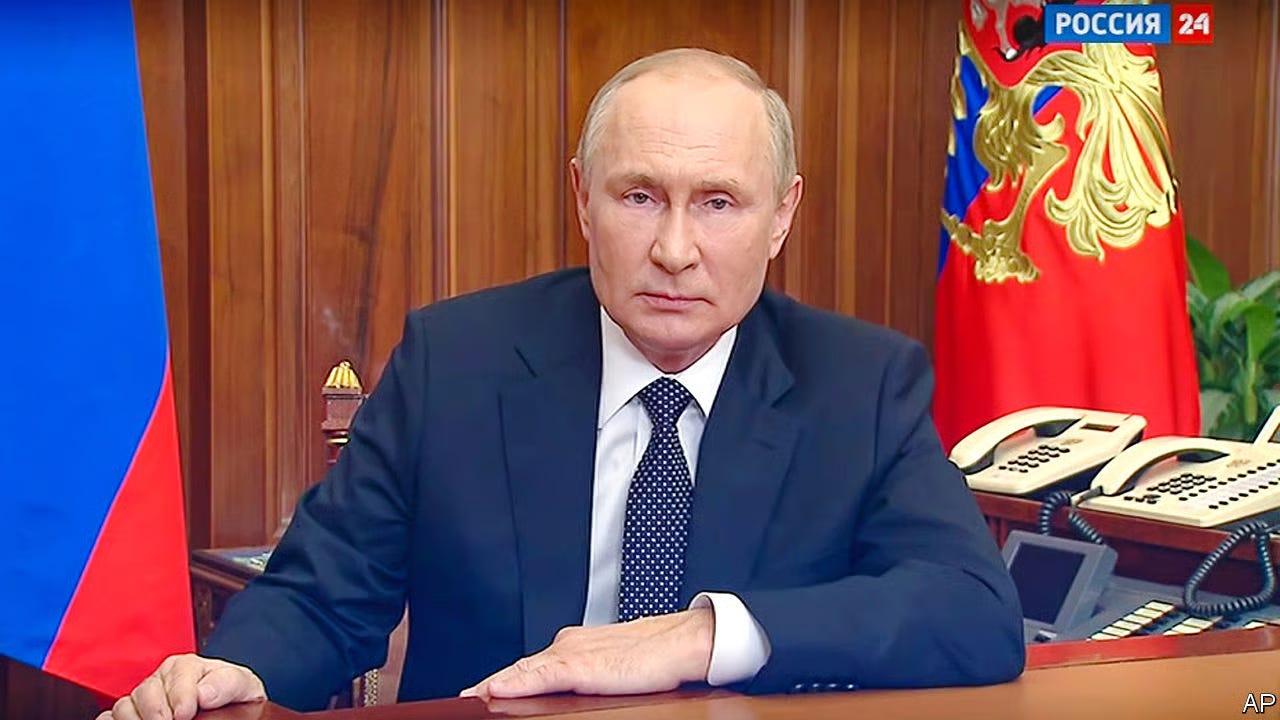
One of the more revealing pieces of news in a week when events arrived like water from a firehose was the report that Vladimir Putin had authorized intelligence sharing with Iran.
In a calmer moment, such news might have drawn sustained attention. Instead, it passed almost quietly through an already crowded cycle.
Yet the implications are not minor.
For several years, Donald Trump has helped weaken American support for Ukraine in its war with Russia. His criticism of NATO and frequent scolding of European allies have unsettled the alliance’s confidence in American leadership. At times, he has suggested greater trust in Moscow’s assurances than in the conclusions of his own intelligence agencies — a posture that startled observers during his appearance with Putin in Helsinki.
Against that background, Russian assistance to Iran introduces a sharper tension.
Iran has been one of Russia’s most important partners in the Ukraine conflict, supplying drones and other military support. Both countries have also operated among the same Shiite militias and political movements across the Middle East as they pursue influence and resources.
This cooperation is not surprising. Nations align where interests overlap.
But the alignment becomes consequential when it intersects with American military operations. Intelligence sharing is not symbolic. It shapes battlefield awareness, targeting decisions, and the safety of forces operating nearby.
If Russia is assisting Iran while the United States confronts Tehran, the result is not simply complexity but a strategic triangle. The United States faces Iran directly, while Russia — already engaged in a prolonged war in Ukraine and under Western sanctions — may indirectly strengthen Tehran’s position.
In the same week, the United States also moved to ease restrictions on Russian oil exports — an economic shift that carries clear benefits for Moscow.
Taken together, these developments do not form a coherent alignment. They illustrate instead the layered and sometimes contradictory nature of modern statecraft, where military pressure, economic policy, and political signaling do not always point in the same direction.
Under normal circumstances, an American president might respond clearly to such a development.
But politics introduces constraints.
Trump has spent years speaking favorably about Putin and emphasizing the possibility of improved relations with Russia. A sudden confrontation would contradict that posture. Ignoring the situation, however, carries its own risks — particularly if American personnel or operations are affected by intelligence shared with Iranian forces.
Moscow may understand this.
International politics unfolds as much on psychological terrain as on strategic terrain. If Russia believes the American president is reluctant to challenge it publicly, limited assistance to Iran becomes more than cooperation — it becomes leverage.
At the same time, the situation may be less immediately explosive than it appears.
The United States has not articulated a clear long-term objective in its confrontation with Iran. Without a defined end state, interactions among Washington, Moscow, and Tehran remain fluid — overlapping alignments rather than a single, coherent conflict.
Modern geopolitics rarely resembles the fixed alliances of earlier eras. It produces shifting partnerships, partial cooperation, and moments when adversaries operate alongside one another without formal alignment.
That reality makes the landscape harder to read.
But it also explains why a quiet report about intelligence sharing — in a week dominated by louder headlines — may prove more consequential than it first appeared.
This is a good read Julian. It has challenged me to be more aware of alliances.