

There are rituals in American high school sports that matter precisely because they are impractical.
Senior Night is one of them.
In Northern Virginia soccer, the tradition is familiar enough: seniors are announced, bouquets are handed out, teammates cheer, cameras flash, balloons drift, and the start time slides later as the families and team poses for one more shot. And—regardless of role or standing—the seniors start. For one evening, the ordinary meritocracy of sport briefly gives way to sentiment and gratitude.
Which is lovely in theory.
It becomes considerably more complicated when the match itself carries genuine stakes.
Tuesday night at Westfield was one of those nights. South Lakes entered with three wins and a loss; Westfield with three wins and a tie. That meant Westfield technically needed only a draw to secure a district semifinal berth and automatic qualification for regionals. South Lakes, however, could still fall to third if they tied and Oakton won. The margins were thin. The implications real.
This was not ceremonial soccer.
And yet the ceremony proceeded.
To Westfield’s credit, the all-senior opening lineup did not merely survive the opening exchanges; it played with urgency. The Bulldogs pressed aggressively, disrupted South Lakes’ buildup, and managed several promising sequences in the final third, even if the finishing touch never quite arrived.
But soccer has always possessed a certain indifference to narrative timing.
Six minutes in, South Lakes scored from what initially appeared a harmless midfield restart. The ball drifted awkwardly over traffic, was misjudged in the area, and Blessing Muchada reacted quickest to head home and put the Seahawks ahead. The concession had little to do with the seniors inserted into the lineup, but the effect was immediate nonetheless: Westfield, on Senior Night, in a match with real stakes, was now chasing the game.
Five minutes later, several regular starters entered.
By then, however, South Lakes had begun to settle. Programs carry memory unevenly, and while this particular Seahawk group may not directly remember the dominance South Lakes enjoyed a decade ago, they played with the assurance of a side rediscovering its former stature. Their shape was organized, their transitions purposeful, and towering goalkeeper Luke Bowen—a 6-foot-5 presence who seemed to occupy both the goalmouth and the imagination of opposing attackers—gave the entire side an additional layer of calm.
The second half only reinforced the pattern.
Westfield enjoyed stretches of possession, but South Lakes looked more dangerous whenever the match opened. Midway through the half came the evening’s defining moment—or what appeared certain to be. Johan Jovel collected the ball deep in his own half near the left sideline and accelerated nearly the length of the field, slicing through defenders in a blur before slotting the finish coolly across the goalkeeper for 2–0.
The South Lakes celebration carried the unmistakable feeling of finality.
It was not merely a fine goal. It was the sort of goal that causes the opposing crowd to fall briefly silent in admiration before remembering the implications.
South Lakes continued forward afterward, energized rather than satisfied. Jovel remained electric, and Westfield goalkeeper Will Paulin was forced into two outstanding close-range saves simply to keep the match alive.
Then came the red card.
With under thirteen minutes remaining, a frustrated Westfield player—having just failed to beat Bowen after a harmless attempt on goal—directed profanity toward himself more than anyone else. But the official had little choice. The card appeared, and the stadium froze. The crowd fell into a stunned, almost physical silence, the kind that feels less like disappointment than inevitability.
At 2–0 down and reduced to ten men, the Bulldogs appeared finished. Around the stadium, the familiar calculations began.
Traffic.
School night.
The game is over.
And to be fair, 95 percent of the time, leaving early is the correct decision.
But sport survives on the remaining five percent.
A numerical advantage in soccer often alters psychology as much as shape. Teams leading comfortably can begin, almost unconsciously, to manage the game rather than continue playing it. South Lakes had been superior for much of the second half, but with the extra man came the faintest trace of complacency.
Westfield sensed it immediately.
A low, hopeful cross from the right by junior wing Yannis Cardoza found junior striker Ethan O’Connor, who timed his movement perfectly and finished in one touch around Bowen, near post. Suddenly it was 2–1 with eleven minutes remaining.
Now the stadium changed.
Westfield pressed with the reckless clarity teams sometimes discover only when there is nothing left to conserve. Five minutes later, Cardoza delivered an inswinging corner toward the near post where defensive midfielder Chandresh Duraisamy—listed generously at 5-foot-9—leaned in and redirected a difficult header just inside Bowen’s near post.
Two goals.
A man down.
2–2.
At this point, memory itself entered the evening.
The year before, Westfield had traveled to Oakton needing a result for the Concorde title and fallen behind 3–0 in a driving rainstorm before mounting an improbable comeback led by Michael Dessalegn, now at Old Dominion. The photos from that night—rain-soaked, dramatic, almost mythic—circulated across social media and became part of the program’s identity. They are etched into the minds of players and parents alike.
Surely lightning could not strike twice.
And yet momentum in soccer is a peculiar thing. Once belief enters a match, structure often follows behind it helplessly.
From open play, Duraisamy controlled a deflected clearance near midfield and quickly redirected the ball into space down the left side. South Lakes misjudged the bounce for the first time all evening, and O’Connor, reading the sequence before it fully formed, timed his run perfectly before finishing calmly across goal.
(photo by Michael Merry, IG @Merryflix)
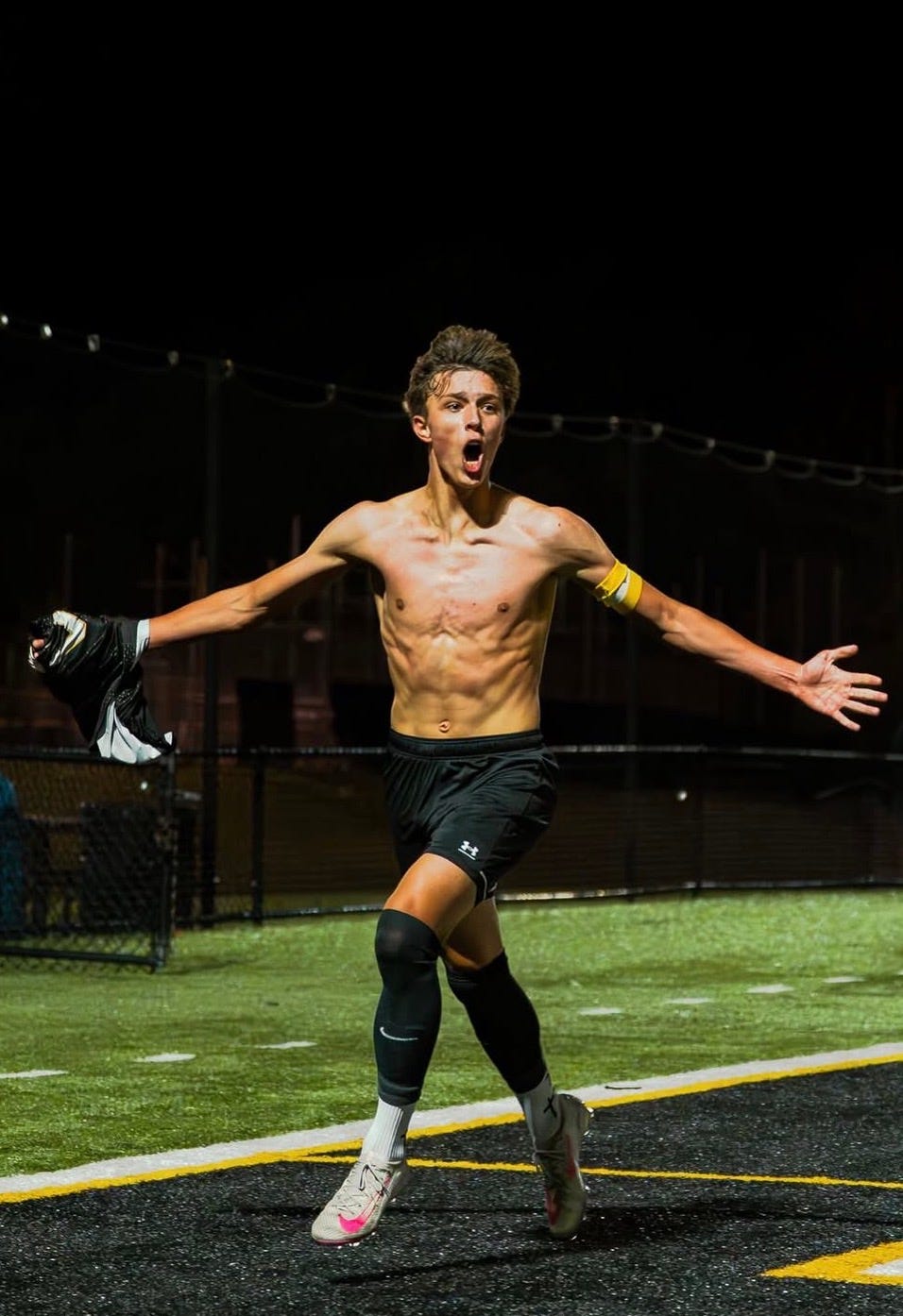
3–2.
Shirt off.
Chaos.
Entire bench sprinting toward the corner.
Turns out, elsewhere in the district, Oakton had lost in overtime, meaning Westfield would have secured its position regardless.
But no one inside the stadium knew that then.
And perhaps it is better they did not.
Because for one extraordinary stretch of ten-man soccer, Senior Night ceased being ceremony and became something far rarer: one of those improbable evenings that high school sports occasionally produce, and that the people present continue talking about long after the standings are forgotten entirely.