

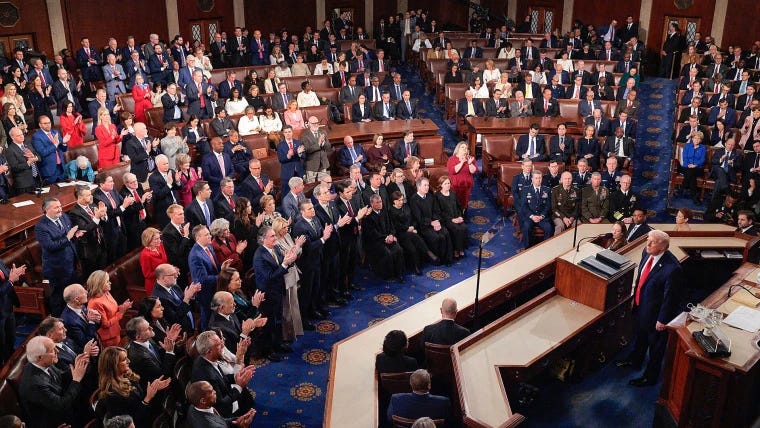
After the State of the Union, much of the analysis turned quickly to the opposition — their reactions, their restraint, their failure to applaud certain lines of the speech. The discussion was familiar. When government actions alarm or unsettle the public, attention often shifts to what the party out of power is doing, or not doing, in response.
But this instinct misunderstands how a republic functions.
In a constitutional system, authority and responsibility travel together. The party that governs possesses the instruments of policy: executive action, administrative direction, enforcement of law, and the ability to shape events directly. The opposition possesses something different — speech. It can criticize, persuade, investigate, and warn, but it cannot command. It can influence outcomes only indirectly, and often slowly.
That imbalance is not a defect. It is the design.
When legislative majorities are disciplined and executive authority consolidated, the practical tools available to those outside power narrow considerably. They may argue in hearings, speak to the press, bring lawsuits, or mobilize public opinion. At times they protest alongside citizens rather than legislate above them. These actions can appear inadequate not because they are passive, but because they are limited. Opposition in a republic is meant to restrain and expose, not to substitute for governing authority itself.
Yet public frustration often seeks immediate agency. Citizens ask what the opposition is “doing,” as if it held the same capacity as those directing policy. This impulse is understandable — people want someone to act. But the question quietly moves accountability. If attention settles primarily on critics rather than decision-makers, expectations shift away from those who actually exercise power.
The remedy in a free society has never been applause or silence in a chamber. It has been persuasion, law, and elections, operating over time rather than instantly. The out-of-power party prepares arguments and organizes voters. Courts examine legality. The public judges. These processes feel slow precisely because they are meant to prevent sudden rule by emotion or force.
None of this requires approval or disapproval of any particular administration. It requires clarity about roles. A republic depends on citizens directing their demands toward those who govern, not toward those who merely oppose.
The opposition may speak loudly or softly, wisely or poorly. But it does not control events. Responsibility rests with those who do.
Democracy weakens not only when power is abused, but when accountability becomes misplaced — when citizens grow frustrated and begin expecting resistance to function as authority.
In a free government, the task is simpler and harder than that:
to judge those who hold power, insist they obey the law, and change them peacefully when they do not.
This is so well articulated—something I’ve been unable to concretely convey to my (non-maga) Republican friends who criticize Dems for their incompetence or inaction.