

Free societies depend less on shared beliefs than on shared rules. Citizens disagree constantly about policy, morality, and leadership, yet constitutional government endures so long as they accept procedures that allow disagreement to be settled peacefully.
Americans often assume those procedures are secured almost entirely within our own borders — by elections, courts, and constitutional design. But the stability of a free government has never depended only on internal arrangements. It has also depended on the character of the world surrounding it.
Americans often assume those procedures are secured almost entirely within our own borders — by elections, courts, and constitutional design. But the stability of a free government has never depended only on internal arrangements. It has also depended on the character of the world surrounding it.
Americans often assume those procedures are secured almost entirely within our own borders — by elections, courts, and constitutional design. But the stability of a free government has never depended only on internal arrangements. It has also depended on the character of the world surrounding it.
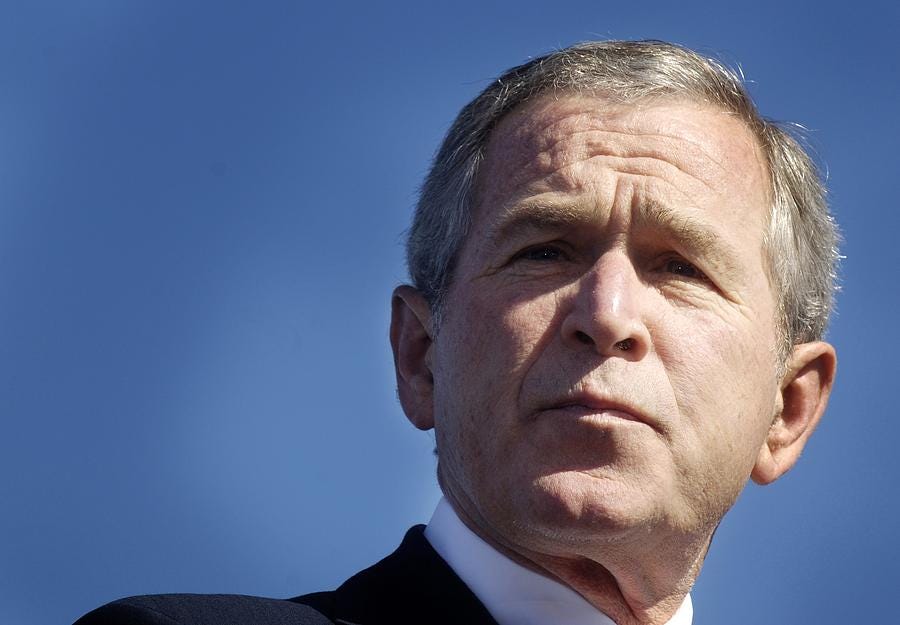
During his presidency, George W. Bush spoke often about freedom. Many Americans felt and still feel the language to be naïve or even opportunistic, detached from the realities of statecraft. Yet his claim on its face was not mainly about American virtue. It was about political structure: free governments function differently when dealing with other free governments.
Nations pursue interests as well as ideals, yet the character of a partner still matters. Democracies argue with themselves. That makes them slower, but also more predictable. Commitments reached through consent endure differently than those imposed through command.
Consider a simple difference. Americans debate speech rules with Germany in legislatures and courts. In Russia, a person can face imprisonment for publicly describing the invasion of Ukraine as a “war.” The distinction is not cultural but structural. One system requires authority to justify itself; the other requires citizens to adjust to it.
The importance of that difference is not merely moral. Americans are freer when power is constrained elsewhere. Governments accustomed to answering to their own citizens tend to behave differently abroad, and their expectations influence the behavior of others. A world dominated by rulers accountable only to themselves does not remain neatly outside our borders. Its habits travel.
The Constitution was designed to restrain power within the United States. But its success has always been helped by an international environment in which restraint exists beyond it. Democratic nations therefore do more than provide example; they create pressure. Alliances, treaties, courts, and shared legal expectations impose costs even on their members. They do not prevent overreach, but they raise its difficulty.
Those external expectations shape internal practice. At home, the vocabulary of administration has grown increasingly technical. “Processing centers,” “detention facilities,” and similar terms carry a bureaucratic neutrality that obscures their human meaning. Bureaucratic language does not merely describe authority; it normalizes it. Citizens gradually stop asking whether a policy is just and begin asking only whether it is permitted. That shift becomes easier in a world where governments elsewhere no longer feel required to justify power at all.
Relations with democratic allies are often slow and contentious because many voices must be persuaded. More centralized governments are easier to negotiate with. But ease and reliability are not the same. Democracies are predictable precisely because disagreement occurs within rules.
The danger to a constitutional order is rarely sudden overthrow. Systems change by resemblance. Governments gradually adopt the practices of those they increasingly treat as peers — broader discretion, greater secrecy, and authority justified by necessity. Each step appears reasonable in isolation. Together they alter what citizens come to believe government may properly do.
For an ordinary citizen, the change is subtle. The law still exists, elections still occur, and courts still function. Yet decisions feel less explainable and more inevitable. Authority requires fewer reasons, and the space between permission and command narrows.
Freedom is therefore not sustained only by national character or constitutional text. It depends on the political company a nation keeps. A republic remains secure not simply when its own citizens value liberty, but when justification itself remains a governing expectation in the world its government inhabits.
We preserve freedom not only by defending it at home, but by living in a world where rulers are expected to explain themselves — and where citizens still expect them to.