

This was a significant week for many of the country’s top high-school-aged players. MLS Next’s annual Flex tournament in Texas drew elite academy teams from across the nation, offering exposure, competition, and the sort of credential that increasingly shapes the American development pathway.
Locally, the consequence was predictable. More than a dozen of Northern Virginia’s best high school players would miss matches this week in order to compete there. Others who have scarcely appeared this spring may yet return in time for the postseason.
That is the modern landscape: school loyalty on one side, elite pathway logic on the other.
Friday’s schedule in Fairfax, Arlington, and Alexandria was relatively light, so attention drifted south and west. Prince William County offered several intriguing matchups, most notably the second meeting between Battlefield and Osbourn Park. Battlefield had surprised many by winning the first encounter 2–1. Osbourn Park, meanwhile, has several players involved in MLS Next circles, so the assumption was simple enough: they would be in Texas.
They were not.
I was told they had skipped Flex in order to play this high school match.
That was not a small decision. Players occasionally find ways to appear for school teams when club obligations suggest otherwise. But missing a premier showcase event to remain with classmates for a regular-season rivalry match is rarer. It suggested something worth seeing.
So I made the drive to Manassas.
I grew up in Fairfax County, barely ten miles from Osbourn Park High School, yet had never been there. In those days, Prince William felt like another jurisdiction entirely—more rural, more working class, and, in the mythology of Fairfax kids, somehow tougher.
Much has changed. Prince William today is unmistakably part of Northern Virginia—diverse, growing, and linked to the same currents as its neighbors. But traces of a distinct identity remain. Rivalries there still feel local in the older sense: rooted in geography, pride, and memory.
Battlefield against Osbourn Park is one of them.
In soccer, we borrow the word derby for such occasions. In Prince William, one could make the case that nearly every county meeting qualifies. Battlefield occupies a particular place in the local imagination. Strong across numerous sports, affluent by county standards, and accustomed to success, it carries the aura of a program others measure themselves against.
Osbourn Park entered the season with its own ambitions. Led by captain and right winger Ryan Lucero, they were viewed by many as a potential state contender. But the season had been uneven: four wins from eight, a loss to nearby rival Osbourn, defeat to Battlefield, and dropped points elsewhere. Friday carried real stakes. Another setback, and the regular season risked slipping from their grasp.
You could sense that in the warmups.
Battlefield, physically, is difficult to ignore. Junior center back Grayson Homan stands 6-foot-4, flanked by more height around him. They are formidable on set pieces, disciplined without the ball, and among the most direct teams I have seen this year.
That directness also carries risk when buildup play breaks down. Roughly ten minutes in, Osbourn Park, Mychael Ayala intercepted a careless pass as Battlefield attempted to play out from the back. Ayala waited just long enough for Ethan Nguyen’s run, then released him clean through. Nguyen finished calmly across goal.
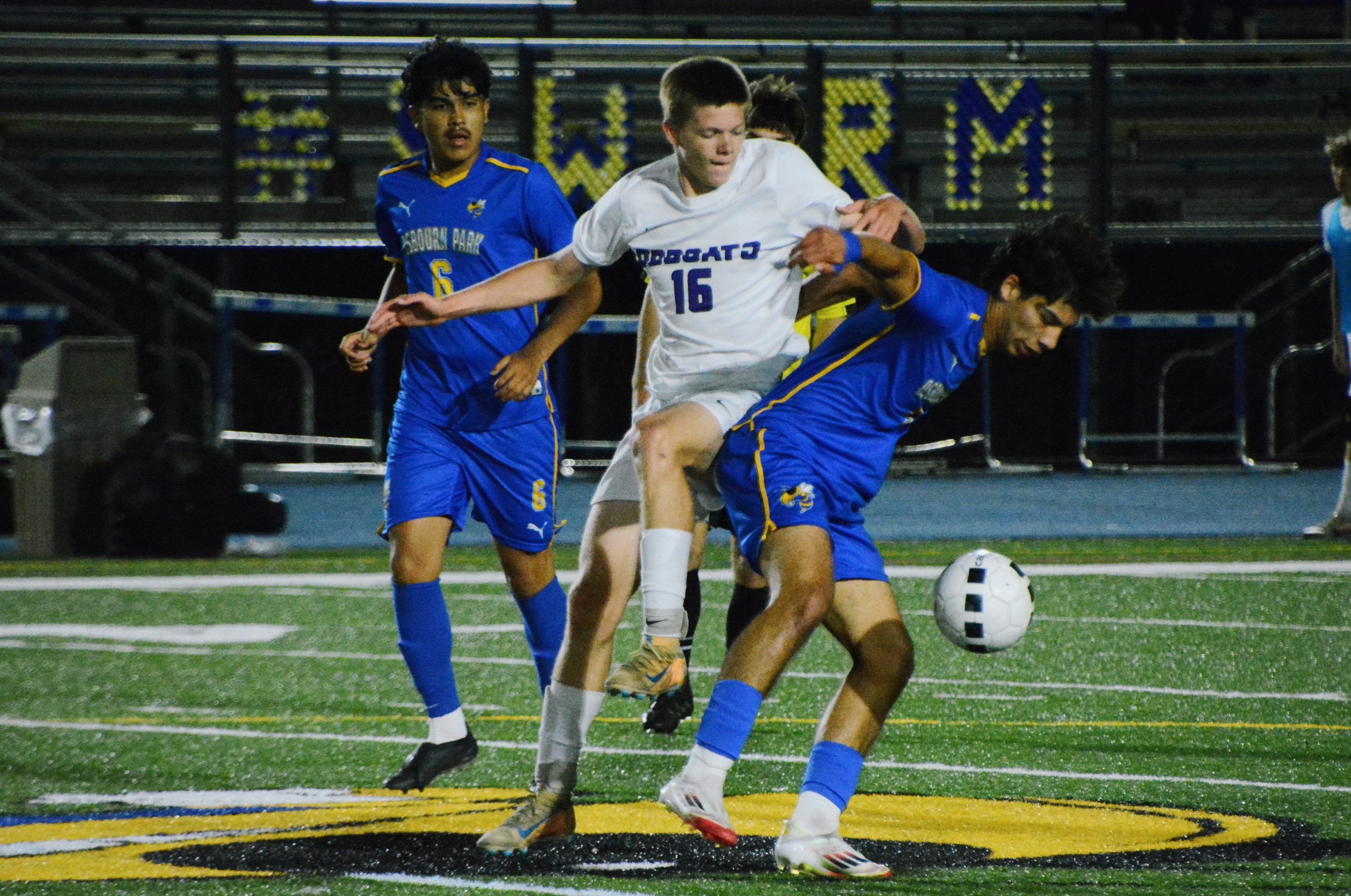
Battlefield’s response was immediate and excellent. Left back Frank Saldana produced the run of the night, driving through the left channel, reaching the byline, and cutting a low cross back for Aiden Kraja, who guided home a clever header from close range.
The match had life.
Osbourn Park regained the lead through Martin Guevara, whose inswinging free kick from near the right sideline bent viciously enough to strike the underside of the far crossbar and in. The goalkeeper had no chance.
After halftime, the balance shifted decisively.
Lucero, increasingly influential down the flank, approached the touchline and cut the ball back early. Melvin Mendoza arrived in stride, took a clever touch into space, and struck with force. It was the sort of goal that changes mood as much as score.
From there, Osbourn Park surged.
Junior Luis Aguilar saved a penalty. Guevara added his second after controlling a long ball and finishing cleanly. Nguyen also completed a brace, this time from a knuckling free kick struck from well beyond 35 yards.
What had begun tense and balanced ended 5–1.
That scoreline may flatter the winner slightly, but not by much. Osbourn Park looked like a side reminded of its quality. Battlefield looked dangerous in moments, but once chasing the match they lost some of their shape, and the spaces grew with it.
There are nights defined by tactics, and others by emotion. This one offered both, but above all it offered goals—many of them memorable.
Osbourn Park remains alive in the regular-season race, with a major meeting against Cedar Run District leader Osbourn next Friday. Battlefield turns quickly to its own response.
And somewhere in Texas, scouts watched another tournament.
But in Manassas, under the lights, a different choice had been made.
I suspect the Osbourn Park players were content to wake up at home.