

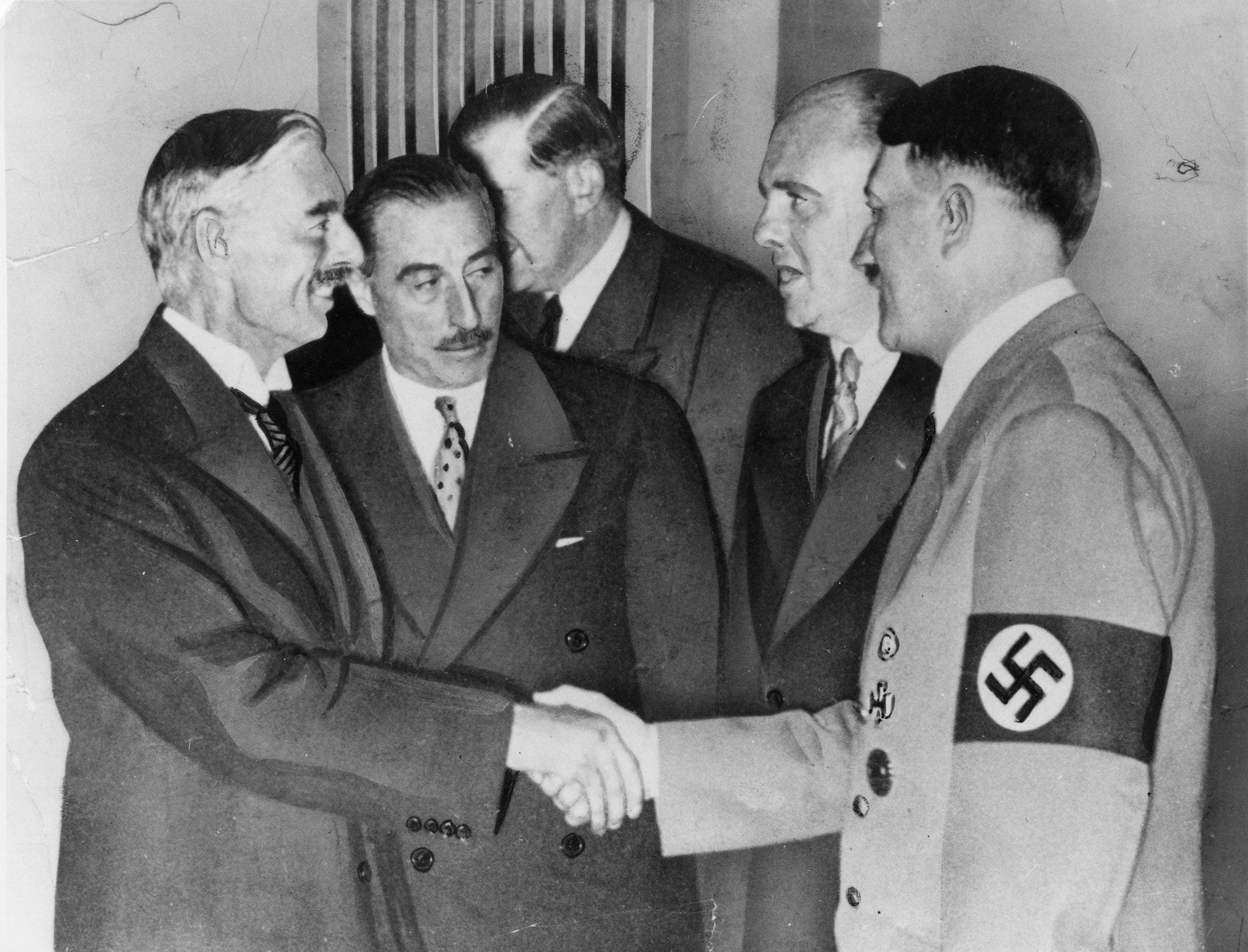
Neville Chamberlain has made a quiet return to the public imagination as we try to make sense of Donald Trump’s increasingly aggressive posture at home and abroad.
The comparison is tempting.
Masked agents in the streets.
Troops in cities.
Institutions weakened or sidelined.
Talk of coercion toward neighbors.
A Venezuela reduced to chaos.
NATO treated as optional.
Even flirtation with realignment in the war between Russia and Ukraine.
In such moments, history offers its most famous warning: appeasement. We are taught early that failing to confront aggression invites domination—that Europe paid dearly for hesitation in 1938, and that tens of millions ultimately died because democracies did not draw a firm line sooner.
And yet history is rarely so neat.
Chamberlain did, after all, buy Britain time. The Royal Air Force was built. Air defenses were prepared. Industrial capacity was mobilized. When war came, Britain was not caught entirely unready.
Chamberlain also declared war unequivocally, honoring Britain’s alliance with Poland when others—including the United States—did not. To treat him as a naïf or a coward is historically lazy.
Nor is it obvious that anyone in 1938, even after Mein Kampf, could fully grasp the scale of catastrophe Hitler intended. With the information available at the time, Chamberlain’s choices were tragic, but not irrational. Blame is easier in retrospect than judgment is in real time.
That is the dilemma now facing Europe and Canada.
Is Donald Trump truly prepared to invade Greenland if confronted—or only posturing for leverage? If he did press further, is it reasonable to believe he would stop there? Can a sustained trade war or open rupture with allies built over generations really be America’s settled course? Is an outright alignment with Russia—wildly unpopular at home—even durable?
Trump is not an ideologue in the historical sense, though the loyalty of his base sometimes edges toward the cultish.
From abroad, it is not unreasonable to believe that Trump may be waited out. He is unpopular at home. His coalition is narrow. His governance erratic. Democracies are patient by design.
And yet there is another lesson we learn early: bullies sometimes retreat when they encounter resistance—not because they are defeated, but because the cost of further aggression becomes uncertain.
This is what makes the present moment so difficult.
It is neither Munich nor Pearl Harbor.
It is not 1938, nor is it 1941.
There is no clean moral geometry, no obvious line to draw that guarantees safety without risk.
The task for democracies is therefore neither appeasement nor provocation, but firmness without hysteria—clarity without theatrical escalation.
To prepare seriously.
To speak plainly.
To stand together.
To avoid mistaking noise for power, or restraint for weakness.
History does not ask us to reenact its analogies. It asks us to exercise judgment under uncertainty.
That, more than slogans or comparisons, is the burden of democratic leadership now.
And it is one we should approach with humility, memory, and resolve—knowing that the wrong lesson learned too confidently can be as dangerous as the right lesson ignored.