

Over the last few years on the sidelines of high school soccer, I’ve gotten to know the student photographers. Every school has them — a small, talented guild of teenagers who hover near the goals, waiting for the perfect reaction shot. They capture the joy, the heartbreak, the improbable volleys, and the moments of pure chaos that adults always seem to miss.
The players invite them to club matches; the clubs invite them to other matches; and before long they’ve built a following. Some have even turned their talent into a small business before they’ve graduated.
I’m a useful acquaintance in this ecosystem. I let them post on my social media, which extends my reach to games I could never attend — games scattered across the county like constellations. They get exposure. More importantly, the players get exposure. And I get a window into the sport’s daily life.
It’s a fair trade, though I would do it anyway.
One of these kids is Mino — unfailingly polite, quietly observant, and a genuinely gifted photographer. As the season wound down, he asked me whether I planned to cover college sports next.
It was a logical question.
He’s graduating, moving on, and assuming I might do the same. This weekend he posted photos from a Washington Spirit game. In Northern Virginia soccer circles, “Mr. Brown” is a known quantity. Why not take the next step, like Mino?
It’s a good question.
I’ve interviewed college and professional athletes on my podcast for years. Why not cover their games as well? Is it a lack of ambition?
I thought about it.
And I realized I had never seriously entertained the idea.
I watch the most polished people in television, media, and social media, and I’m rarely overwhelmed. With enough persistence, why couldn’t I do what they do?
But covering high-school sports has never been about chasing the highest level.
I’ve always found that if I pay close attention, I can become passionate about almost any competition. I’ve been fully immersed in the NFL, the NBA, horse racing, professional cycling, soccer, tennis, table tennis — you name it. Once I learn the rivalries, the best players, and the history, I’m in. I once would spent weeks waiting for Liège–Bastogne–Liège like it was a national holiday.
High school sports, though, are different.
They are accessible in a way college and professional sports simply aren’t. The games are close. The gyms and fields are familiar. I don’t have to drive to Richmond or Baltimore, or limit myself to one local college program. High school sports let you immerse yourself in the entire landscape — the rivalries, the communities, the stories that never make the news but matter deeply to the people living them.
There is also a kind of innocence here, or at least something adjacent to it. Recruiting, scholarships, and club ambitions certainly exist, but they are not yet the dominant force they become later. Most of these kids are still playing for their school, their friends, and the chance to make a little history in a place they call home.
And the access is unmatched. Coaches respond. Players talk. Parents share stories. On social media, the kids communicate freely, and I can learn their tendencies, their personalities, and their small rituals before big matches.
But the real reason, I think, is that I’m part of this culture.
I played basketball and football at Robinson. My sister won two state championships there as a point guard. I coached at Robinson and at Marshall. I officiated for years. My son helped lead Yorktown to a regional title and a state final. My wife went to Lake Braddock and teaches in public schools.
And somewhere along the way, I became an unofficial historian of the area — especially of its sports and its complicated, evolving relationship with race.
Mino’s question made me think.
We spend much of our lives assuming that every worthwhile endeavor points upward — a larger audience, a bigger stage, a more prestigious venue. Sometimes that is true.
But not everything valuable exists farther away.
(photo by David Custer Media)
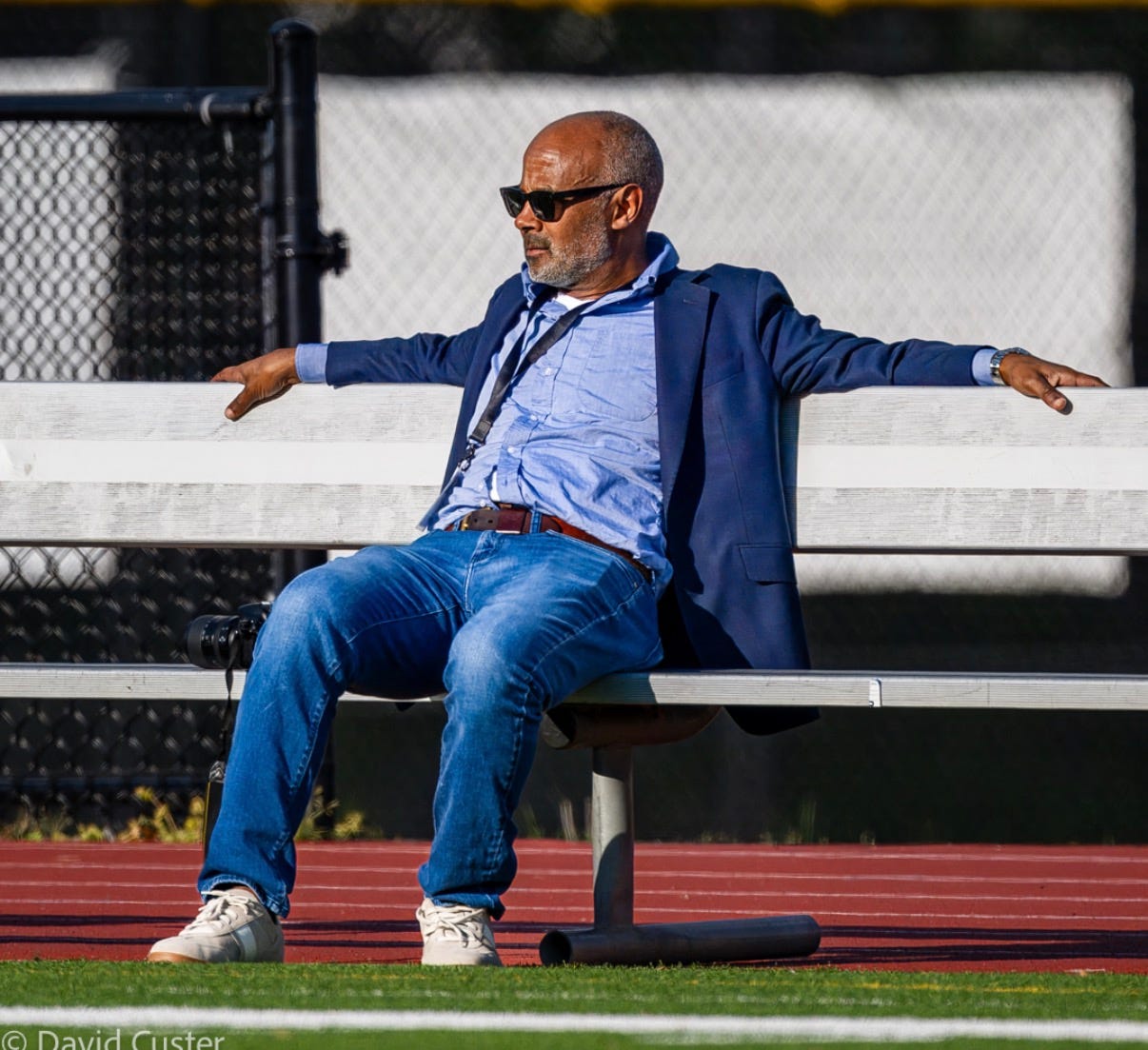
Sometimes value is found in familiarity. In knowing the history of a field. In recognizing the rivalries. In understanding why a game that means nothing to the outside world means everything to the people playing it.
What we have here is a patchwork of schools and rivalries and stories that somehow becomes a shared culture.
The fields.
The gyms.
The rivalries.
The stories that vanish unless someone bothers to remember them.
I could probably cover bigger games.
I could probably reach larger audiences.
But I’ve realized that what keeps drawing me back is not the level of play.
It’s the sense of place.
And that is enough.