

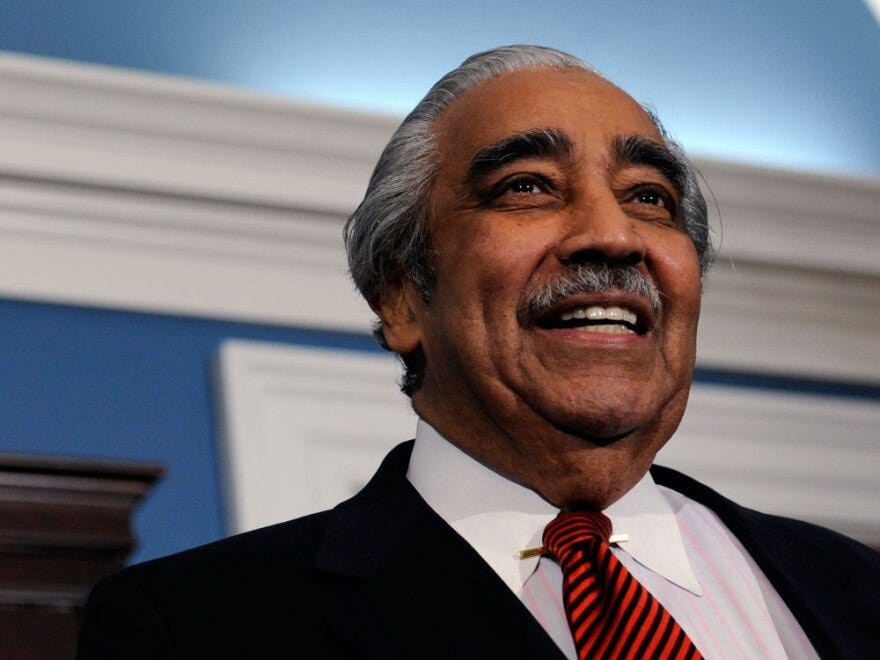
One of my favorite politicians of my lifetime was Charles Rangel — a Korean War hero with enough charisma and swagger for a dozen members of Congress. I agreed with him on most issues, but more than that, I admired his ability to survive and operate in the sharp-elbowed world of American politics. He was a friend and confidant of Nancy Pelosi, a man who understood both policy and power.
So when he was sanctioned by the House for ethics violations, it was a genuinely sad day. Watching him, a man I respected, brought to tears on the House floor was painful. And the violations themselves were hardly the sort of thing that resonate with ordinary voters — a tax deduction here, a foundation donation there. Inside-baseball infractions. The sort of technical missteps that seem almost quaint when set beside what some Republicans have walked away from unscathed.
Contrast that with the case of Graham Platner, now seeking the nomination to replace Susan Collins. Here, the allegations are not obscure or technical. They are the kind of things any voter can understand immediately: tattoos linked to Nazi imagery, explicit messages, even accusations of domestic violence. You can call it opposition research or the press doing its job, but if the claims are true, they go directly to character. They make us question whether we can trust the person at all — which, of course, is the point of raising them.
In the end, however, voters rarely choose among saints. They choose among coalitions. In our two-party system, the decisive judgment often occurs in the primary, where voters choose the candidate they believe can carry the banner in November. Once the general election arrives, the choice narrows. Most members of Congress vote with their party the overwhelming majority of the time. The job, structurally speaking, is not complicated.
But when we look at the flaws of a politician, the question becomes: which flaws matter, and which can we live with? How do those personal failings shape the decisions they will make in office? I happen to think Susan Collins is better than many in her party, and I don’t feel compelled to punish her for being human like the rest. But if a candidate is so compromised that we cannot imagine them representing us with integrity, then we have a different problem entirely.
Primary voters have now spoken. Perhaps that is enough. Or perhaps the harder question remains the same one it has always been: not whether a politician has flaws, but which flaws we are willing to excuse in someone who would represent us.