

From time to time, devastating AI parodies circulate online targeting prominent Black conservatives — or, more precisely, Black public figures accused of taking positions that seem to comfort white audiences at the expense of Black ones. The term often hurled at them, “coonery,” is among the harshest among African-Americans, a word designed to wound and exile. There is an uncomfortable contradiction in using the vocabulary of racial degradation to punish someone for supposedly betraying racial dignity.
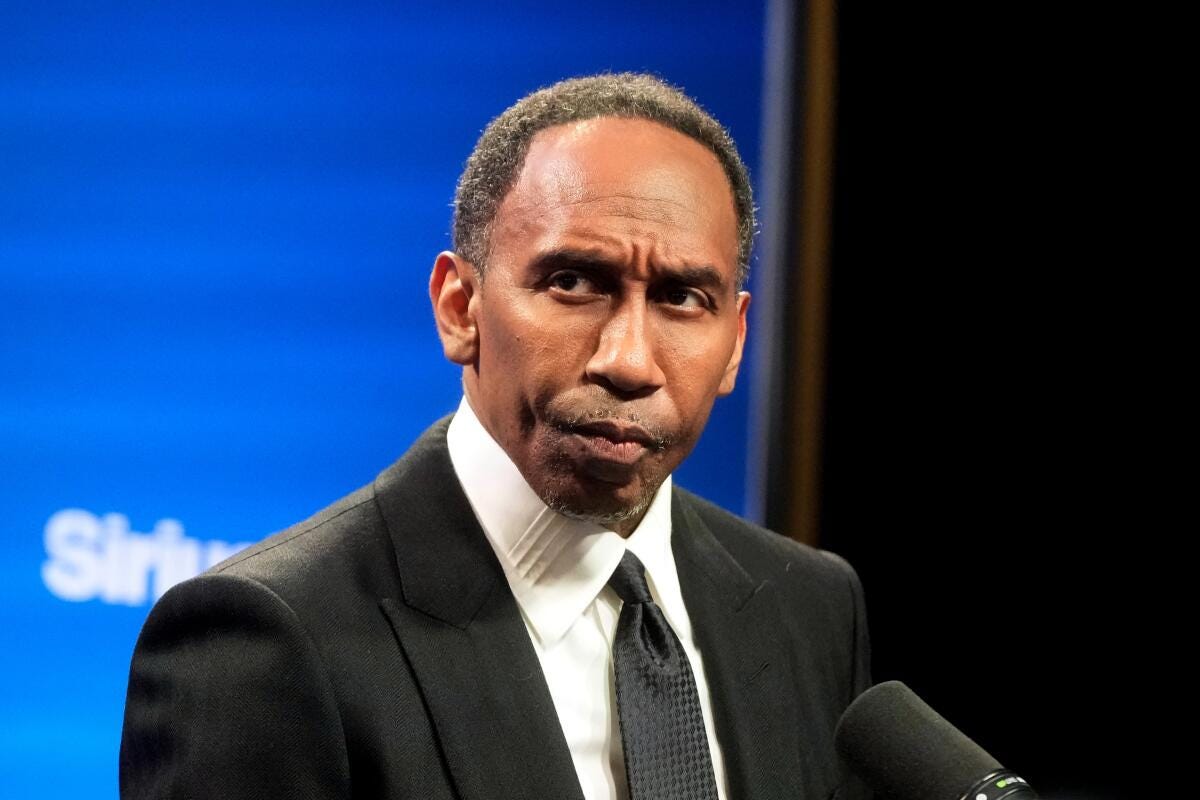
Recent videos have featured Clarence Thomas, Thomas Sowell, Byron Donalds, Candace Owens, Tim Scott, Jason Whitlock, and others. Lately, Stephen A. Smith has found himself in the crosshairs.
Smith is not a consistent conservative, but occasional alignment with Trump and a recent “Thumbs Down” award from the National Association of Black Journalists have put him on the defensive. The question is whether the criticism is fair.
There obviously is nothing inherently wrong with being a conservative — including being a Black conservative. Some tenets of conservatism over the last sixty years have appealed to Black voters: lower taxes, skepticism of unaccountable government, religious and social conservatism, and even criticism of unions that, in certain eras, limited Black political participation. Thomas Sowell, particularly in his earlier work, made arguments from this tradition with formidable intelligence. I find much of his later work considerably more ideological and less persuasive, but dismissing Black conservatism itself as racial betrayal would be both intellectually lazy and historically wrong.
The problem is not conservatism.
The problem comes when loyalty to a political movement requires defending — or refusing to challenge — things that should be indefensible.
When Trump says cruel things about Haitians, African Americans, Latinos — or, for that matter, almost anyone — Black Republicans have rarely distinguished themselves through public opposition. We do not need to pretend that every person defending such rhetoric privately finds it objectionable. If someone genuinely believes degrading things about Haitians or Black Americans, that belief deserves criticism on its own merits. But surely many understand perfectly well that the rhetoric is false, cruel, or both. Yet the public response is repeatedly deflection, both-sides arguments, strategic silence, or enthusiastic defense.
Why?
There are undoubtedly different answers for different people. But we should not automatically supply the most charitable one.
Political loyalty has rewards. So does access. So does celebrity. And sometimes there is a great deal of money involved.
That makes the uncomfortable question unavoidable: are we being fair?
Perhaps we are harsher on Black conservatives than on white conservatives who hold precisely the same views. We do sometimes expect more from Black public figures when the subject is race. We assume history gives them a particular awareness of what certain rhetoric can mean, and that their prominence gives their response unusual weight.
That expectation may itself impose an unfair burden.
But the value of the endorsement is unequal too.
A Black public figure defending rhetoric directed against Black people can provide something a white defender cannot: absolution. His or her presence becomes part of the defense. How can this movement be hostile to Black people? Look who is standing with us.
And there is an economic reality here that should not be ignored.
There is a market for dissent, particularly when the dissenter reassures an audience that wants to hear that its conduct is neither prejudiced nor harmful. A Black commentator willing to attack Black institutions, minimize racial grievances, or excuse rhetoric that would sound very different coming from a white voice can become extremely valuable.
That does not mean every Black conservative is selling out. But neither should we be naïve about the possibility that some people discover that there is money, attention, access, and influence available for doing precisely that.
Nor does sincerity necessarily settle the question. Someone can sincerely hold an ugly belief. Someone can sincerely convince himself that loyalty to a political movement justifies overlooking conduct he would condemn from the other side. The relevant question is not simply what is hidden inside someone’s head. It is what he says, what he excuses, whom his words benefit, and whether his willingness to speak courageously extends to the people whose approval and money he enjoys.
That is why criticism of Black conservatives cannot simply be dismissed as intolerance toward ideological diversity. Nor should every Black conservative be required to carry some predetermined racial politics as the price of authenticity. Both ideas deny individuals the freedom to think for themselves.
But representation carries weight.
If a white politician remains silent when an ally uses degrading racial rhetoric, we may consider him cowardly. When a Black politician stands beside the speaker and excuses it, his presence can become part of the argument that no offense occurred. The burden placed upon him may be greater, but so is the political usefulness of his endorsement.
Should we ask for more courage? I think so.
Should we be disappointed when some appear to profit handsomely from going along — lending their voices and, sometimes, their identities to rhetoric that demeans others? It is hard not to be.
None of this makes racial insults directed at them acceptable. “Coonery” remains an ugly word regardless of its target. Nor does disagreement with the political majority of Black America constitute betrayal.
But independence ought to run in both directions. The courage to disagree with your community means considerably less if it is never accompanied by the courage to disagree with the people rewarding you for doing so.
Perhaps that is the fairest standard.
Representation carries weight. Silence carries weight. And when the stakes involve dignity, history, and the treatment of vulnerable people, courage is not optional.
It is the price of leadership.