

It was, for democracy, the best of times and the worst of times.
On the same day that reports suggested the administration was examining federal leverage against Disney after a comedian’s joke at the president’s expense, the Senate entertained another theatrical foreign-policy gesture toward Cuba, speculation circulated that the president’s likeness might appear on passports, and former FBI Director James Comey faced renewed legal scrutiny—this time over a meme.
Meanwhile, from across the Atlantic, King Charles III addressed a joint session of Congress.
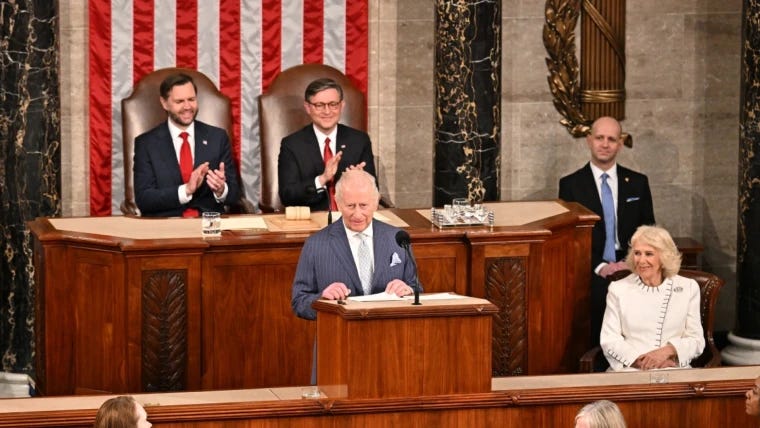
And he reminded the room what public speech can look like when seriousness is still in fashion.
His address was measured, elegant, and historically aware, delivered with the sort of composure now so rare that it almost startles. One need not favor monarchy to recognize quality when it appears. Indeed, Americans—being properly suspicious of inherited crowns—are perhaps especially free to admire the virtues of a man without desiring his office.
What did the King say that was so extraordinary?
Mostly, he said sane things.
He spoke of constitutional balance and the dangers of concentrated power. He reaffirmed support for Ukraine and the broader democratic alliance. He spoke respectfully of religious pluralism, national friendship, and the long, evolving partnership between two nations whose histories are entwined in paradox: a republic born in revolt against a crown, now applauding one.
In saner times, none of this would be remarkable.
But ours is an age in which moderation can sound radical simply because it is calm, and decency can appear bold merely because it is practiced aloud.
The applause that greeted him came from both sides of the aisle. Whether members rose from admiration, diplomatic instinct, or a desire not to exhibit domestic dysfunction before an international guest is impossible to know. Perhaps all three. In any event, they rose.
That, too, was something.
The contrast with our own public life was difficult to miss. We live in a moment when grievance often substitutes for argument, performance for governance, and perpetual agitation for leadership. We are surrounded by men eager to seem strong, and too seldom by those content simply to be steady.
Charles, whatever one thinks of monarchy itself, offered the older virtues: restraint, proportion, memory, duty.
So too, in a different sphere, has the Pope in recent weeks. His comments on war, suffering, and social obligation have not been revolutionary. They have been humane. Which is to say, in the current climate, unexpectedly useful.
Americans have long distrusted both crowns and miters, often for sound historical reasons. We prefer elected authority to inherited station, and civic argument to clerical command. Fair enough.
But there is an irony worth noticing.
At a time when republics produce so many would-be kings, an actual king can still model humility.
At a time when politics rewards noise, an old institution can still produce dignity.
At a time when many democracies seem unsure of themselves, figures outside the electoral scramble sometimes speak with greater moral clarity than those inside it.
This does not argue for monarchy, nor for government by churchmen. It argues for standards.
The lesson of the day was not that hereditary systems are superior, or that republics are doomed. It was simpler than that.
Character still matters.
Form matters less than conduct.
And if a king and a pope must remind modern democracies of that truth, the embarrassment is not theirs.
It is ours.