

Wednesday night’s boys–girls doubleheader at Oakton High School, with visiting McLean, offered a useful study in contrast—not simply in results, but in tone, intensity, and cohesion.
Coaches who have worked across both boys’ and girls’ programs often note a difference in rhythm. The girls’ game tends to sustain structure and collective responsibility; the boys’ game, particularly in lower-stakes matches, can rely more on individual moments and fluctuate accordingly.
The two matches, both non-district, seemed to reflect that distinction.
The boys played first. Though both teams entered from different directions—Oakton at 7–1, McLean at 2–5—the match carried the feel of a friendly. Key midfielders were held out, the tempo was uneven, and possession often lacked urgency. Moments of quality appeared, but sporadically. Given the level of both programs, the game never quite settled into a sustained rhythm.
McLean’s 4–1 win, powered by Joshua Barnes’ hat trick, while surprising on paper, felt consistent with the flow of the match—moments that broke their way, aided at times by Oakton’s lack of sharpness, rather than sustained control.
The girls’ match, by contrast, began at full intensity and rarely relented.
Despite the non-district setting, there was no sense of calibration or restraint. From the opening whistle, both sides played with urgency, structure, and intent—less as individuals managing a schedule, and more as a collective responding to expectation.
Oakton struck first through a set piece, as Katelyn Ingrao’s corner was driven toward the near post and met decisively by captain Ella Dennis.
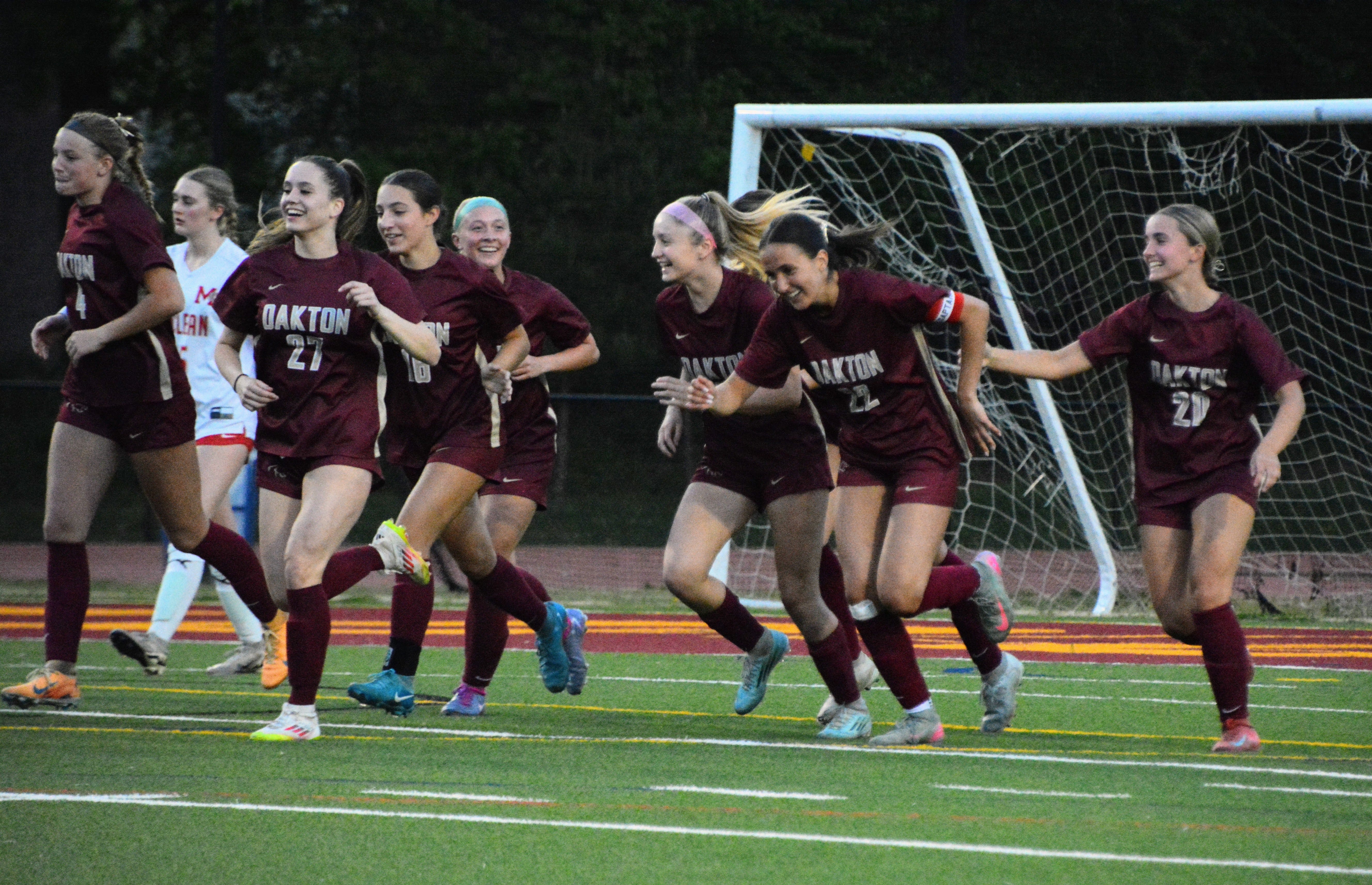
The pressure continued. Within minutes, Maddy Ok capitalized on a misplayed ball from the McLean back line, finishing with composure to double the lead. Shortly thereafter, Taryn McFeely produced the moment of the night, turning sharply off an Ingrao pass, slipping past a defender, and lifting a finish over the goalkeeper from outside the box.
At 3–0, the match might have drifted. Instead, it sharpened.
McLean responded with resilience, led by freshman Naomi Plerhoples, who showed both pace and composure in front of goal. Her two finishes—both taken intelligently inside the box—pulled the Highlanders back into contention.
What followed was tension rather than control. Oakton, having dominated early, was forced to manage the game more carefully. McLean, encouraged by the comeback, pressed higher and looked increasingly dangerous in transition.
The decisive moment came from quality once more. Maddy Ok found Katelyn Hubbard wide on the right. Cutting onto her preferred left foot, Hubbard curled a shot beyond the goalkeeper from distance—a goal of both technique and clarity, restoring Oakton’s margin at a critical point.
The final stages were open and contested, McLean continuing to push and Oakton forced to defend with greater urgency than earlier in the match. The 4–3 result reflected not only Oakton’s attacking quality, but McLean’s refusal to fade.
If the boys’ game drifted, the girls’ game demanded.
Not simply in effort, but in consistency—the ability to sustain structure and purpose regardless of circumstance. The celebrations told part of the story—collective, immediate, and shared. More revealing was the way the game itself was played: with clarity, connection, and visible commitment to one another and to the instruction being carried out.
Two non-district games, played on the same field, under the same conditions.
But very different rhythms.