

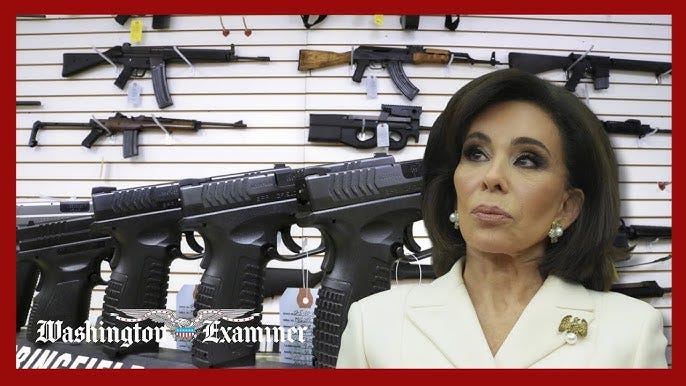
This week the Department of Justice announced it would sue the District of Columbia over its restrictions on AR-15–style rifles. It is, at minimum, a curious posture for a government to assume: the federal executive suing the capital city it already governs, over weapons whose proliferation has been repeatedly cited as a reason the National Guard must remain perpetually on standby in that same city.
The Supreme Court’s decision in Heller did, after much historical excavation, establish that the Founders intended to protect an individual right to bear arms. But even Heller left open a critical and unresolved question: whether that right is without limit. The Court gestured toward regulation, toward thresholds, toward reasonableness—but left the particulars to future litigation. That ambiguity was not an accident; it was an invitation to prudence.
What is odd, then, is not merely that the DOJ has chosen to intervene here, but that it has done so in the one jurisdiction where the symbolic and practical stakes are highest. Washington is not rural Wyoming. It is the seat of government, the locus of diplomacy, protest, intelligence, and political violence—real and threatened. To argue simultaneously that the city is so dangerous it requires extraordinary federal protection, yet so safe it must tolerate weapons designed for battlefield efficiency, is a contradiction that strains credulity.
The timing only sharpens the unease. In the wake of political violence—Trump wounded, Charlie Kirk murdered—our public discourse follows a familiar and dispiriting script. Rather than interrogating access to weapons whose range and lethality make prevention nearly impossible, we are invited instead to speculate about ideological blame: Democrats, immigrants, Muslims, transgender Americans—any culprit will do, so long as the instrument itself remains beyond scrutiny.
The suggestion, as always, is that more guns would have solved the problem. That if only more civilians had been armed with comparable firepower, tragedy would somehow have been averted. This is less an argument than an article of faith, and one notably impervious to evidence.
Taken together—the Court’s maximalist reading, the DOJ’s aggressive posture, and the absolutism of gun advocacy—these choices do not make us safer. They make us more divided, more anxious, and more exposed to precisely the violence we are told is inevitable. Blaming Democrats may be an effective sales strategy. It is not a public safety strategy.
The danger is real. The damage is cumulative. And the cost is borne not by ideology, but by people.