

Yesterday, after a Final Four game, UConn women’s coach Geno Auriemma declined to shake South Carolina coach Dawn Staley’s hand. The reasons may, in time, become clearer. Basketball is an emotional game, and moments of strain are not uncommon.
Still, the gesture lingered longer than the game.
It drew more attention than the game itself—a remarkable outcome given the stakes and the achievement. One suspects a few UConn players did not mind the diversion. But the imbalance is notable.
I have long had a soft spot for both coaches. I remember seeing Auriemma around the University of Virginia when he was an assistant, and Dawn Staley in the gym, playing pickup with a seriousness that hinted at what would follow. They absorbed something enduring there—standards, discipline—and carried it into careers that now stand among the most accomplished in college basketball.
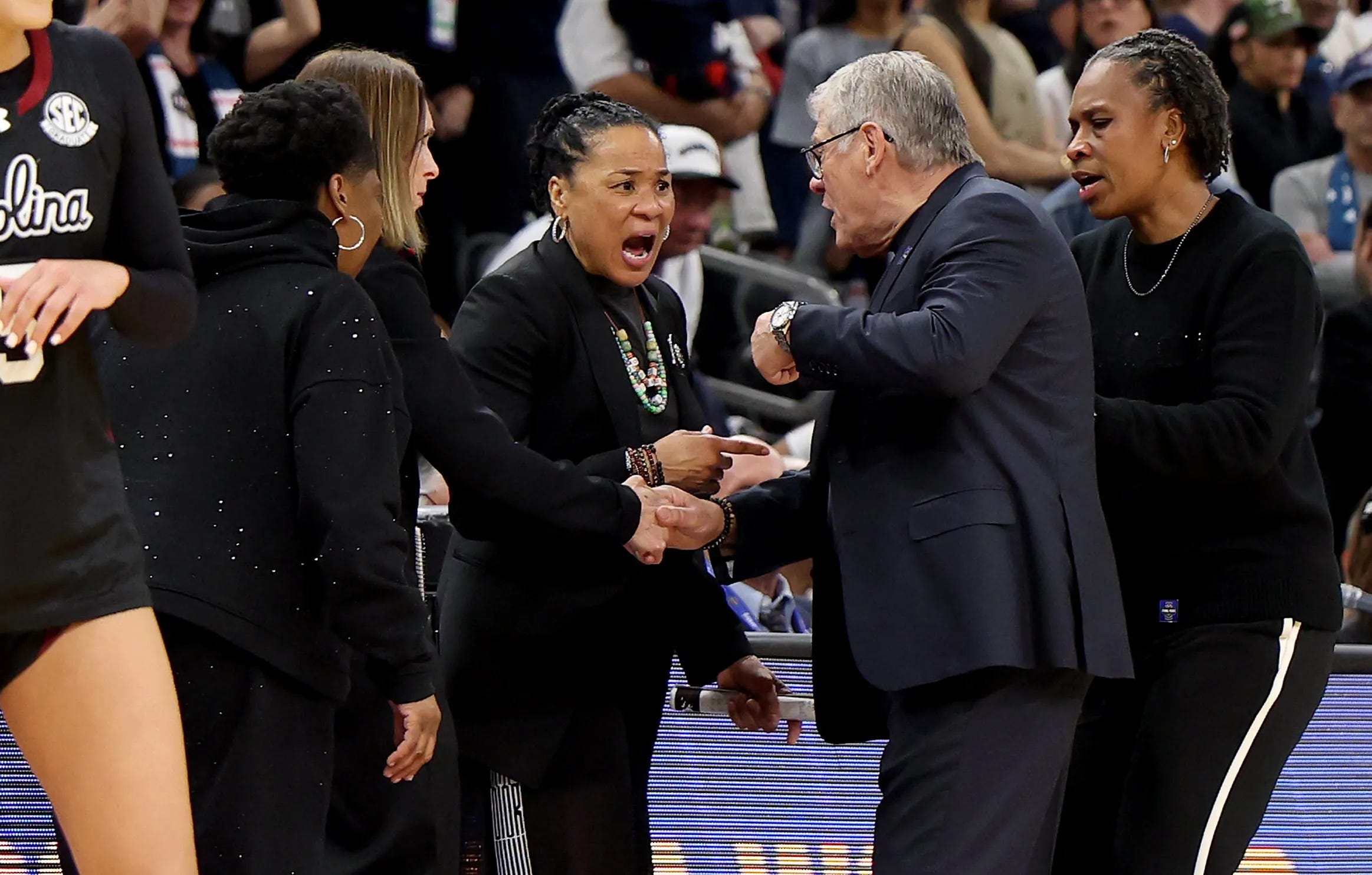
Which makes the moment feel, if not consequential, then at least instructive.
Why does it resonate?
Because manners, though often dismissed as small things, are not small in function. They are the visible edge of respect. They signal limits—on ego, on impulse, on the temptation to reduce an opponent to something less than a peer.
And we notice when they are absent.
It is, in a way, reassuring that we do.
We live, after all, in a period in which the language of public life has been altered—deliberately, and from the top. Donald Trump did not merely depart from the conventions of political speech; he redefined them. He has described groups of people in terms that, not long ago, would have been disqualifying in national leadership. He has treated opponents not simply as adversaries, but as objects of derision—“low IQ,” among other formulations—and has shown a willingness to generalize harshly about entire populations.
It would be imprecise to say that he alone is responsible for the coarsening of public discourse.
But it would be equally imprecise to ignore the influence of a president who made such language routine—and, for many, acceptable.
And yet something else has happened alongside it.
The expectations have not disappeared.
I remember election night in 2016, and a comment from Van Jones that has stayed with me: “the kindness will have to come from ordinary people.” It sounded, at the time, like a concession.
It has proved, instead, to be a kind of resilience.
More than a decade on, and well into a second term, the country has not entirely surrendered its sense of what is proper. Even when leadership falters—when responses to events, even solemn ones, feel misjudged or unduly celebratory—the broader expectation remains intact. People still register the difference. They still react to it.
Not uniformly. Not always consistently.
But noticeably.
I am reminded of a high school administrator I once spoke with on the sideline of a football game. By all accounts, he supports Trump. He is also widely respected—steady, thoughtful, committed to the students in his care.
And yet, in his daily conduct, he does not imitate the coarser aspects of the political culture he supports. He does not disparage colleagues, or blame reflexively, or instruct students that those outside their community are lesser. He does what good administrators—and good citizens—have always done.
He exercises judgment.
Which suggests a quiet but important distinction.
Political rhetoric can shift norms. It can lower the ceiling. It can make certain forms of expression more permissible.
But it does not, on its own, erase the floor.
We still know, in most settings, what is expected of us. We still recognize the difference between intensity and incivility, between competition and contempt.
Which brings us back to the handshake.
It is not, in itself, a matter of great consequence. Games are won and lost. Emotions run high. Explanations may yet emerge.
But the reaction to it—the sense that something small but meaningful had been absent—is worth noticing.
Because it suggests that, even now, we have not entirely abandoned the idea that how we conduct ourselves matters.
Not as ornament.
But as evidence of who we are.