

When we moved from Arlington to Loudoun County a few years ago, one of the challenges was distinguishing among so many new schools that, at first glance, appeared remarkably similar. The subdivisions blended into one another. The demographics felt familiar. The architecture repeated itself in carefully planned patterns of row houses, cul‑de‑sacs, and town centers. What, exactly, separated one community from another?
Over time, the answer revealed itself the way it often does in suburban America: through schools, rituals, and sports.
We settled at Riverside in Leesburg, where I quickly discovered a strong soccer culture under coach Kieran Harris. Last year’s senior class alone produced six college players, including three at the Division I level. The program had identity, expectations, and even its own vocabulary. Before long, I had learned the “Roll ‘Side” cheer and grown attached to a team that played with both technical quality and collective confidence.
But Loudoun County’s newest soccer power may now reside farther south, in Aldie.
Lightridge, still a relatively young school, already possesses many of the ingredients that help build lasting culture: distinctive colors, a memorable nickname, community energy, and now, most importantly, a state championship. The Bolts captured the Class 5 title last season under All‑Met Coach of the Year David Cesnik, after Riverside’s upset loss in the opposite semifinal prevented what would have been a fourth meeting between the emerging rivals.
A championship alters posture. Teams begin carrying themselves differently. Confidence becomes institutional rather than emotional.
And on Monday night, the setting matched the stakes. Spring sports were in full flight—softball, baseball, and track all humming around the campus. The weather was perfect: low 60s, sunny, a light wind drifting across the field. The crowd stayed engaged from the opening whistle, reacting to every challenge and moment of tension. This rivalry is shaped by strong coaching, deep soccer cultures, and a mix of players that should keep both programs competitive for years.
Lightridge arrived with the air of a defending champion: composed, assured, slightly swaggering without becoming careless. The Bolts entered at 9–1–1, unbeaten in district play, with only an earlier draw against Riverside blemishing their conference record. Riverside, meanwhile, has quietly rebuilt after heavy graduation losses and entered the match in a healthier psychological position than a year ago—competitive, dangerous, but no longer burdened by the weight of being overwhelming favorites.
The tactical contrast emerged immediately.
Riverside lined up in a traditional 4‑4‑2 and began brightly, pressing aggressively and looking to force errors early. Lightridge, operating from a 4‑3‑3, appeared almost stubbornly patient. The Bolts circulated possession across the back line and through midfield, often completing long sequences entirely within their own half. It was not sterile possession so much as deliberate manipulation: an attempt to stretch Riverside’s shape and force the Rams’ front line—including the dangerous Prince Grewal—into exhausting defensive work.
Riverside struck first regardless.
About eight minutes in, a set piece bounced awkwardly through traffic before falling to Virginia Tech‑bound center back Luke Stavrou, who produced the game’s first moment of real quality. His volley across goal into the upper‑right corner was struck with the calm technique of an attacking midfielder rather than a defender. For a moment, the night tilted toward Riverside.
Lightridge responded quickly.
Five minutes later, Dylan Conti delivered a dangerous ball from a set piece on the right flank that found center back Caden Perkins just inside the 18 yard box. Perkins redirected it off the inside of the left post and in, leveling the match and restoring the Bolts’ rhythm.
The game then changed in a more subtle but decisive way.
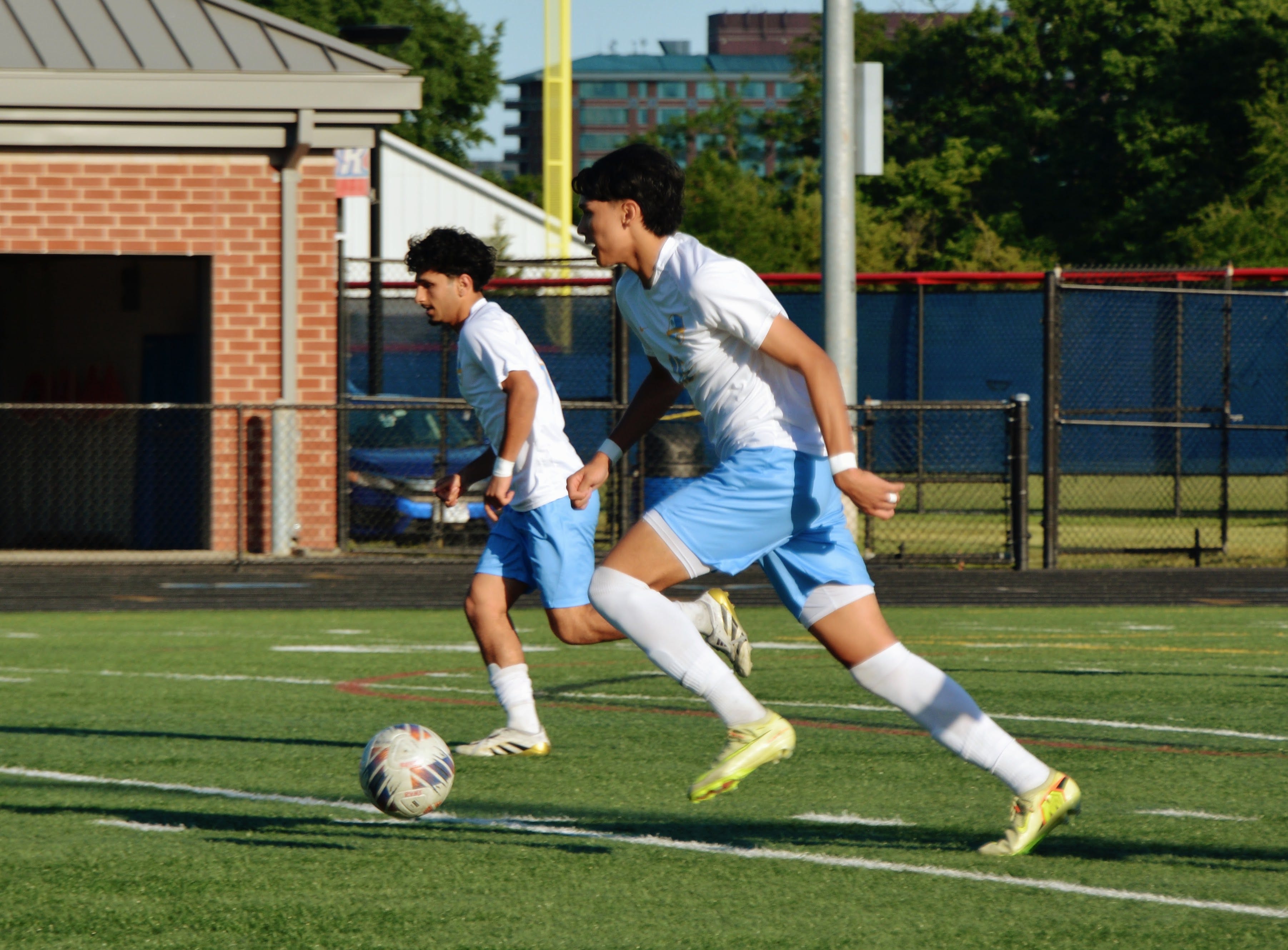
When 6‑foot‑2 junior Pranabh Malla entered, Lightridge gained not simply size but control. Sitting in front of center backs Brayden Moyssiadis and Perkins, Malla gave the Bolts a physical and technical anchor that allowed their possession game to breathe. One sequence captured his influence perfectly: a surging run from midfield through traffic, long strides carrying him through challenges before exchanging a quick one‑two with Christian Tshiteya and slapping a ball across the face of goal for Lightridge’s second.
By the second half, the match increasingly resembled the sort of game champions tend to play. Lightridge no longer merely possessed the ball safely; it began advancing with purpose. Riverside’s defensive shape stretched wider as the Bolts moved possession side to side before accelerating through gaps.
The third goal mirrored the first in quality. Left back Chris Washington struck a superb volley from outside the area, curling it into the far‑right corner with a technique strikingly similar to Stavrou’s earlier finish. By then, Lightridge looked fully in command.
A late defensive mistake gifted the Bolts a fourth to Enzo Quagliata, perhaps exaggerating the margin slightly but not the overall balance of play.
What distinguishes Lightridge is not simply talent, though there is plenty of it. The Bolts are physically imposing, organized, and tactically disciplined. More importantly, they play with the patience and assurance of a side that now expects important matches to bend eventually in its direction.
And perhaps that is what success ultimately creates in high school sports: not arrogance, but institutional memory.
Round two of this rivalry belonged clearly to Lightridge. But if Monday night proved anything, it is that Riverside and Lightridge are no longer merely new Loudoun schools searching for identity amid the county’s endless suburban expansion.
They have both arrived.