

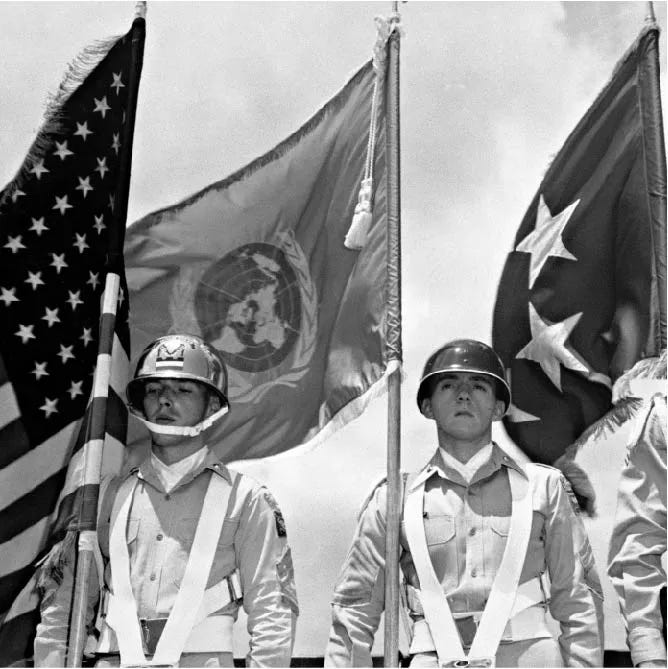
The United Nations is an institution born of high ideas. After the failure of Woodrow Wilson’s League of Nations, the victorious powers of World War II resolved not to repeat the mistake. Two European wars—and one global one—had killed more than sixty million people and devastated much of the world. A forum had to exist where disputes between nations could be argued before they were fought. Thus, the UN was born.
At its best, it mattered. During the Korean War, the UN rallied much of the free world to defend South Korea. The war ended inconclusively, but the principle was established: aggression would not go unanswered. Through later crises—in the Middle East, the Balkans, and beyond—the UN remained a place where serious people made serious arguments, before the world. Small countries were guaranteed a voice. Major powers retained disproportionate influence through veto and stature. The arrangement was imperfect, but it reflected reality. Approval mattered. Votes mattered.
And when countries failed to win those votes, it usually wasn’t because the institution was corrupt or feckless. It was because the math didn’t work. The world was unconvinced. Your invasion, your border claim, your action on the high seas—too few members agreed. That is not a moral judgment. It is arithmetic.
Attacks on the UN, the International Criminal Court, and even NATO are often framed as principled objections. In practice, they are assaults on legitimacy itself. When a nation fails to win votes, it questions the forum. When persuasion fails, it discredits the counting. The problem is rarely that the rules are unclear; it is that the outcome is inconvenient.
It is in this context that proposals like the president’s so-called “Board of Peace” come into focus—not as diplomacy, but as avoidance. When multilateral arithmetic becomes inconvenient, one can always invent a smaller table, select the chairs, and declare consensus. A board is easier than a ballot. It requires no persuasion, no patience for disagreement, and no acceptance of losing. For those done with math, it offers the comfort of order without the burden of legitimacy.
The difficulty, of course, is that legitimacy cannot be subcontracted. A forum designed to bypass disagreement does not resolve conflict; it merely conceals it. History is unkind to arrangements that mistake control for consent.
Nowhere has this abandonment been clearer than in recent events involving Venezuela. There was no serious attempt to vest authority in the UN to adjudicate leadership or guide a transition. The world was allowed to speak, but not to decide. Worse, there was little appetite for the UN to help shape what comes next—a path toward self-governance, legitimacy, and consent.
This is often framed as institutional failure. It is not. It is great-power preference. True democracy at the international level is inconvenient when it produces outcomes you don’t like.
The cost of this approach is not abstract. It produces more war, less diplomacy, and fewer tools for solving global problems—from climate to migration to conflict itself. A world where only the strongest decide is not a stable one. It is simply a louder one.
If international institutions feel weaker today, it is because the powers that built them no longer wish to be bound by them. That is not a failure of the UN. It is a failure of commitment—by those who no longer wish to count, persuade, or wait.
And history is unforgiving on this point: when nations abandon math, they eventually relearn it the hardest way possible.